Edifice: Eight storeys to build the World
Marcus Aurelius, Meditations
7.9 Everything is interwoven, and the web is holy; none
of its parts are unconnected.
They are composed harmoniously, and together they compose the
world.
One world, made up of all things.
Life is full of tradeoffs, and so is philosophy.
There are many desiderata to balance in developing one’s own view of the world. But there is one tradeoff in particular we’ve encountered time and time again in these pages. It reflects the perennial tension between a lavish ontology, replete with treasure troves of exotic entities, and a diffident universe of bare essentials. The former may impress us with its explanatory chutzpah, but the machinery it posits could strain anyone’s belief. The latter offers more epistemic security, but does not explain much of anything.
I have no more chance of avoiding this fundamental dilemma than my forebears, but having it in mind can only help and find an elusive, principled middle ground. Although I often err on the plenitudinous side, it is with the mathematician’s conscience that whole infinities can spring from just a few founts.
With the three Realms of reality, we’ve evoked a range of objects from (ostensibly) the physical, mental and abstract realms, and discussed the various ways in which they may relate to each other.
With the twenty-eight Layouts, we’ve used some notions of inter-level metaphysics to clarify what it is for one thing to be grounded in, caused by, dependent on, or entailed by another. That enabled a more thorough consideration of all possible relationships between the three realms.
With these eight Storeys, I will argue for my actual positions on each of the questions that was raised before. That includes positions regarding hierarchy (what grounds what, which objects is derived from which other), and regarding construction (how can that grounding, that derivation, be rigorously described).
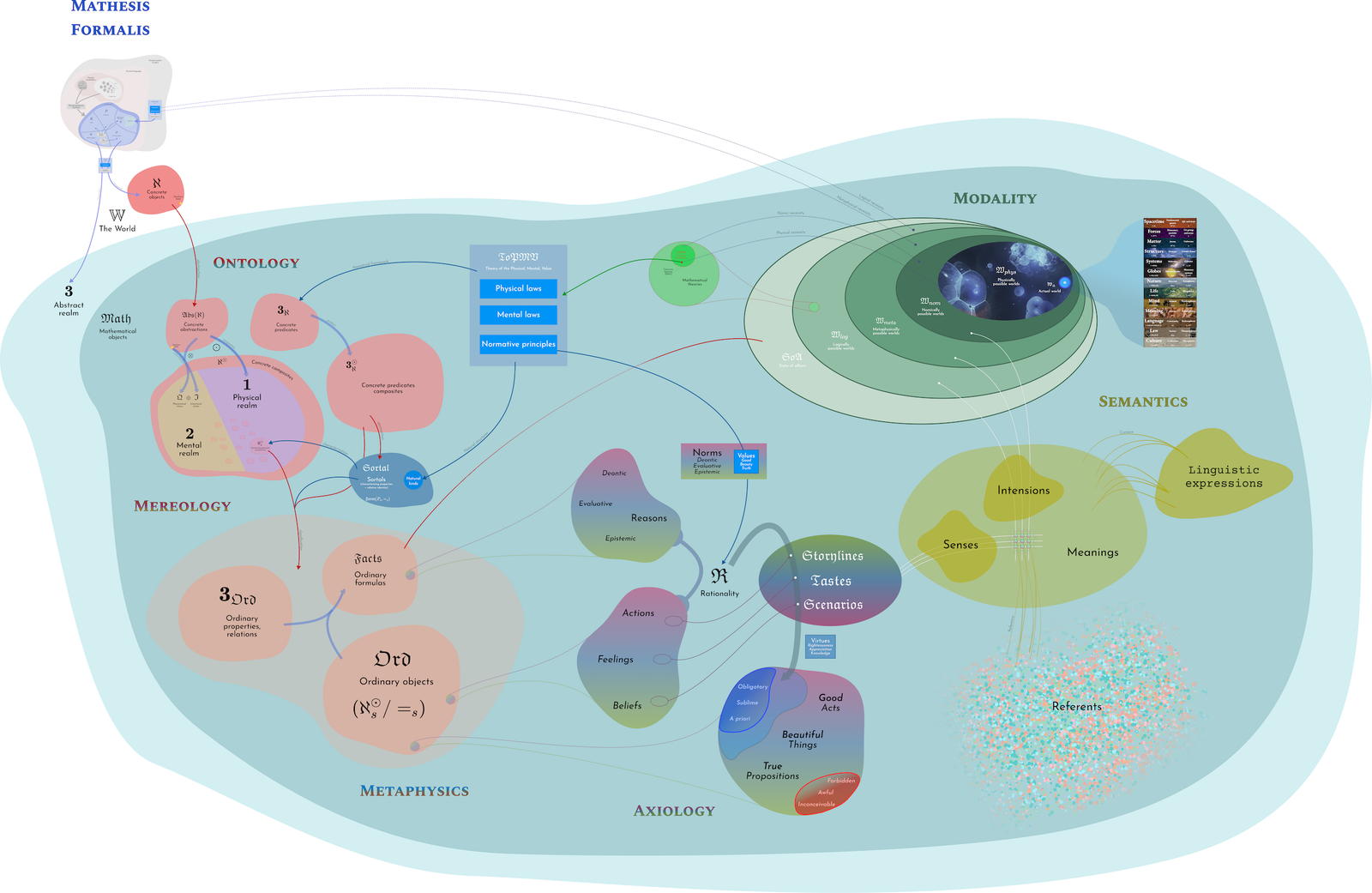
We shall proceed under the banner of formalization, and ultimately reach a full cartography of everything that is: the Chart of All Things.
The requirement to formalize a construction with strong hierarchical features also evokes architectural works, perhaps a ziggurat, with its stepped silhouette (aptly, ziggurats are also some of the earliest-built structures known to man), or another vertical design. Every floor, every storey will be grounded in what precedes, and will introduce new classes of objects from the abstract realm.
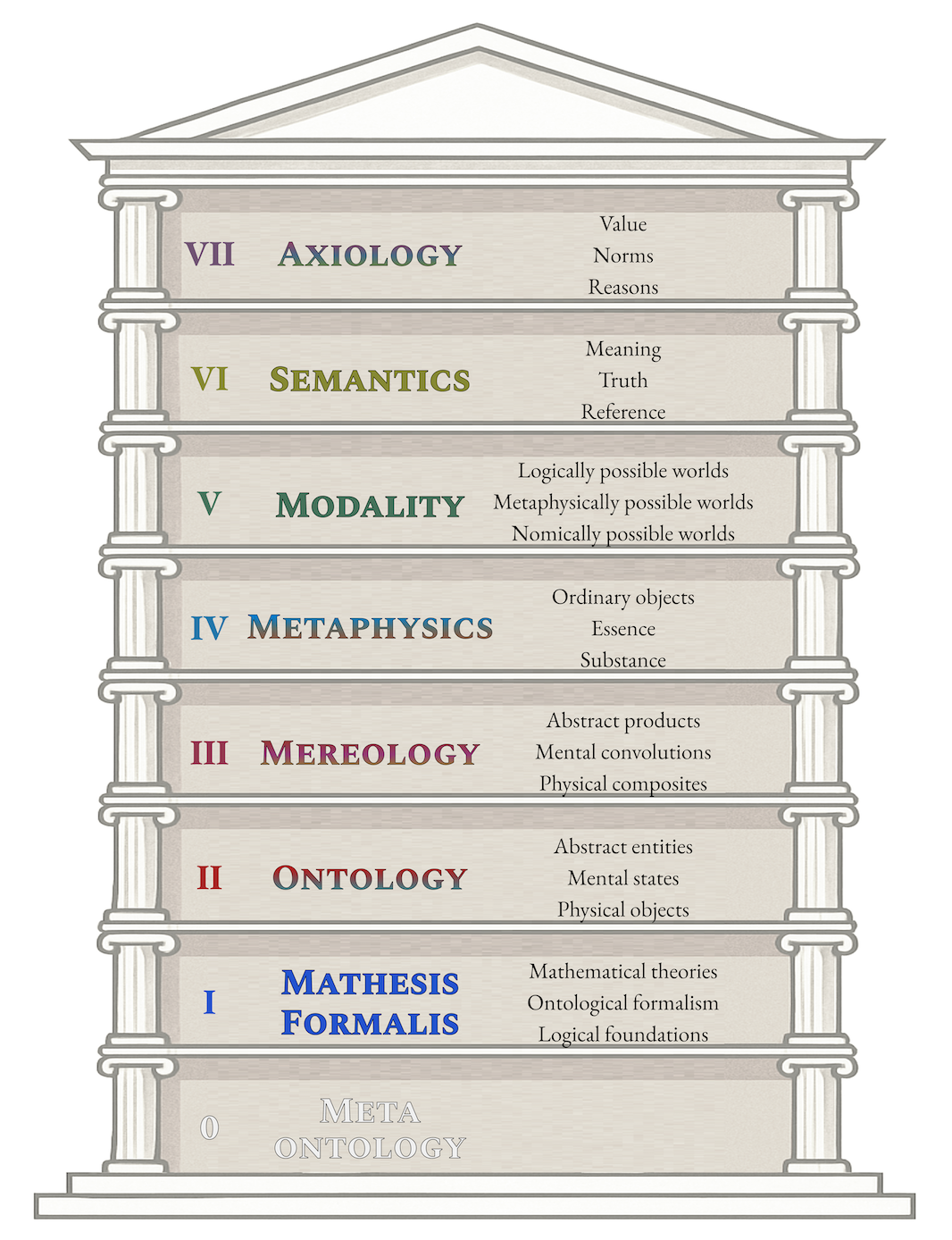
[0] Meta-ontology
is a deep philosophical underground rather than a foundation. It considers what it is to be and what can be said about existence.
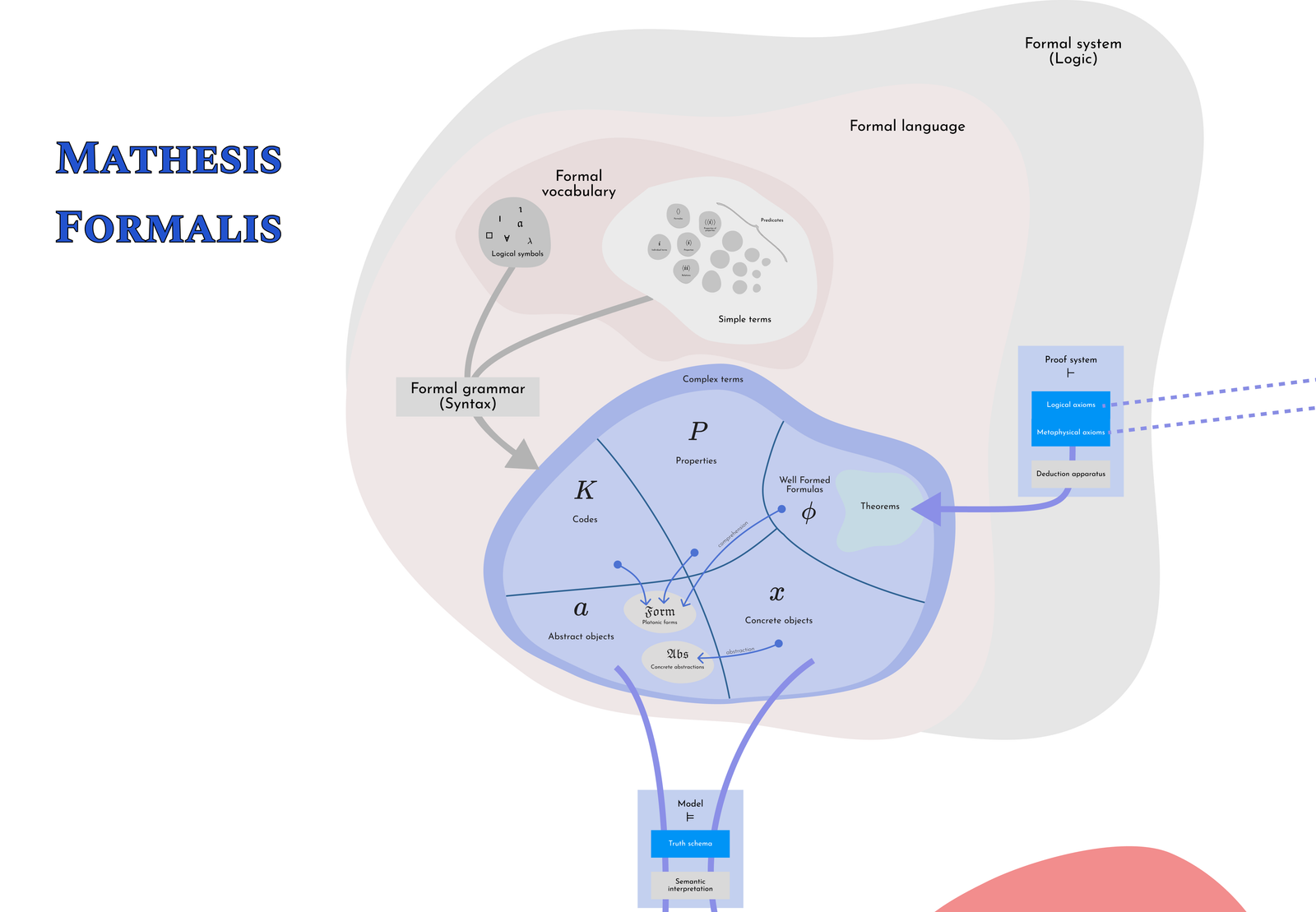
[1] Mathesis Formalis
is the true foundation of our architecture, a study we may also call formal ontology.
Formal systems are always based on logic. We will illuminate what logical foundations should be and discuss whether there is one true logic at the ground of it all.
We will then explicitly build our formal language, starting with a vocabulary of logical and non-logical symbols (simple terms), adding syntactic rules able to generate complex terms. A logical axiom schema and a deduction apparatus help complete the formal system. But the true ontological foundations stem from the adjunction of metaphysical axioms and ontological semantics that lay the groundwork for the most fundamental dichotomies of all: being and non-being, concrete and abstract, essence and accident.
The last part of mathesis formalis sets out the all-important mathematical foundations. A formal ontology without mathematical content (sets, numbers…) is an elegant, but barren structure, hence the need to seriously reflect on the construction of mathematical objects.
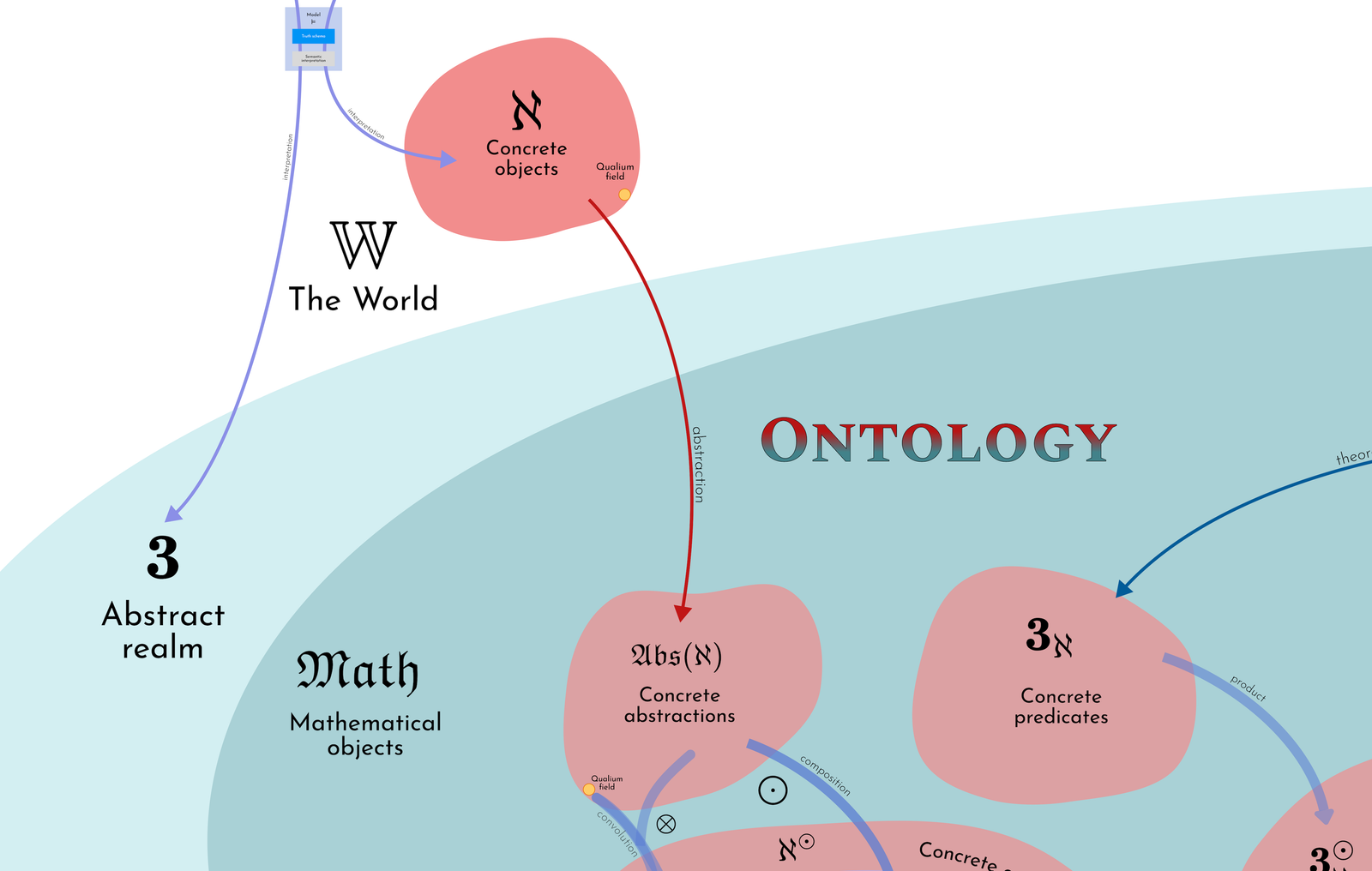
[2] Ontology
puts to work the powerful formalism of Mathesis and its rich mathematical content toward a proper study of the World. We will determine what the fundamental categories of existence are, as well as their relationships. All options were presented in our “28 layouts”, and we shall pick one that is consistent with the rest of our choices.
The question of physical objects brings us back to the mind-body problem…
… as does that of mental states.
To conclude on the existence of abstract entities, we solve the problem of universals.
[3] Mereology
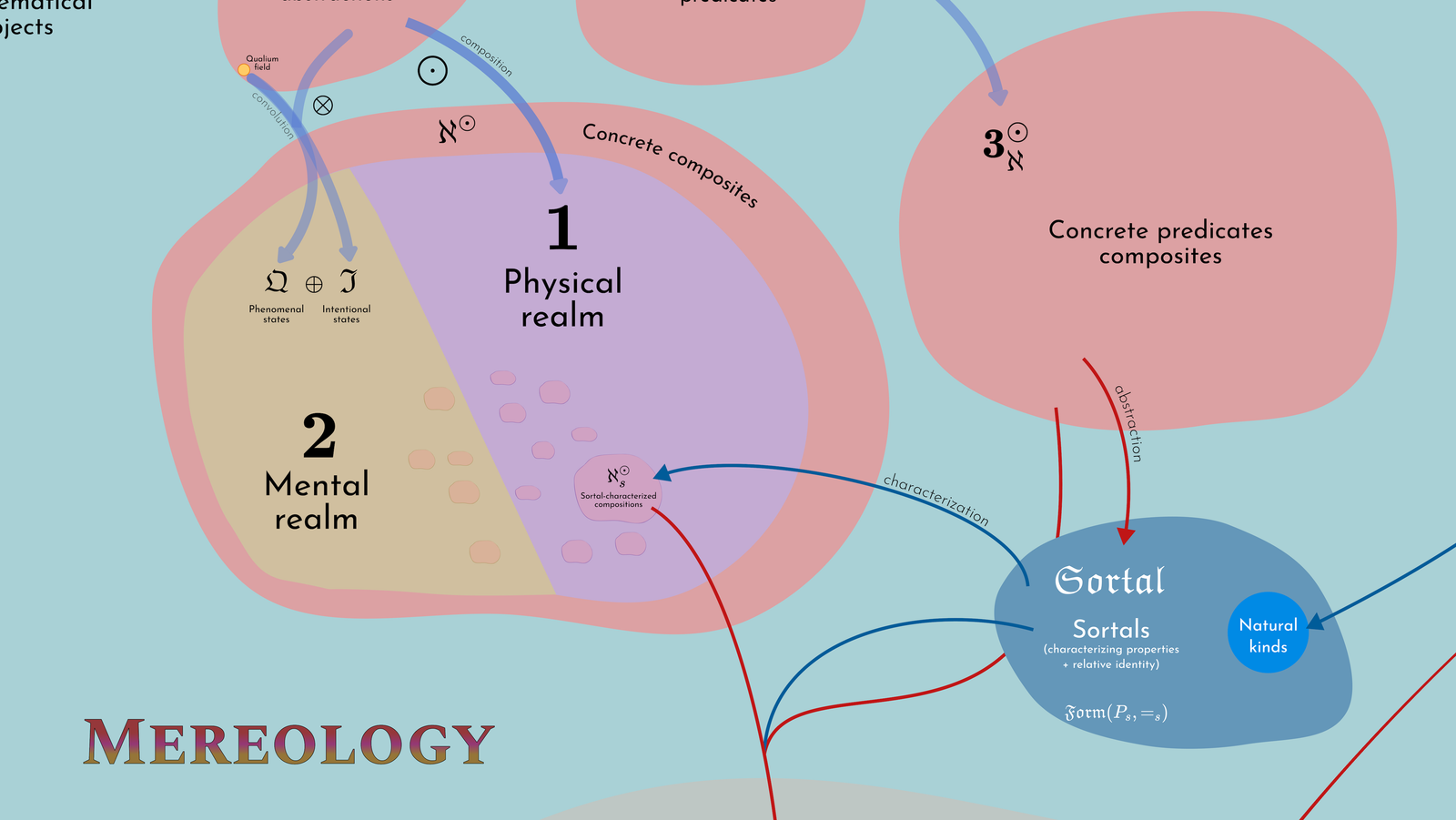
is the study of how several objects from the ontology can join to form a different object. We will again consider each of the three realms of existence in turn.
Are physical compositions distinct objects in their own right?
How can primitive mental states combine into complex mental structures or even into minds?
What kind of abstract algebra governs the way abstracta can operate on each other?
[4] Metaphysics
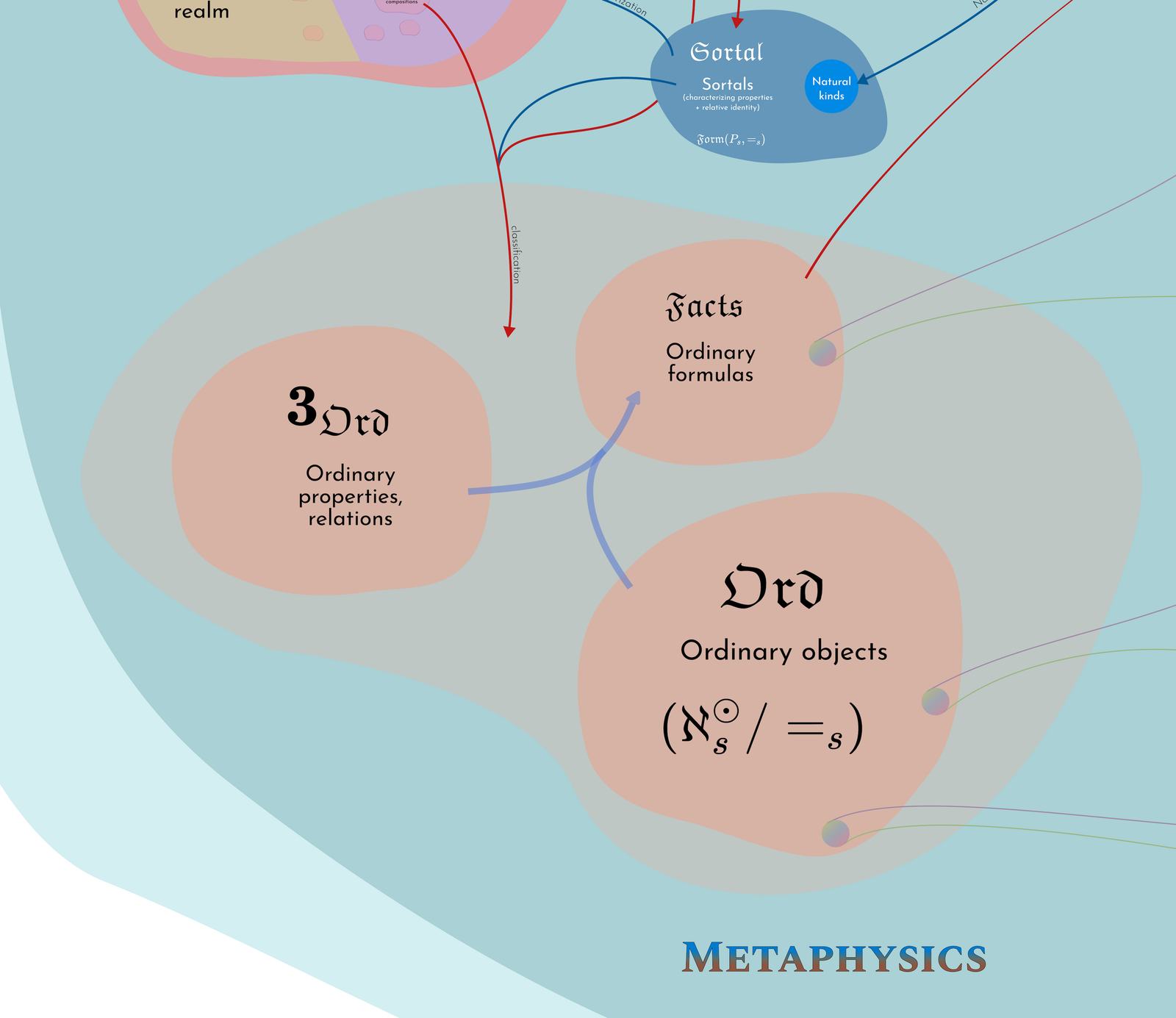
comes into play once one realizes that amorphous composites of physical or mental primitives are still not the objects of our discourse, action and representations (a dog is not the same thing as a pile of atoms or an amalgamation of cells).
The concept of substance should help us determine which types of objects have a “hard core” beyond their properties.
Complementarily, essence represents a shell of essential properties deemed to characterised individual objects — we shall consider the concept’s merit.
Constitution explains the distinction between raw objects and their ordinary version (the same heap of atoms can constitute a pile of clay, or a statue).
[5] Modality
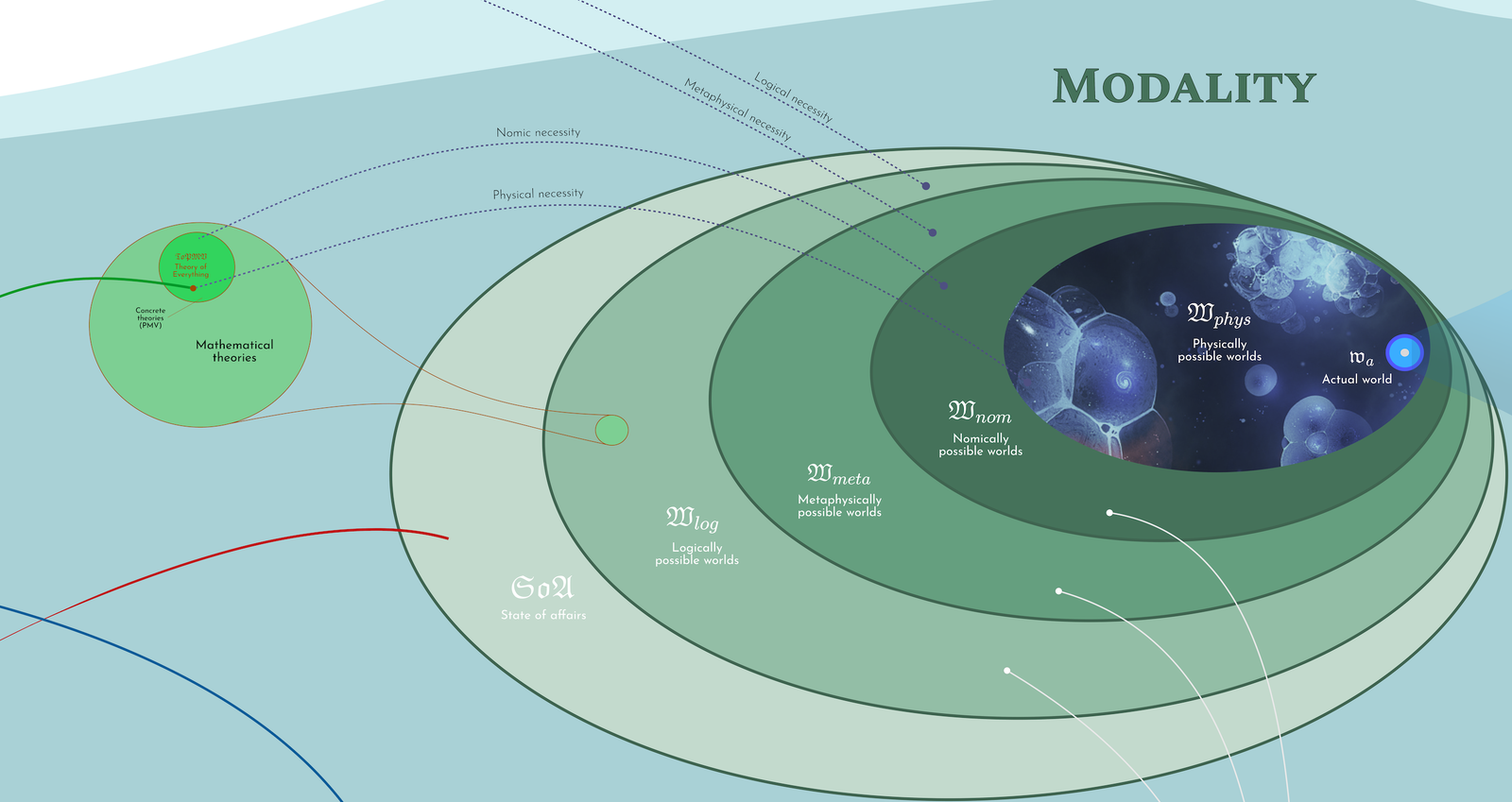
or modal metaphysics, expands the scope and enables us to think of possibility and necessity. Where standard metaphysics defined ordinary objects, the building blocks of thoughts and utterances about "our" world, this upper storey brings to life the merely possible, the fictional, the utterly impossible, and much more.
Physically possible worlds are alternate realisations of our universe, starting from the same laws and initial conditions. We can show that modern physics depict a much vaster array of such worlds than our forebears had imagined. The more speculative multiverse theories even present worlds with different laws and initial conditions. We call them nomically possible worlds, although their metaphysical connexity with our observable universe is not in question, making them part and parcel of the physical realm.
Physically and nomically possible worlds encompass an infinitely diverse range of outlandish states of affairs, but they still ought to have depth. That is very different from the “cardboard” nature of fictional worlds, which are typical examples of metaphysically possible worlds.
We can think of some objects that are not allowed by the laws of metaphysics, or even those of logic. In this section we make clear what logically possible and logically impossible worlds may amount to.
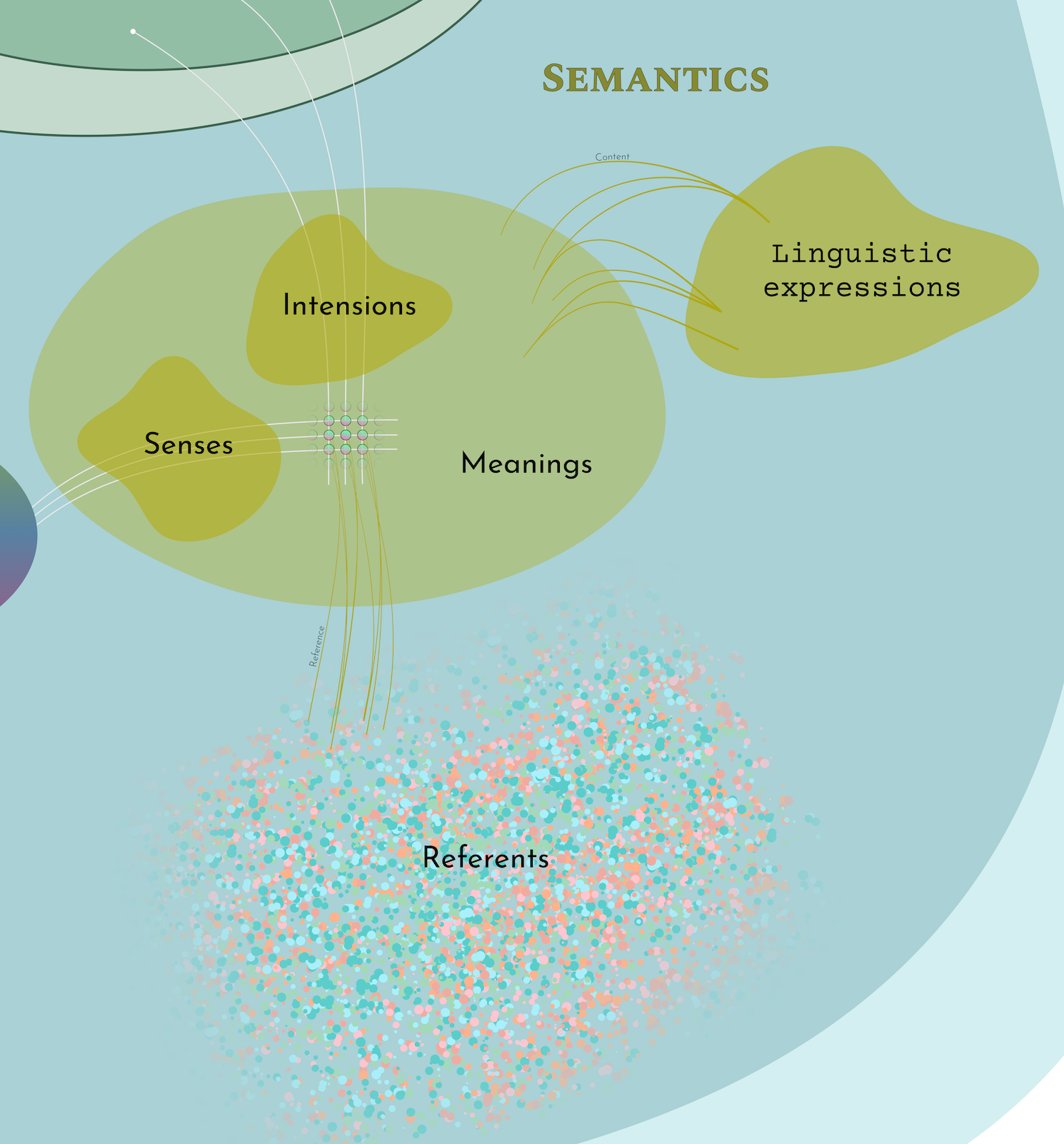
[6] Semantics
as a topic can be seen as highly contingent to our species having evolved to use languages. You are reading linguistic expressions that convey my ideas to you. Here we will show that semantic objects have universal philosophical import, whether talking apes exist in the world or not. To that end, we make use of all the inferior storeys, up to modality.
First, we formalize the concept of an expression designating a thing: that’s the idea of reference.
Then, we introduce the concept of truth-values and choose a theory of truth.
Lastly, we try to make sense of meaning and develop a full semantic theory.
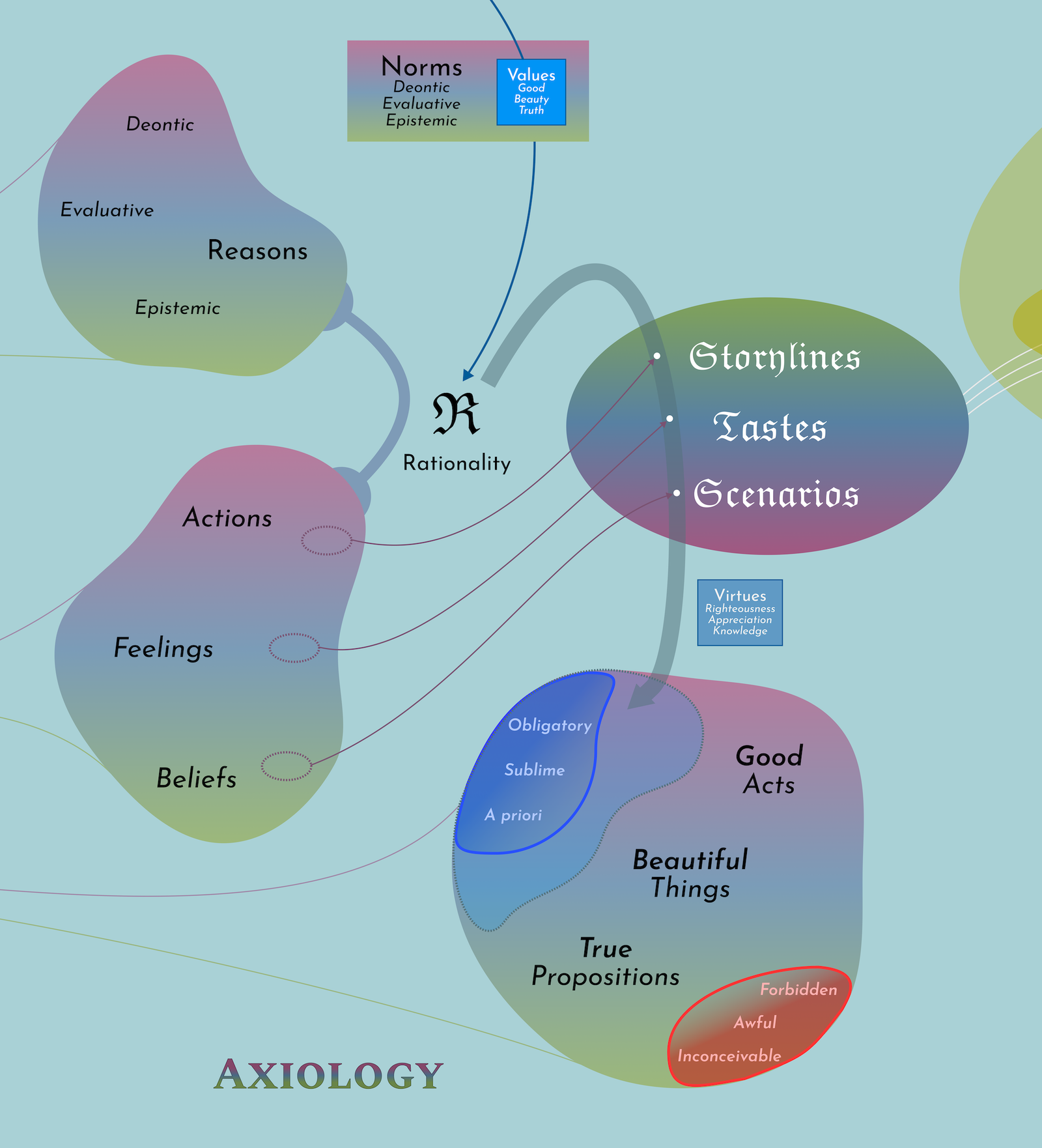
[7] Axiology
stands as the top storey of our abstract ziggurat, the study of value. Up to this point, we were not equipped to formalize statements about aims, reasons, norms, principles, virtue or values.
It is common to say we have reasons to act, to feel or to believe in certain ways. Once again, we’ll use formalization to build that concept with rigor, and show how neatly it ties with rationality and teleological thinking.
Reasons are normative in nature, and our next step will be to investigate in details the concepts of norms.
Norms can be expressed as judgments on value. At this supreme height, we will develop a theory of value and shine a light on its absolute aspects.