General structure
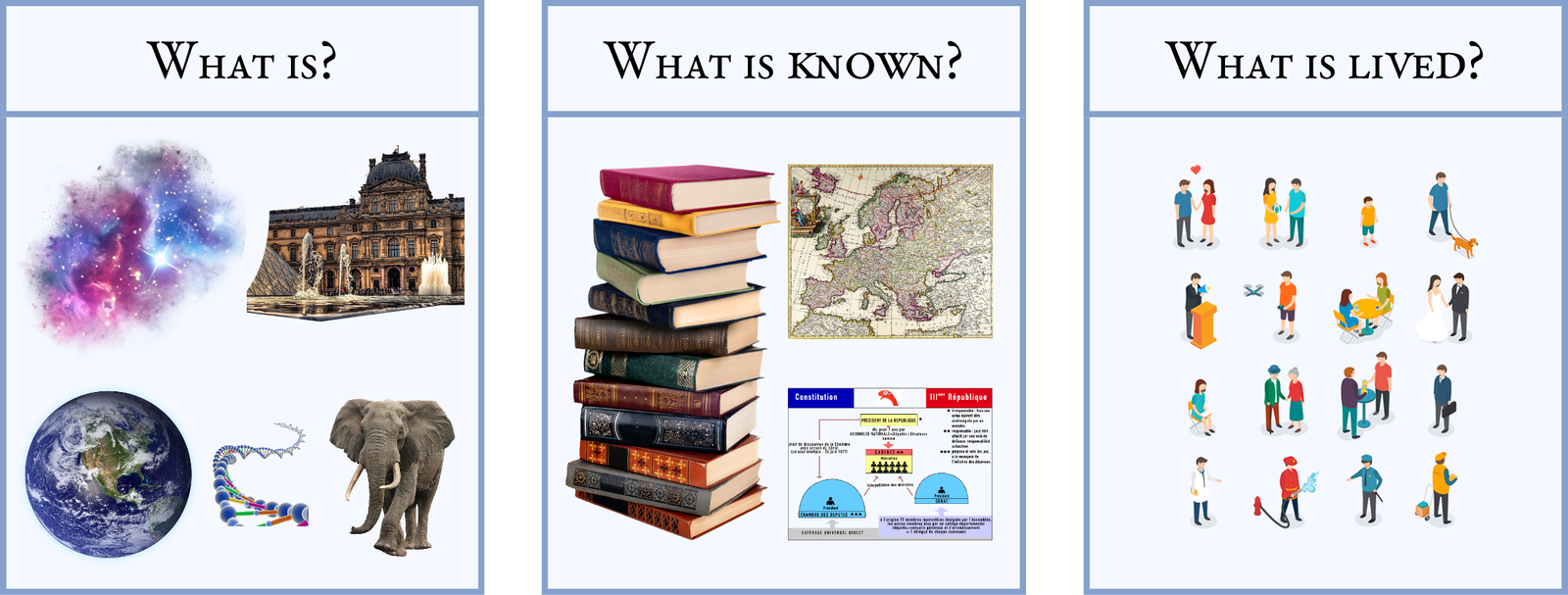
Les Fleurs du Monde will expose a universal system of classification, with three aspects:
The structure of the world:
Classification of what is.
The content of knowledge:
Classification of what is known, meant, thought, written, said...
The experience of life:
Classification of what is lived or experienced by human beings.
The general structure of the classification can be visualized as a simplex, and shall be called the Map of Everything
The 3-dimensional simplex, one of five Platonic solids, is just another name for the regular tetrahedron, or triangular pyramid, thus called because of its simplicity and elegance (simplicissimus).
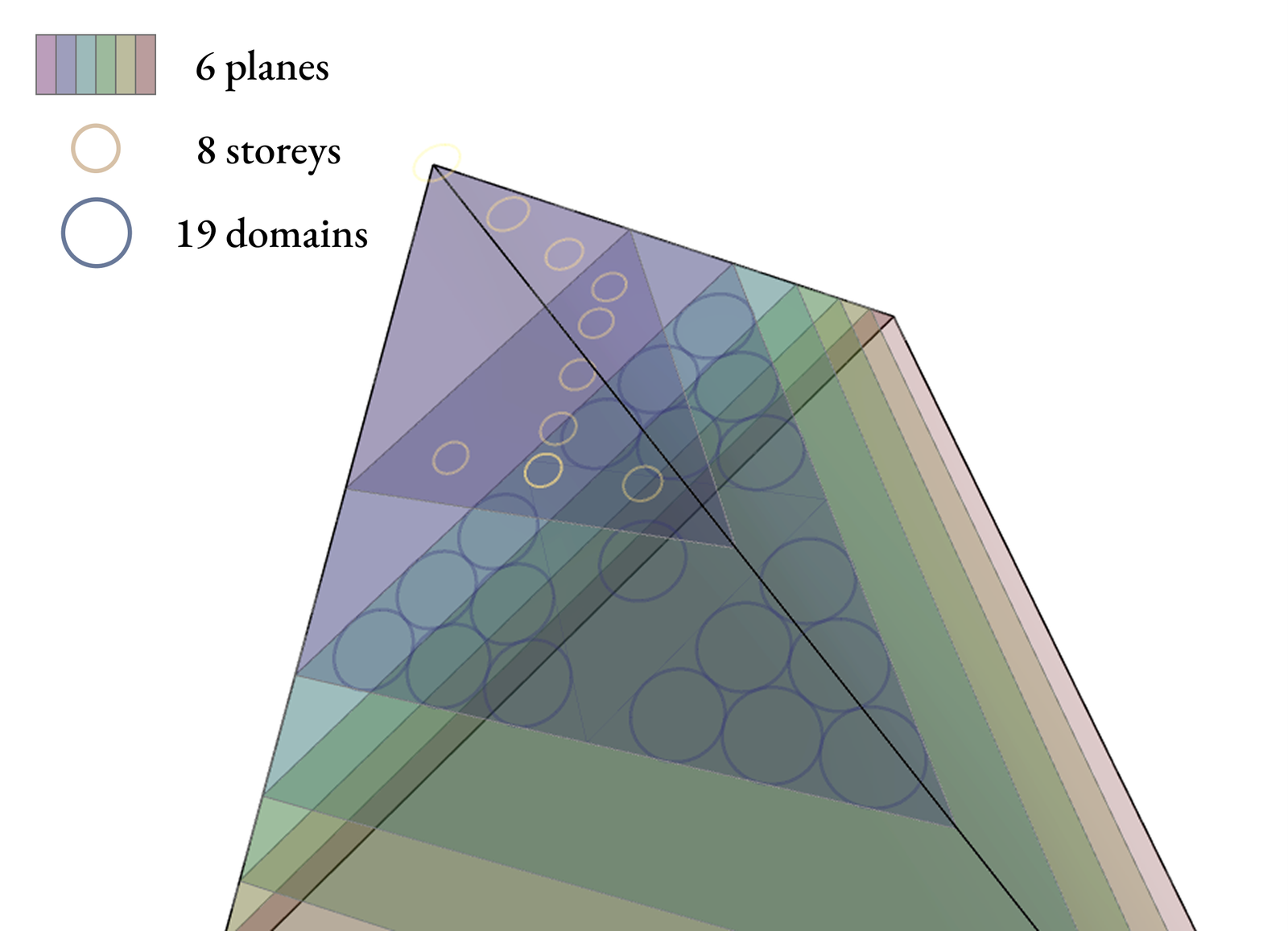
The image below is a preview of the complete structure.

Six planes
There is a six-plane continuum covering two of the three aspects: what is known (4 planes), and what is lived (2 planes).
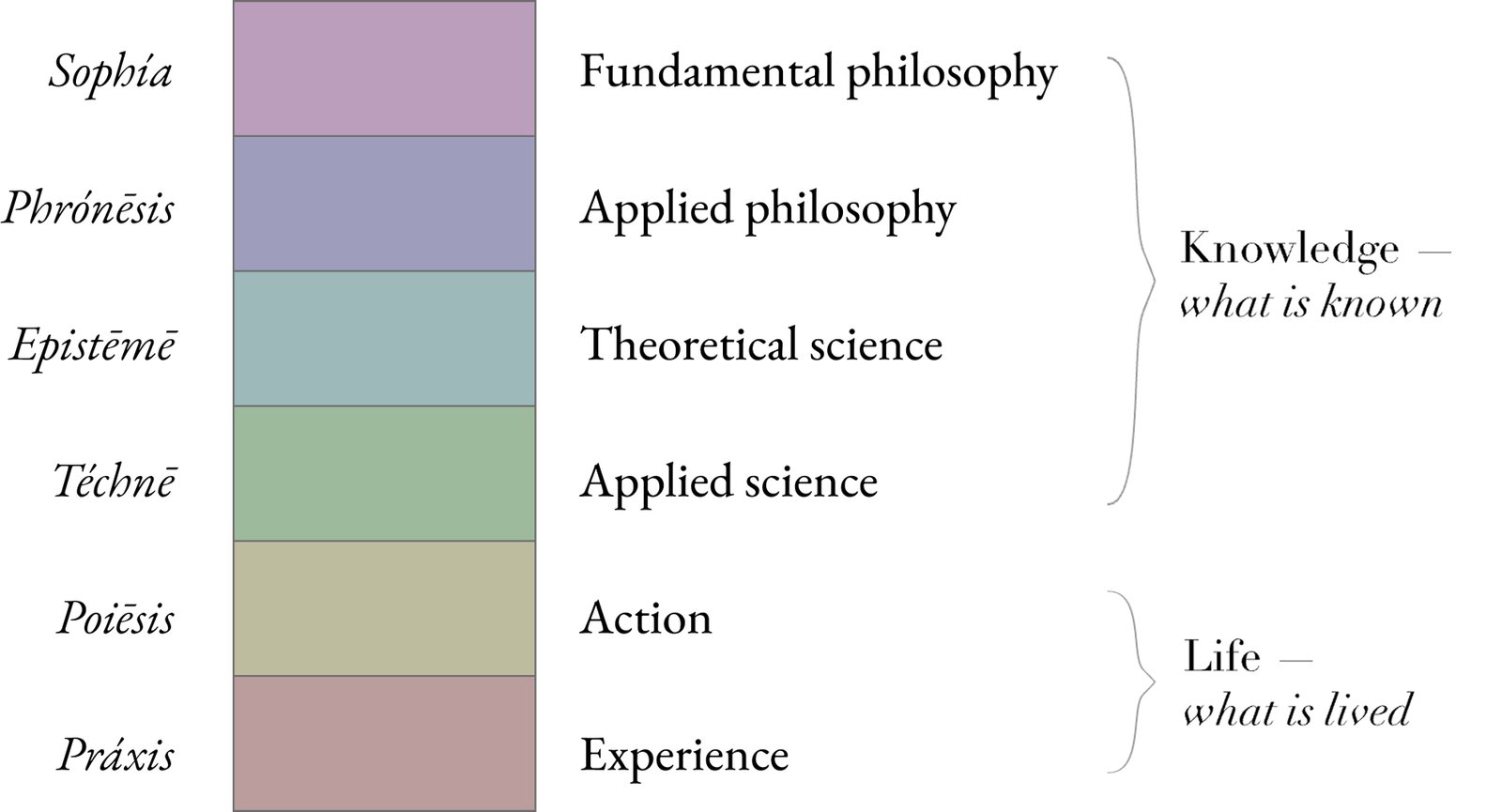
Sophía: Fundamental philosophy
First-order knowledge about things in the world.
Phrónēsis: Applied philosophy
Second-order knowledge, applying sophía to domains from the epistēmē level.
Epistēmē: Theoretical science
First-order knowledge about our physico-mental universe.
Téchnē: Applied science
Second-order knowledge, applying epistēmē to aims borne out of poiēsis-level activities.
Poiēsis: Human activity.
Práxis: Human experience.
The six planes, as we will see, divide the Map into six layers, along its longitudinal axis.

Eight storeys
All things in the world are part of a hierarchy, from the simplest formal structures at its root to the subtlest of ideas.
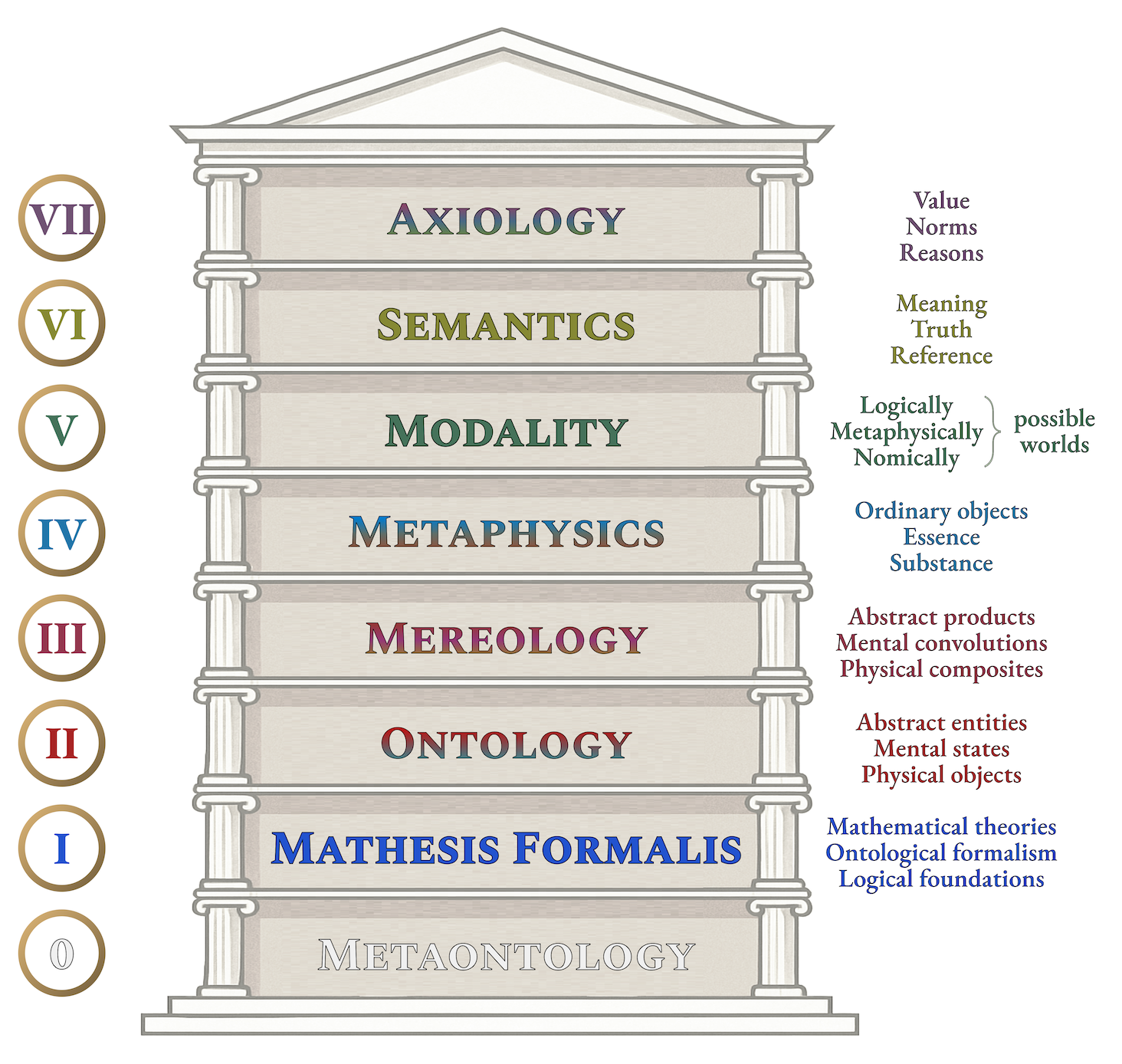
Their nature, connections and dependences are the core of what is, the last aspect of my classification, and are summarized in the Chart of All Things.
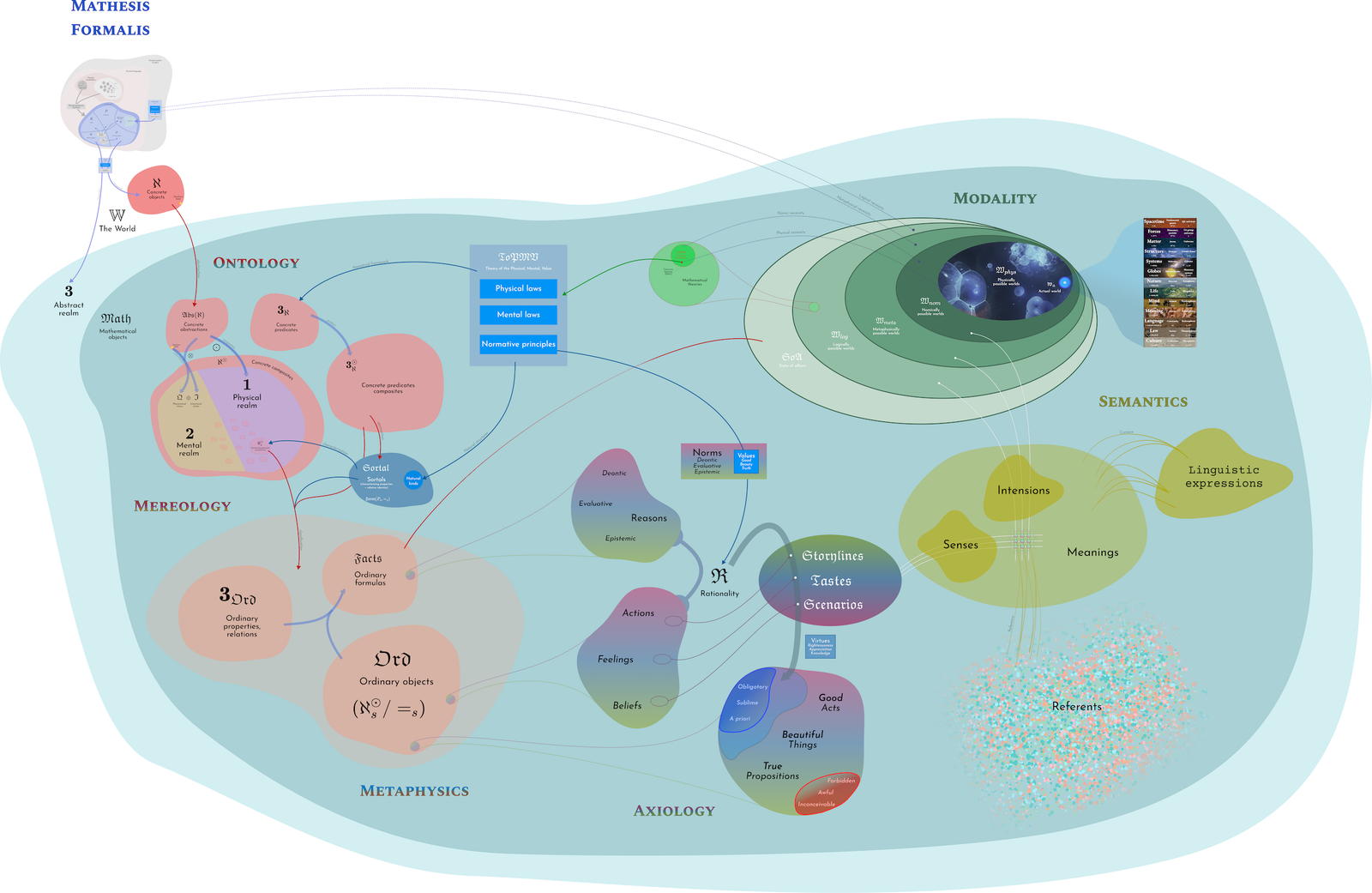
The chart confirms the leveled nature of the world, like a building where each storey is sustained by the ones below it, and rooted in their inner structure.
The eight storeys and their central concepts are:Meta-ontology: the concept of existence.
Mathesis Formalis: logical, ontological, mathematical foundations.
Ontology: simple objects from the three realms (physical, mental, abstract).
Mereology: complex objects from the three realms (physical, mental, abstract).
Metaphysics: ordinary objects (substance, essence, constitution).
Modality: possible worlds (nomically, metaphysically, logically).
Semantics: reference, truth and meaning.
Axiology (often split into Ethics, Epistemics and Esthetics): reason, norms and value.
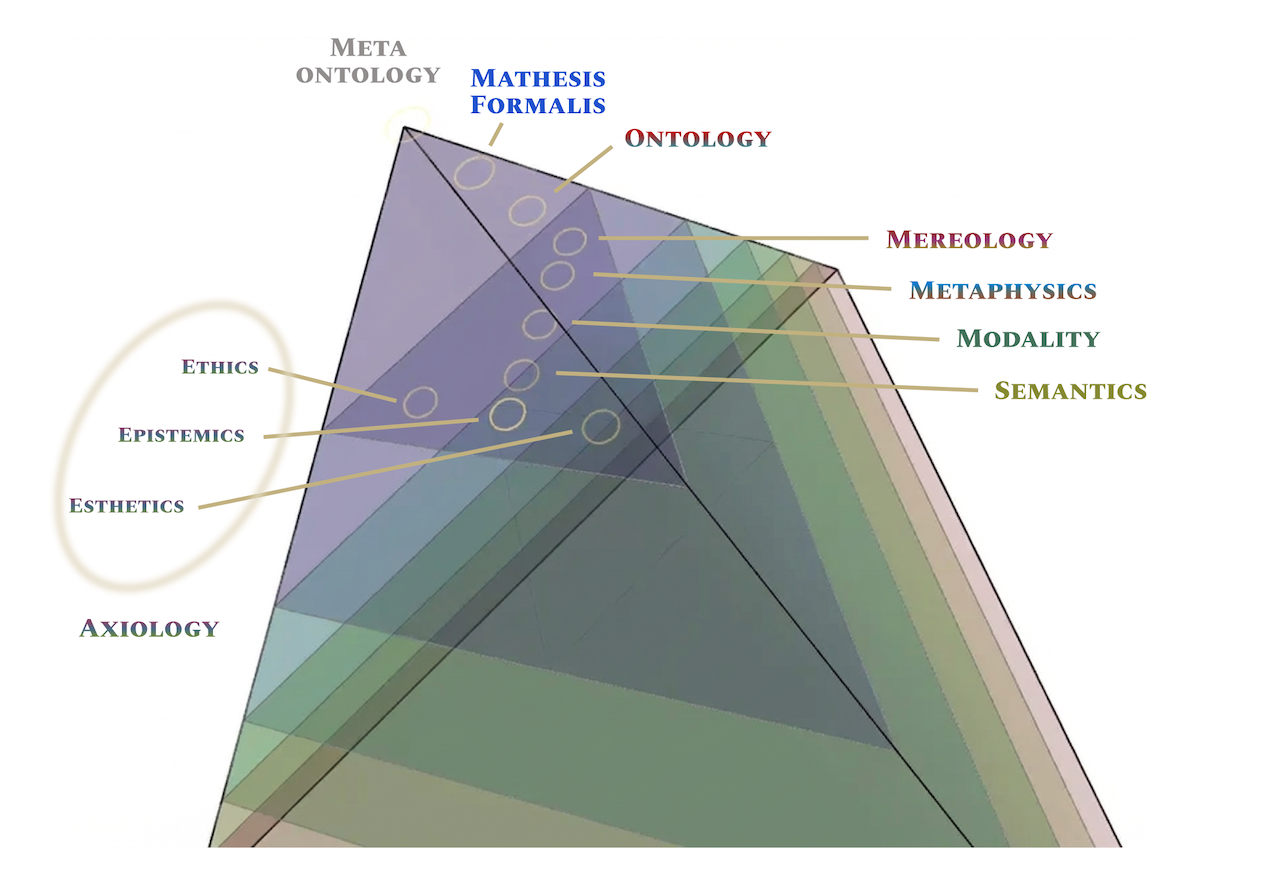
The study of the world's structure in its broadest, most abstract generality (leaving aside the specific features of our universe) belongs to fundamental philosophy.
The eight storeys are thus represented in the top layer of the Map, that of Sophía.
Thirteen stages
Structure is not confined to the abstract lands of fundamental philosophy. Concrete, natural reality also presents itself in layers. The core mission of philosophy, after all, is to carve our world at its joints.
Everywere we look, it seems that the complexity of the physico-mental universe can be tamed if we consider it as a superposition of intertwined levels.
This Great Chain, or Scala Naturae, comes to light as a sequence of thirteen stages, in order of time, size and scarcity. To each stage, I have associated an emerging concept, fundamental elements ("the micro") and a milieu acting as a crucible for the following stage ("the mega").
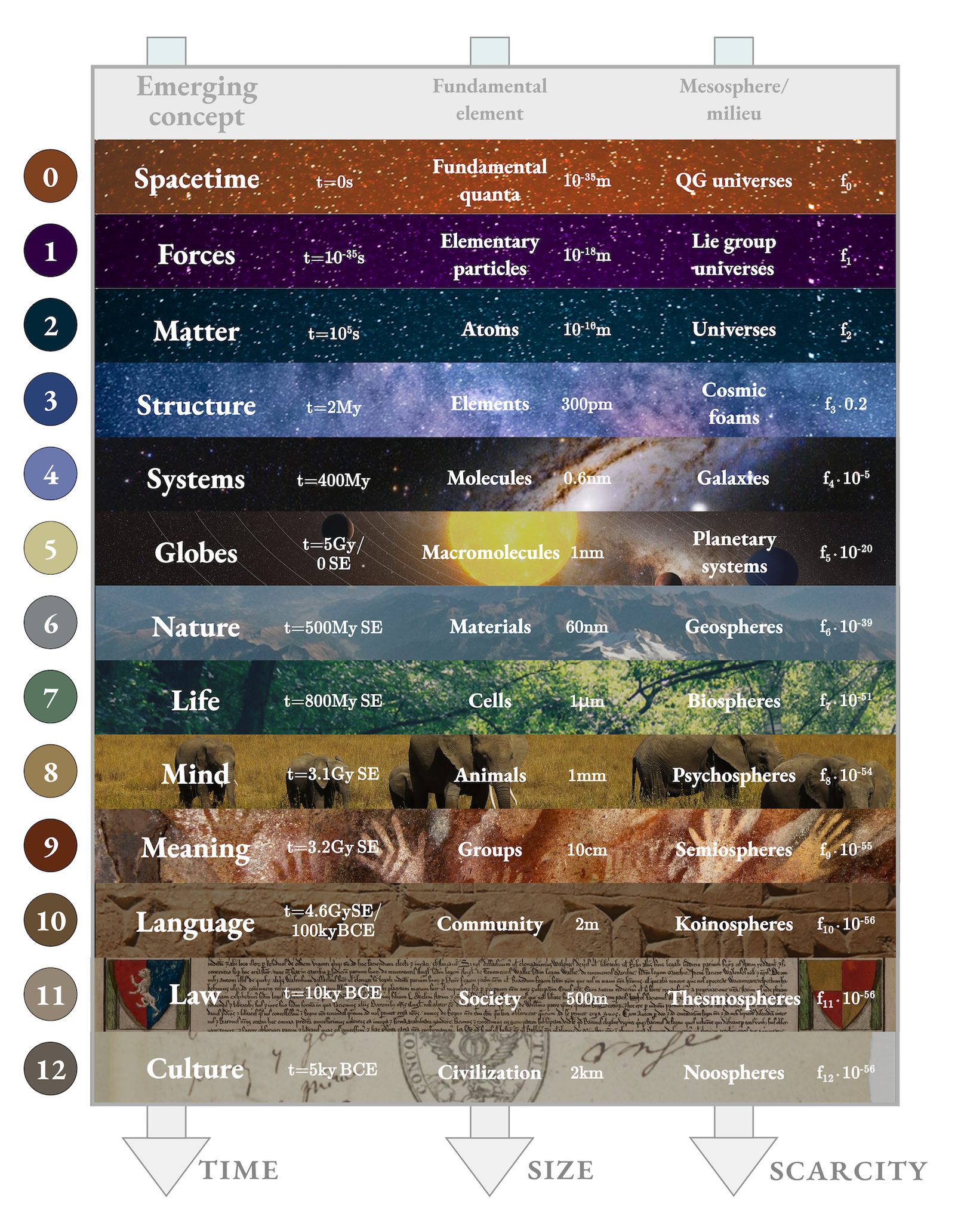
The characteristic elements and milieus from each stage emerge through a continuous evolutionary process. From elements of the previous stage arise some unstable firebrands, prone to quickly devolve into final elements, cold and unchanging.
Under the right conditions can also appear meta-stable object, diverse and reactive enough to foster the riches of complexity, stable enough that future stages, for which they will be in turn the starting point of a new evolution.


19 domains
Neither the eight storeys, the thirteen stages, nor some outright concatenation, are the last word in representing what is.
The co-existence, in the human sciences, of different modes of justification (Erklären/Verstehen), different statements (nomothetic/idiographic) and different granularities (holistic/individual) prevents a compression on a single axis. So does the axiological disparity between good, truth and beauty.
All these dichotomies diffract into a fresco of structures that rely on very different epistemological bases and thus must crystallize into distinct domains.
I distinguish nineteen domains spanning a triangle. They are split in three groups, plus an outlier:
| ○ Physical | ○ Astronomical | ○ Chemical |
| ○ Geological | ○ Ecological | ○ Biological |
| ○ Geographical | ○ Economical | ○ Social |
| ○ Legal | ○ Political | ○ Historical |
| ○ Mental | ○ Linguistic | ○ Cultural |
| ○ Scientific | ○ Literary | ○ Artistic |
| ○ Mathematical | ||
The vertical axis of the triangle can be matched with the sequences of eight storeys and thirteen stages, as per the correspondence below.
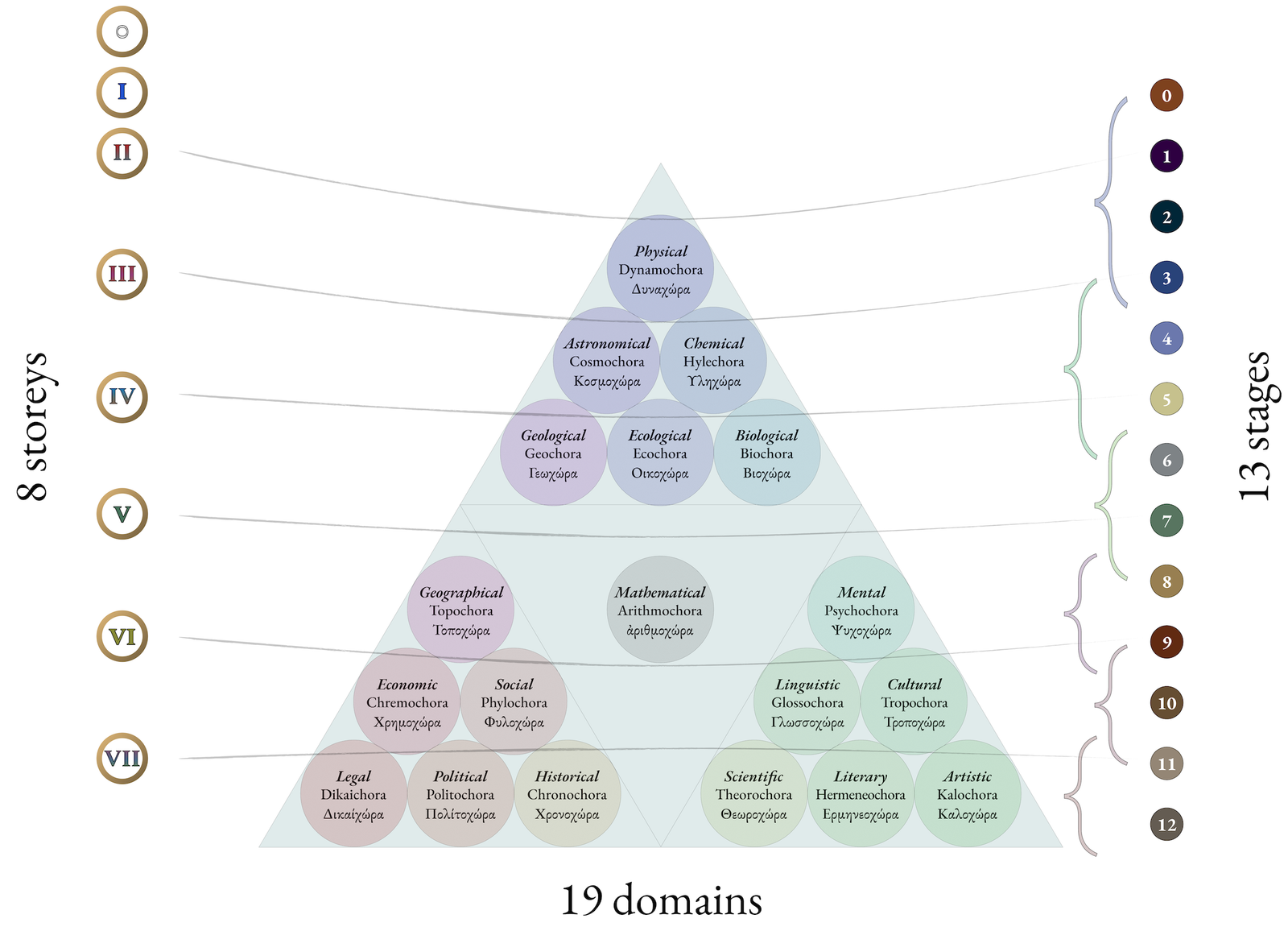
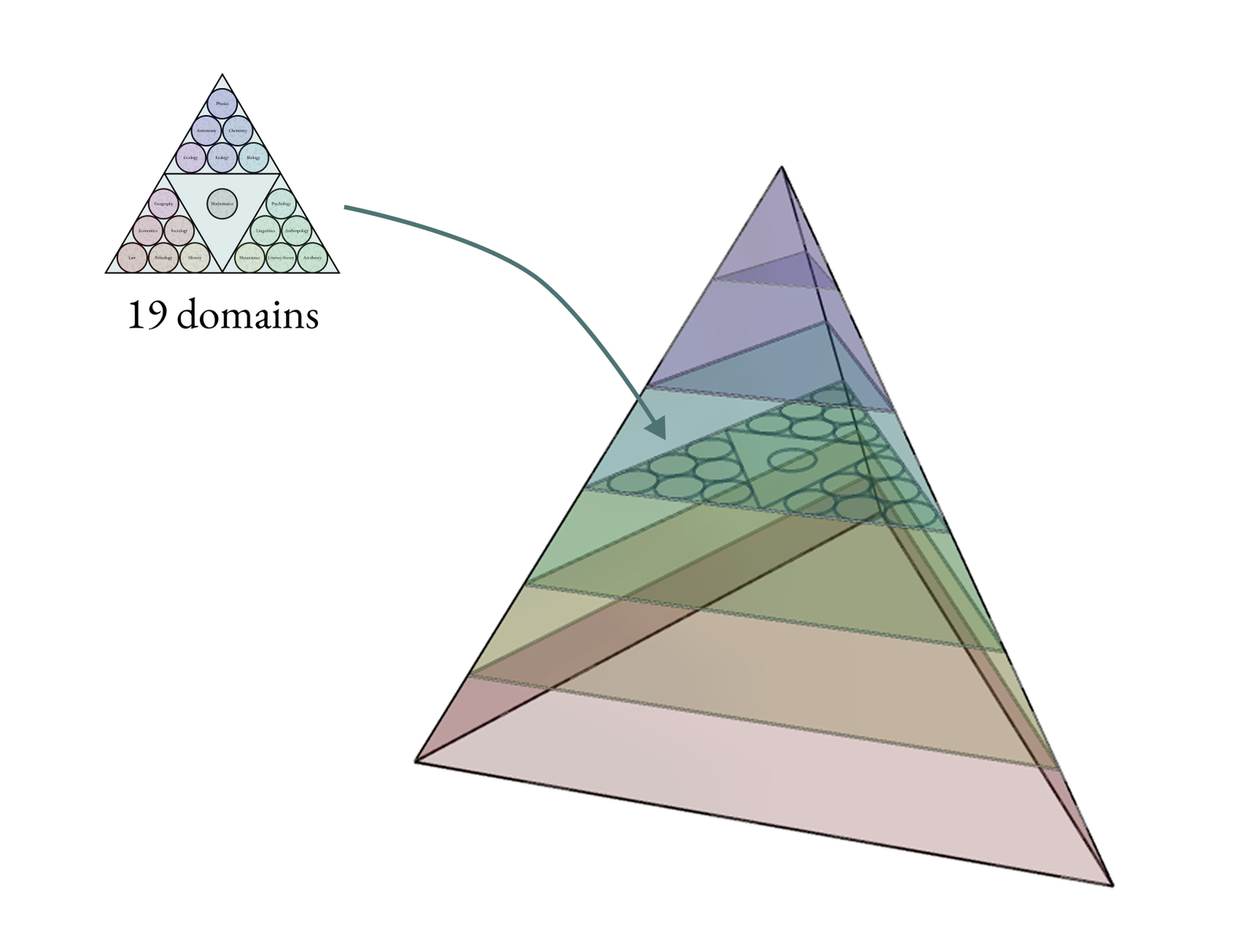
The domains are not fenced gardens, but rather clusters with hard cores but porous borders. Yet, they delineate a sector of what is.
The projection of a given domain through the longitudinal axis of the Map lays out the relevant disciplines, practices and experiences across what is known and what is lived.
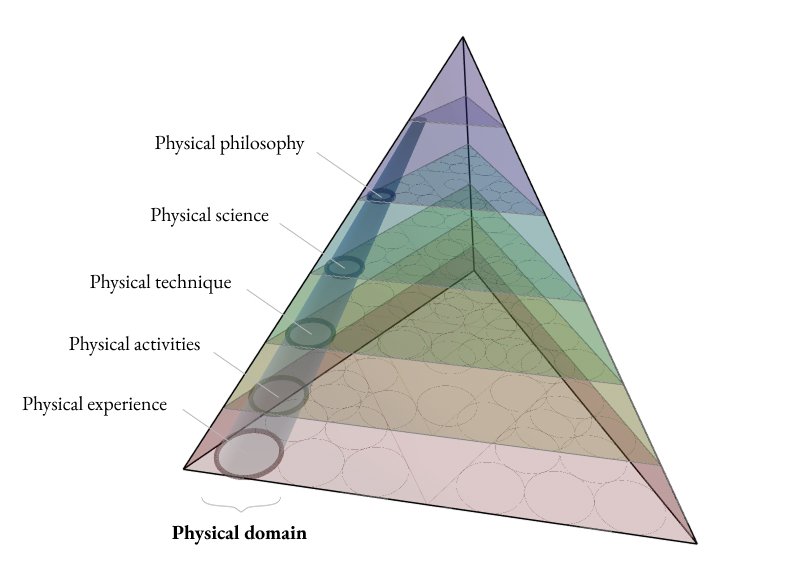
The Map of Everything
We can then recapitulate, once more, the general structure of the Map.
Six planes, covering modes of knowing, acting, living, are shown as layers of the pyramid.
Eight storeys, symbolizing the progressive construction of formal structures, from ontological primitives to good, truth and beauty, are laid out in the uppermost layer.
Nineteen domains, clusters of knowledge, activity and experience spanning what concretely is in our universe, are disposed into triangles within each layer, outlining nineteen cones in the vertical dimension.