Episteme + Techne = science
Episteme, the Greek word for knowledge, is commonly translated in English as "science". I have entitled this level "fundamental science" — a daring phrase in that it is prone to encourage misunderstandings, if insufficiently clarified. Used outside of a specific context, it could elicit visions of white-coat-clad researchers in a laboratory, which is not in incompatible with the actual working definition I shall use, but is needlessly restrictive. As to techne, the Greek word for "craft", I have rendered it as "applied science".
Generally speaking, I have used the term "science" very liberally in what precedes, in particular while contrasting that level of knowledge with the philosophical ones; in this section we shall clarify matters.
What is science? The problem of demarcation
In so doing, we need to delve into the polysemy of science, and will refer to definitions from the Oxford English Dictionary (2nd ed.).
"The state or fact of knowing; knowledge as a personal attribute". This, the broadest definition, does not reflect the common usage of science in twenty-first-century english, but matches that of episteme in ancient Greek or of scientia in Latin.
"Philos. ’knowledge’ as opposed to ‘belief’ or ‘opinion’." This definition directly references the classic Greek triad of epsiteme, gnosis and doxa. This is a refinement of the previous definition since it introduces the idea of justification: scientific knowledge, along these lines, cannot come solely from personal introspection nor from following the public sentiment.
"A particular branch of knowledge or study; a recognized department of learning." This definition of science actually opens the way to the idea of sciences, that there cannot be one sole branch of knowledge, and presents science as an activity rather than an abstract body of knowledge or a quality.
"A branch of study which is concerned either with a connected body of demonstrated truths or with observed facts systematically classified and more or less colligated by being brought under general laws, and which includes trustworthy methods for the discovery of new truth within its own domain." In a much more restricted sense, this sets up a test for a branch of study to be considered a science based on its outcome and method.
"In modern use, often treated as synonymous with ‘Natural and Physical Science’, and thus restricted to those branches of study that relate to the phenomena of the material universe and their laws."
Firstly, we can remark how science can denote, on the one hand, a human endeavour, on the other hand, a body of knowledge (or, more neutrally, a set of claims or proposition). I would deem the choice to be mostly conventional as all concepts can be transposed from one picture to the next: for instance one can talk of science as following a certain method, or as being produced via a certain method, and so on. Based on previous sections of this work, it should be clear that the activity of scientists must be placed in the domain of poiesis (human activity), while episteme and techne shall henceforth refer to a body of knowledge.
Coming back to the dictionary entries above, they are by nature lexicographic rather than philosophically-minded, yet they prefigure the central elements in the problem of demarcation. The question of demarcation came to the fore during the Enlightenment, when science was given an enhanced role as the supreme expression of human reason, that shall sweep away the webs of tradition and obscurantism, thus making paramount the ability to distinguish it from pretenders and false prophecies. The development of a specialized philosophy of science in the twentieth century led to further attempts to solve that vexing problem.
It was Karl Popper who coined the phrase: "The problem of finding a criterion which would enable us to distinguish between the empirical sciences on the one hand, and mathematics and logic as well as ’metaphysical’ systems on the other, I call the problem of demarcation." Accordingly, most discussions surrounding demarcation have sought to build a normative approach around the gold standard provided by the modern natural sciences.
Amongst the criteria envisaged to operate the demarcation were:
Justification, or to what extent claims, to be scientific in nature, need to be epistemically warranted. Greek ideals of a science made of only "true statements" seem a tad simplistic now; more practical criterias such as verificationism or falsifiability have been proposed.
Method, or the process leading to the construction of scientific claims.
Subject matter: the set of objects that scientific claims can be about.
Values, ethos, or spirit in which the claims were made — this viewpoint is more historicist or sociological: it seeks to distinguish scientific knowledge based on then set of institutional imperatives that helped birth it. Robert Merton suggested [social] universality, communality, disinterestedness and organized scepticism. We can also add Thomas Kuhn’s criterion that in science, failures of an established theory must lead to adjustments and challenges.
Although there is litte consensus around these criteria of scientificity, refining them is a raison d’être of contemporary philosophy of science, which usually leads to a fairly restrictive definition. Physical science is seen as the archetype against which all other disciplines are evaluated. All the natural sciences usually make the cut as "proper science", while psychology, economics or sociology are at best marches of that domain. Let’s be clear: an agreed-upon standard about empirical science has crucial implications from educational, legal or political perspectives.
Yet, this work is primarily about ontology and classification, and standards of scientificity will not be key to my delineation of episteme. This ultimately allows to sidestep this difficult issue. After all, it has been advanced, by the likes of Paul Feyerabend, that no permanent set of criteria could convincingly define science. In the same vein, Larry Laudan has spoken of the demise of the demarcation problem.
The view of scientific disciplines that we’ll adopt here is closer to the broadest of English definitions, or to the German term Wissenschaft, which includes the natural sciences (Naturwissenschaften), the social sciences (Sozialwissenschaften), formal sciences like mathematics (Formalwissenschaften) and what in English would oft be called humanities (Geisteswissenschaften). In English, science and the humanities are more often than not set in opposition. My frequent use of the Greek terms episteme and techne, it should now be clear, is therefore not pedantic, but rather a way to stay on neutral ground, and avoid disorienting readers with terminology that may prove too charged in their own language.
With that much wider domain, we are now facing our own issue of demarcation. If we don’t use some specific criteria of scientificity, won’t this level of knowledge come to encompass nearly everything, down to unstructured bundle of mundane facts, such as my neighbours’ names, or the number of leaves on my houseplants?
I will use one sole guiding criteria: that episteme, together with techne (more on the disctinction between them later), cover all knowledge that is part of, or borne out of, a theory, a systematic scheme of ideas or claims that endeavors to explain, understand, organize, or make predictions about a given subject matter. This subject matter needs to be about something in our world; it is then fair to say all possible subject matters can be mapped on an ontology.
A tight net: the web of beliefs
What can we take from this? The astute reader is bound to notice that my definition of theory is extremely broad. This confirms that I am far from applying stringent tests of scientificity such as the ones physical theories are subjected to. Those, and all the knowledge they’ve evidenced, can comfortably find their place within the episteme level, as can the formal and social sciences, given this definition. Traditional humanities such as philology, art history or literature studies are also covered since they share, to an extent or another, an urge to explain, understand or organize. It also seems possible to capture lots of "proto-scientific" or purely observational data: the description of a bright star by ancient astronomers can be seen as part of a systematic attempt to organise perceptual experience.
Is the net too tight though? Is my knowledge of a friend’s love life involved in an unconscious systematic inquiry into human behaviour, or just a mundane fact? Is it just part of my personal knowledge in a cognitive sense, or also of Knowledge as a more ehtereal concept?
The whole point I’d like to make is that my episteme/techne field does capture everything in terms of subject matter, but then the use of the theory concept can be wielded as an organizational principle. Quine, for one, pictured a continuum between science and "common sense". In the same way, I’m not propounding criteria that would separate the wheat from the chaff, but rather envisioning episteme/techne as a fuzzier domain, with some sharp, crystalline regions, and others lost in the mist of daily life and unconnected facts.
Quine’s related image was that of a web of beliefs. Some beliefs occupy a central position, others are peripheric, and the web is topologically structured based on distance to the experiences, and on empirical data points likely to "put pressure" on a given belief. The concept of connective centrality can correlate with the idea of theoreticality. A belief that all swans are white can be reversed if I see a black swan, but it’s not bound to affect the wider web much; on a fundamental law of logic or physics, however, may depend whole swaths of the collective web of belief. This theoreticality should of course not be thought of as a simple index but rather as an aspiring partial-order relationship over the vast domain of human knowledge.
Whither "bad science"?
As has been now abundantly explained, our expansive definition of episteme and techne knowledge leaves aside traditional criteria of scientificity, which are to be worked out independently of this classification. Beyond mundane, daily facts we may colloquially call non-science, we will find in our continuum of knowledge some forms that are often more contentious:
Historical science: theories that were once cutting-edge, but from today’s standpoint are considered both evidently wrong and methodologically flawed; for instance: Ptolemy’s heliocentric model.
Un-science: systematic set of claims about a given subject matter that were never considered as successfully passing any scientificity test; e.g. a religious scholar’s statement that Earth is at the center of the Universe because scripture says so.
Pseudo-science: misguided work that seeks to create an impression of scientificity, but in an ultimately spurious way; for instance, a "crank" using calculations and observations to prove the Sun and the other planets orbit around the Earth, while not engaging with contradictors.
Bad science: scientifically unimpeachable work that reaches wrong conclusions following unvoluntary errors; e.g. incorrect observational data unwittingly collected due to a broken instrument.
Satire/hoax: non-scientific claims about scientific subject matters; content-wise they can be strictly identical to the preceding categories, while intent (and therefore the nature of the human activity at work there) differs.
Ultimately, this should clarify once again that neither episteme nor techne are about identifying some form of "genuine" or "good" science; they cast a much wider net — just like an industrial activity classified under poiesis would be covered even if the artifacts were sloppily produced and incapable of serving their stated purpose.
Science needs to be about something...
Lastly, let’s come back briefly to our contention that scientific subject matters need to map on an ontology. This may seem entirely tautological: scientific claims obviously need to be about something...
The statement should be taken more as a reminder that classification, chiefly the delineation of first-order disciplines, needs to be consistent with an ontology’s structure. Let’s consider theology: to monotheist religions, God is an actual being, characterized by uniqueness; as such He cannot be a subject matter of physics (not belonging to the natural world) nor of psychology (being irreducible to the substance of human soul), hence the need for an autonomous discipline studying divine matters. Theology’s presence alongside the other sciences is thus a mere reflection of religious metaphysics. Our ontology will not start from the same postulates: the concept of God will be considered from a cultural perspective; at episteme level, divinity studies will then be placed amongst enquiries into human culture.
A different kind of example is astrology: its subject matter’s ontological status is not in question, but its identity is. It is sometimes assumed that astrology shares its subject matter with astronomy, but astrology doesn’t really seek to explain facts about astral bodies, nor does it seek to understand human behavior. Instead it aims to understand and explain the stars’ influence on human behavior. We would argue this influence has no place in our ontology amongst natural phenomena, and should be considered a cultural phenomenon; claims by astrologers will thus be classified within the corresponding discipline in the episteme field.
Episteme vs Techne
We’ve discussed the concepts of episteme and techne somewhat indifferently in the broad context of human knowledge, and shall now contrast them. I’ve already noted in the previous section how episteme could translate as "science" or "knowledge", and explained that the former could apply to both episteme and techne, respectively in fundamental or practical guises.
Now it is time to concentrate on techne, a term which is also rife with polysemic analogs. Its most common English translations are skill and art; of course it also yielded technique and technology.
The knowledge in "practical knowledge"
The OED defines skill as the capability of accomplishing something with precision and certainty, acquired or learnt with practice and practical knowledge in combination with ability. This linkage between the worlds of human knowledge and of human action is characteristic of the techne level and will be recurrent in the present discussion.
The concept of practical knowledge has a storied philosophical history in itself, with three main conceptions.
Knowledge of a subject matter with practical aims. For instance: of a car engine, or of financial accounting.
Knowledge acquired through a practice: what one learns about car engines repairing them, as opposed to learning in books.
"Know-how" as opposed to "know-of". Knowledge-how translates into an ability or disposition to perform certain actions. For instance, "knowing how to ride a bike" seems different, in ordinary usage, from "knowing what one does while riding a bike" or "what to do in order to ride a bike".
It seems clear that (2) is part of (1): what I learn through practice must by definition have practical uses. The relationship between (3) and (1) is far from being as clear and gives rise to three positions: intellectualism stipulates that knowledge-how is simply part of knowledge-of; moderate anti-intellectualism that they are of a different nature, though often complementary; radical anti-intellectualism that it is knowledge-of that’s a special case of knowledge-how.
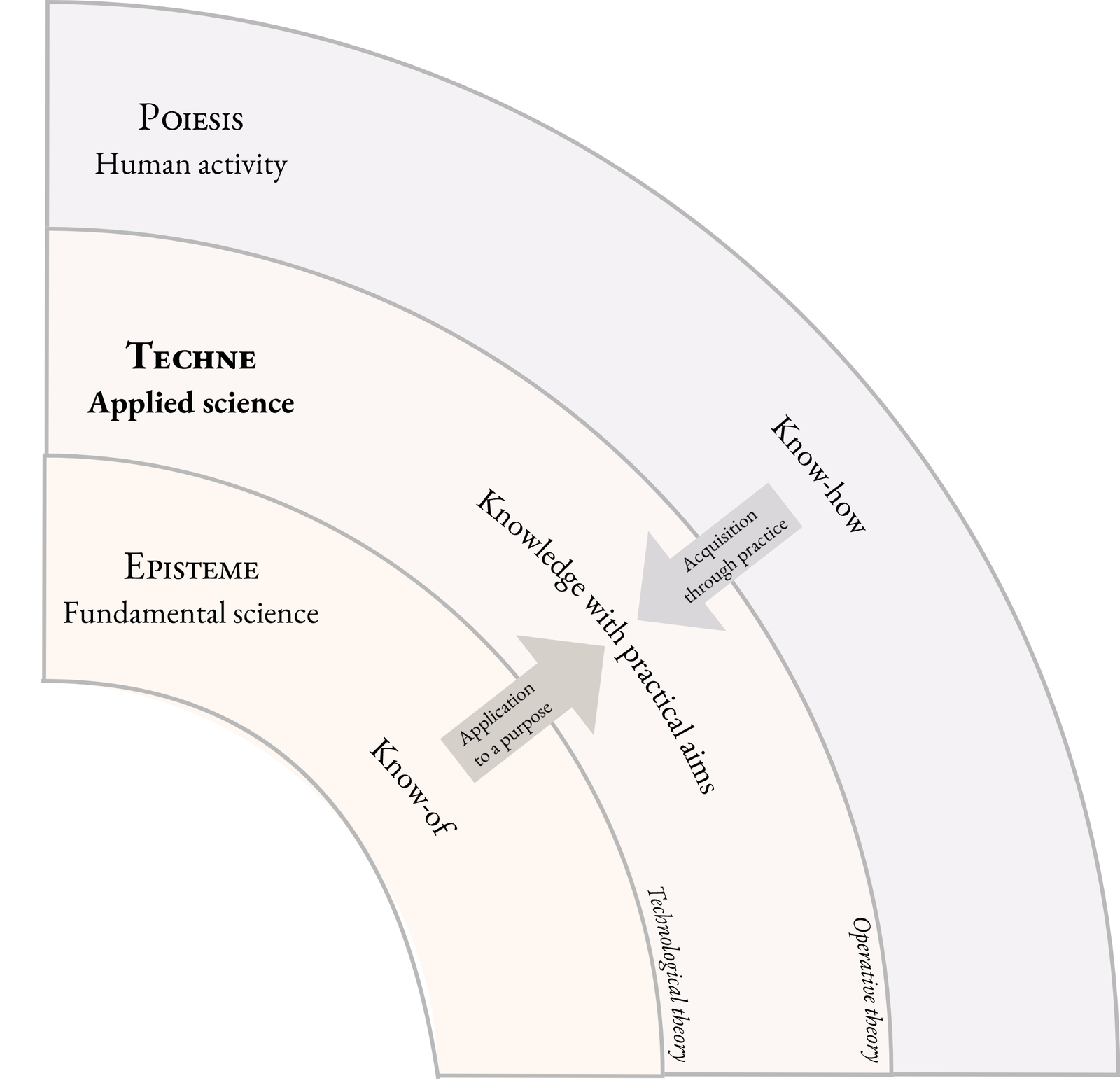
In this work I shall endorse the intellectualist position. This is not the place for a lengthy argument in its favor; in short, I consider that despite the superficially significant difference in quality between the two, a close examination of knowledge-how would evidence a form of atomic composition from elemental "knowledge-of" propositions. Knowing how to ride a bike may just be enabled through a bundle of non-conscious thoughts and reflexes that are known, even though the rider is unable to express that knowledge declaratively.
With (2) and (3) being parts of (1), it turns out the latter is the most general definition of practical knowledge. I would then propose for techne to be all human knowledge of subject matters with practical aims. This is consistent with its aforementioned adequation with applied science. Besides, the notion of "all human knowledge", we would remind, should be construed as the continuum that we described in the "episteme + techne" section.
The practical in "practical knowledge"
The problems raised by this definition, however, should be immediately apparent: their locus is in the phrase "practical aims". The difference between theoretical and practical pursuits is subject to interpretation, to inscrutable intentions, and to historical change. It has been asserted, for instance, that Greek geometry, seemingly a pure inquiry if there ever were one, arose out of the interest in land-surveying problems around the Nile.
Like our characterisation of episteme as fundamental science before, that of techne as applied science could invite misunderstandings. In common parlance, applied scientists seeks concrete interpretations of scientific propositions to some useful end, while practitioners work out solutions in situ, employing methods borne out of concrete experience (think of the inventor figure as an archetype). Mario Bunge outlined a distinction between technological theory which "is based on scientific theory and provides the decision maker with the necessary tools for planning and doing" and operative theory which "is directly concerned with the decision maker’s and the producer’s acts. But the fact that we’re not imposing any specific test of scientificity allows to blur such distinctions (they are highly significant in other contexts, but not key to our present purpose), incorporating not only the technological and operative theories, but also large swathes of daily acumen.
What to make, then, of the demarcation between episteme and techne? Given the issues around the concrete delineation of practical matters, "practicality" seems like too dull an edge to operate a clean split of episteme and techne into two mutually exclusive sets. Again, it is best to picture a continuum and episteme/techne as poles of attraction on either end. Most "formal knowledge" would be quite well-defined in that regard and display clear "coordinates" — for instance, close to one of the poles, or firmly in the middle. There is little doubt that astrophysics belongs to episteme while agricultural engineering is close to techne; something like polymer chemistry would rather sit somewhere in between.
This continuum thus allows to reproduce in a flexible fashion the spectrum we know, from pure, basic, and applied research, to engineering and craft. Most daily knowledge, however, cannot be that easily classified in and of itself and often doesn’t have a clear subject matter. Declarative statements such as "My name is Jonathan." or "I own a book about wine." don’t seem to belong to any systematic scheme to explain or understand, nor do they seem prone to encourage practical actions. Yet, clustered with others, they may.
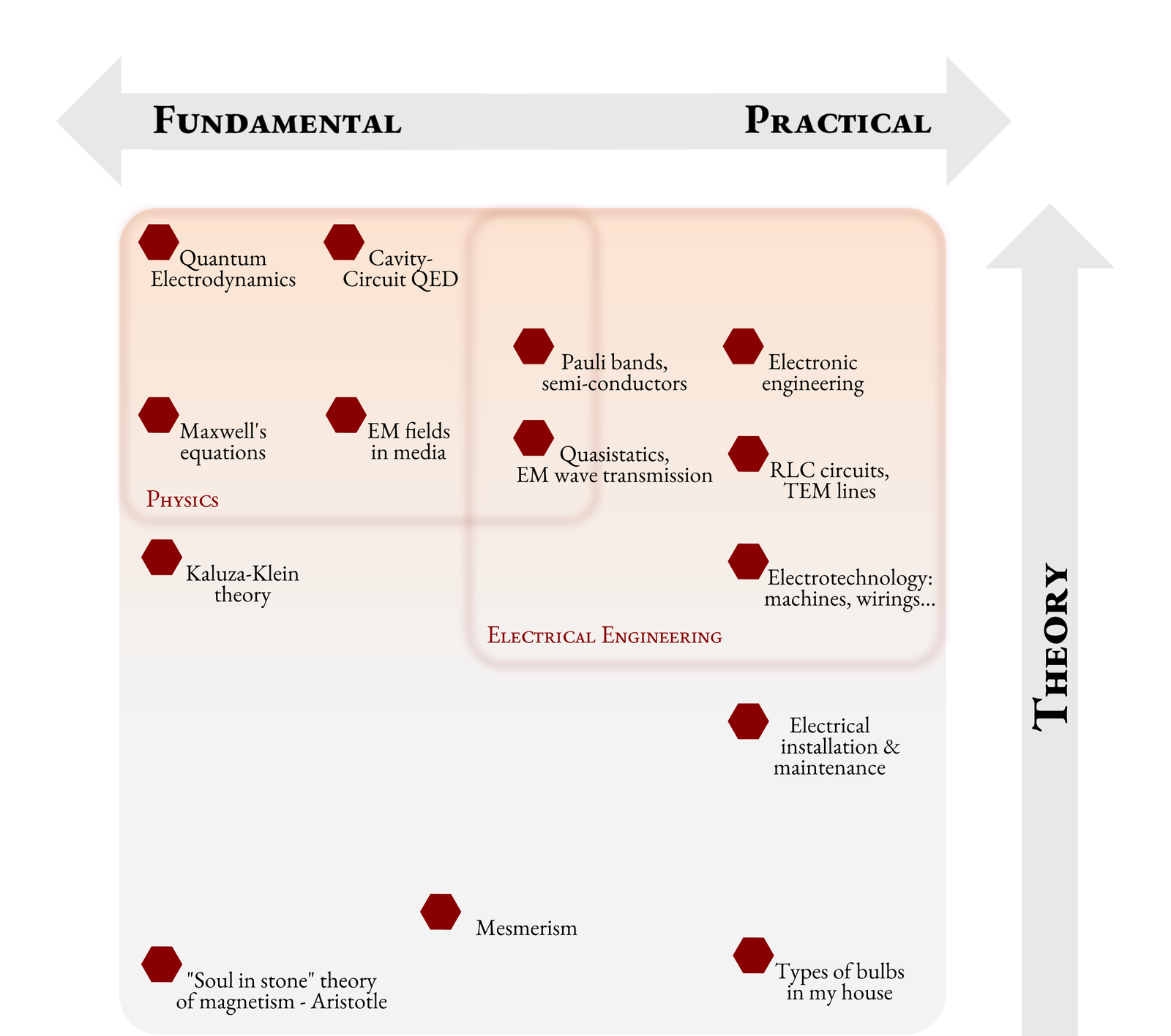
In our classification of knowledge, we’ll still outline first-order disciplines at both the episteme and techne levels. As confident in that division as we may then feel, it’s important to remember those inquiries act themselves as attraction poles, the center of dense clusters of knowledge. These stars shine bright in the galaxy of knowledge, but most of it is actually stardust, in between disciplines, and in between levels.
Semantic miscellany
In the context of this work, we’ll use the ancient Greek techne as much as possible to avoid ambiguity. Yet it is useful to shed some light on how we’ll use this term and come back to some common English translations. A better understanding will prevent possible mis-interpretations when those words inevitably appear in various contexts.
Art
is remarkably polysemic and its semantic footprint is wide. Let’s refer again to the OED and organize the most relevant definitions:
Art as skill:
" Skill in doing anything as the result of knowledge and practice; an acquired faculty of any kind"
"Skill in applying the principles of a special science; technical or professional skill"
"Skill displaying itself in perfection of workmanship, perfection of execution as an object in itself."
Art as activity:
"An industrial pursuit or employment of a skilled nature; a craft, business, profession"
"A pursuit or occupation in which skill is directed towards the gratification of taste or production of what is beautiful"
"The application of skill to the arts of imitation and design, painting, engraving, sculpture, architecture"
Art as knowledge:
"Certain branches of learning which, [...] their main principles having been already investigated and established, are in the position of subjects requiring only to be acquired and practised.
"A practical application of any science"
Art as object: colloquially, art is sometimes used to denote an artwork or an artefact.
It should be clearer than ever that "art" is a dangerous word to use in a professedly rigorous work! As a matter of fact, let’s toy with language for a moment and consider the following sentence: "learning art has allowed me to master the art of composition, which I have put to good use now that I work in visual art, and am making art for a living". Occurences of that one word refer, in order, to a body of knowledge, a skill, a profession and to objects! For a contrasting illustration, let’s consider an equivalent sentence with a different subject matter and vocabulary: "learning physics has allowed me to master techniques to solve beam equations, which I have put to good use now that I work in civil engineering, designing bridges for a living."
Craft
is essentially synonymous to art in its various guises:
"Skill, skilfulness, art; ability in planning or performing"
"A branch of learning or knowledge, a science"
"An art, trade, or profession requiring special skill and knowledge".
However, their common senses have diverged in a case of twin autohyponymy (displacement of a general sense to a more particular one): art without further context is now evocative of the Fine Arts, and craft of handicraft or manual labor. It is likely that J.S. Bach or Michelangelo, who lived prior to that divergence, would feel more kinship with fellow craftsmen than with contemporary artists.
Technique
, despite the direct etymological link to techne, is less general in principle. It is:
"A manner of artistic execution or performance in relation to formal or practical details (as distinct from general effect, expression, sentiment, etc.)"
"The mechanical or formal part of an art"
"The manner of execution or performance in any discipline, profession, or sport; also, skill or ability in this department of one’s art"
"Mechanical skill in artistic or technical work, loosely, a skilful or efficient means of achieving a purpose"
"A characteristic way of proceeding"
This term has strong affinities with the concept of mechanical, planned, calculated tasks.
Technology
carries the same connotation, being "the scientific study of the practical or industrial arts.". Like art, it can denote a body of knowledge, a profession, or its output: inventions, machines, tools or utensils (as in "technology being used for this project").
Engineering
covers a range of disciplines or activities and is frequently tied with technology. It is the profession of "one who contrives, designs, or invents", but also more generally "one who is claimed to possess specialized knowledge, esp. as regards the treating of human problems by scientific or technical means..
As with craft, the divergence of technique from art has been progressive. In medieval times, the trivium and the quadrivium making up the liberal arts were complemented with John Scot Erigen’s mechanical arts, such as weaving or metallurgy. The term remained in use until the nineteenth century, alongside industrial arts and useful arts (the United States constitution sets up the basis of patent law "to promote the Progress of Science and useful Arts"). It also persists in the name of some higher education institutions in France, like "Ecole Centrale des Arts et Manufactures" or "Ecole d’Arts et Métiers".
A more recent development is the popularity of design as a body of knowledge and an activity at the nexus of aesthetic, practical and technical concerns. As such it comes to blur the aforementioned boundaries that have appeared between the arts and technology. In language, autohyponymy caused their sense to diverge, which crystallized into academic and professional separation. To an extent, design has been building bridges and breaking barriers.
What should we take away from all this? First, that the semantic field of techne is a minefield of polysemy, with single terms referring to knowledge, skils, activities or artefacts. For the purpose of our discussions in this work, techne will always refer to applied science, a body of knowledge, as opposed to the activities of poiesis. Second, the evolving sense of these terms, informed by the vagaries of historical usage, should not obscure their proximity. To make a musical work, one may employ a musical artist, a melody craftsman, a sound designer, a recording engineer and an audio technician; these professions are well-defined at a given point in time, but philosophically speaking, clear-cut delineations would require well-formed ideas about aesthetics, practicality and intention, which we’ve seen can be challenging.