Foundations: Three lenses into existence
As explained at the outset of this book, the Map that best represents the deep structure of the world is a simplex (aka a regular tetrahedron). We’ve already moved transversally from its base to its tip, going through the four planes of theoria (answering the question: "what is known?"), then poiesis and praxis (answering the question: "what is lived?). Each of the six planes can then be approximated to a triangle. Travelling inside one of these triangles (for instance, at episteme level, through geology, biology, psychology...), we are running through subject matters (the Earth, life, mind...), which shows the connection to what is.
Indeed, if something is the object of human enquiry, activity or experience, it seems sensible that it should exist. But it’s not that easy to say what exists. How and with what would you make the world if you had to start all over again? That is what we’ll work on in this part.
To start on a stable footing, it is essential to dispatch some major ambiguities by delineating three lenses through which we’ll consider existence. Terms of the art like metaphysics, ontology or existence have picked up a distinctly "esoteric" tint in common parlance. But that is highly misleading, which this introduction will hopefully illuminate.
The metaphysical lens takes all the objects of our discourse (plainly, things we can talk about) and groups them into categories.
The ontological lens takes these high-level categories and determines which are fundamental domains of existence, and which are just derivative instead.
The meta-ontological lens goes deeper into the rabbit hole and examines the question of existence, or being, itself. That examination includes the question "does it matter at all?".
The metaphysical lens: what is this?
A small child, learning about the universe she’s just been thrown in, has one favorite utterance: what is this?.
"This is Figaro."
"What is Figaro?"
"He’s a dog."
"What’s a dog?" "That’s an animal."
"But what’s an animal?" etc.
This kind of regress ought to be very familiar to all parents. Conversely, children can try to guess a secret word, sifting through more and more precise categories. They call this parlor game "twenty questions"; philosophers prefer to call this a Porphyrian tree. Other examples can get hard to parse pretty swiftly.
"What is this?"
"It’s a ’3’."
"But what is it?"
"That’s a sign representing a number."
"And what is that?..."
"Why are you smiling?"
"Because I’m happy."
"What is happy?"
"It’s a feeling."
"And what’s a feeling?..."
However we call it, this inquisitive game seeks to sort all the things that make up our world into classes; in a nutshell, that is the metaphysical lens. Some philosophers have have been known to state, quite pompously, that the final aim of that process is to decipher the ultimate nature of things. That phrasing may appear over-ambitious, but that is not altogether different from the activity of scientists. Metaphysical considerations are deeply embedded within the empirical sciences — a statement which only seems controversial insofar as many scientists would use other terms, though they could hardly find fault with the intent.
Consider a famous example: general relativity, Einstein’s theory of gravitation that became a more successful alternative to Newton’s. In the Newtonian theory, the answer to the question "what is gravity?" is "an object — the gravitational field — that exists in space and time". In Einstein’s model, the answer would be: "a property of spacetime — namely, its curvature". Where metaphysics diverges from purely scientific work is that it doesn’t stop there: a physical theory is axiomatic and just posits the ultimate nature of its basic bricks: as long as they can be adequately represented by mathematiical objects, we’re in business! In contrast, metaphysics keeps relentlessly prodding: "Sure it may be a property of spacetime, but what is spacetime? And for that matter, what is a property?".
The ontological level: what is there?
At the (very hypothetical) end of our metaphysical enquiry, we’re meant to have nicely sorted everything into classes. Those classes go from the very small ("people named Jonathan Teyssandier") to the very large ("material objects"). Using the natural inclusion relationship (all people named Jonathan Teyssandier are also material objects), we should have been able to iterate and make our way up to a small number of top-level classes, conventionally called categories.
It seems reasonable to assume those will be very general. It would certainly come as a surprise if the system of irreducible categories looked somewhat like this: "elephants, atoms, pentagons, mountains between 2 and 3 miles high, heaps of sand, sets of five eggs, freedom and Saoirse Ronan". This level of baroque is amusing to consider in Borges’s short stories, but would be quite vexing if in any way "real". A fruitful intuition about basic categories relates to cosmogony: imagine that you’re a god, and a very organised one. Think of the neoplatonic Logos, not of some whimsical trickster divinity... Having a rough idea of what Creation should look like, what’s the shortest to-do list you can jot down for yourself? The book of Genesis, for one, provides a definite answer from its very first page: God made the world from light, the sky, the sea, dry land and plants, astral bodies, fish, birds, land animals, and man. Philosophical list of categories look very different but draw from the same idea: the world is ever-changing and multifarious, but we can try and find out the most irreducible, eternal categories of things in it.
Coming back to our question, "what is there?", we could take a page from Quine and simply answer "everything": the class that subsumes all our fundamental categories, thereby containing all things — implicitly, all things that are. This may seem slightly anti-climactic, even self-evident... Of course, everything is!
But there lies the rub, and the core of ontology: what does qualify as a thing that is in a philosophical sense? At the metaphysical level, we didn’t burden ourselves with such questions. Reprising Quine’s phrase again, I’d say we’ve let Plato grow a very lush beard, replete with all sorts of would-be entities: "Matter? Sure. Mind and soul? Why not? Forms, maths, ideas? OK. Mythical creatures, disproved planets? Huh, I guess?". Well, according to some, there comes a point when it’s time to make Plato a tad more presentable, and to wield Occam’s razor.
But what will be cut from the category of everything? And whatever it is, wouldn’t the mere fact we’re naming it and talking about it make it a thing? Oftenwise, this stumbling block can be lifted through careful language analysis. Take the statement that "red is my favourite color". Naively, this could be taken to imply there is a thing called "red" (and another called "color"). Syntactically, the sentence is similar to, for instance, "Paul is my favourite Beatle", which is just plucking an object out of a class. But one could say that upon uttering the words "red is my favourite color", we actually mean something like this: "for any two things A and B, if A is red and B is not red, then I am prone to like A more, all else being equal". If we accept this interpretation, then "red" need not be an object — it is "no thing" (we would then say that the word "red" as a noun does not refer).
In summary, here’s what we will need to build an ontology:
Positively, a set of categories that exhaust every thing in our world (the metaphysical lens).
Negatively, a set of retorts about all purported entities that don’t seem to fit into these categories: either
they’re non-entities, linguistic shadows borne out of under-analyzed speech, or
they are "something else": they do belong to one of the categories, but some analysis is needed to go beyond appearances (borne out of language, or simply habit) and identify their true nature.
The meta-ontological level: what is being?
At the metaphysical level, we’ve been idly talking about things as they presented themselves (the what in "what is it?"); at the ontological level we’ve been more discerning about exactly what could qualify as a thing (the it in "what is it?"). Now we shall focus on the is — the nature of being.
Before going any further, some semantic housekeeping is needed: ontologists have realized early on that the verb "to be" was pretty fickle. Let’s distinguish straight away between four main uses:
Identity: "I am Jonathan" (\(I=J\))
Subsumption: "I am a human" (\(I \in \mathbf{H}\))
Predication: "I am French" (\(\mathbf{F}I\))
Existence: "I am" (\(\exists I\)).
We will henceforth use "being" in the sense of "existence".
Approaching the question "what is being?" feels a bit like reaching the top of Mount Everest: oxygen is sparse, conditions are hostile, this may not be our favorite spot, but it certainly is special and extreme — once on top, there’s nowhere to go except down to the more hospitable slopes of ontology, metaphysics, then "regular philosophy" and the green valleys of theoretical science.
The modern philosopher most associated with enquiries into being, Heidegger, certainly highlights this endeavor’s importance Basically, all ontology, no matter how rich and firmly compacted a system of categories it has at its disposal, remains blind and perverted from its ownmost aim, if it has not first adequately clarified the meaning of Being, and conceived this clarification as its fundamental task. To Heidegger, Being, especially as its major avatar of Dasein, is inextricably linked to the experience of human subjects. To non-sympathizers, this may raise suspicions about the whole enterprise: by studying being, are we doomed to slide into existential considerations, or worse, half-religious, half-poetic musings?
The first concern here is whether ontology is vacuous: perhaps questions about existence are barren and the ontological enquiry simply moot. Such a position is often known as ontological deflationism, and we’ll highlight two versions here.
Ontological indeterminism is the simple belief that ontological statements have no determinate truth-value: they are neither true nor false. This amounts to describing the world as an amorphous lump with no ontological joints to be carved. To research whether the number 6 exists or not, not only would tell us nothing of the world’s true nature, but also wouldn’t be of any use to further human knowledge (and indeed, it is inconsequential to mathematics whether the number 6 does exist in the same way that you and I do).
Easy ontological realism is the phrase used by David Chalmers to denote a range of positions that combine realism and deflationism. Realists believe that ontological statements have an objective, determinate truth-value. In that, they obviously run counter to indeterminism, which is indeed a form of anti-realism. What about "easy" then? Broadly speaking, easy realists endorse an ordinary interpretation of existence assertions. In so doing they adopt the practitioner’s, or more generally the non-ontologist’s standpoint. For instance, "there exists a prime number larger than 1000" can be proved as an ordinary existence statement by just showing that 1009 is prime. Proving it as a "hard" existence statement however would probably require to discuss whether numbers in general exist.
It is our view that easy realism fits in the deflationist group of views, since its whole point is to represent ontological truths as trivial or shallow. The trio of analyticity (semantics), apriority (epistemics) and necessity (modality) is sometimes invoked to provide a more rigorous characterization, although the idea of "easiness" seems hopelessly fuzzy.
Having introduced the word "realism", I would be remiss if I didn’t allow myself a short digression and pinpoint some terminological pitfalls. Realism and anti-realism are more commonly associated to metaphysical positions — with platonism and nominalism as respective archetypes. Yet the corresponding ontological positions do not use the same lens and are actually orthogonal: metaphysical anti-realists deny the existence of many objects and make sure to not quantify over them in their theories; ontological anti-realists don’t believe there is a true set of ontological claims, but often need to adopt a stable-enough outlook that is valid in context. In fact, most of them probably lean towards metaphysical realism, in keeping with the analytical tradition.
A second concern is whether ontology is futile.
Ontological skepticism accepts that there may be objective ontological truths, but affirms that ontological claims are pointless since we cannot acquire genuine knowledge on the topic — that is essentially an epistemological point.
Ontological pluralism is a more fruitful view under this rubric. As developed by Carnap, the argument goes that different ontological views can be meaningfully argued for or against, but in the context of a "linguistic framework" (an internal setting). Switching between these frameworks amounts to translation to our preferred "language" (perhaps the one that seems easier to use in a given context) but has no further consequences. Thus external debates about ontology only amount to verbal disputes. We can find an analogy in mathematics: stating that \(i=\sqrt{-1}\) seems to entail that imaginary numbers exist; yet we could create a field structure on \(\mathbb{R}^2\) where all the results from complex analysis could be transposed — a cumbersome task for sure, but ultimately just one "translation" (in this case, an isomorphism) away from the alternative. Unlike indeterminists, pluralists do believe there are determinate, true or false assertions to be made about existence. However they are still anti-realists, since they don’t believe any ontological truth to be objective: they only are determinate under specific assumptions.
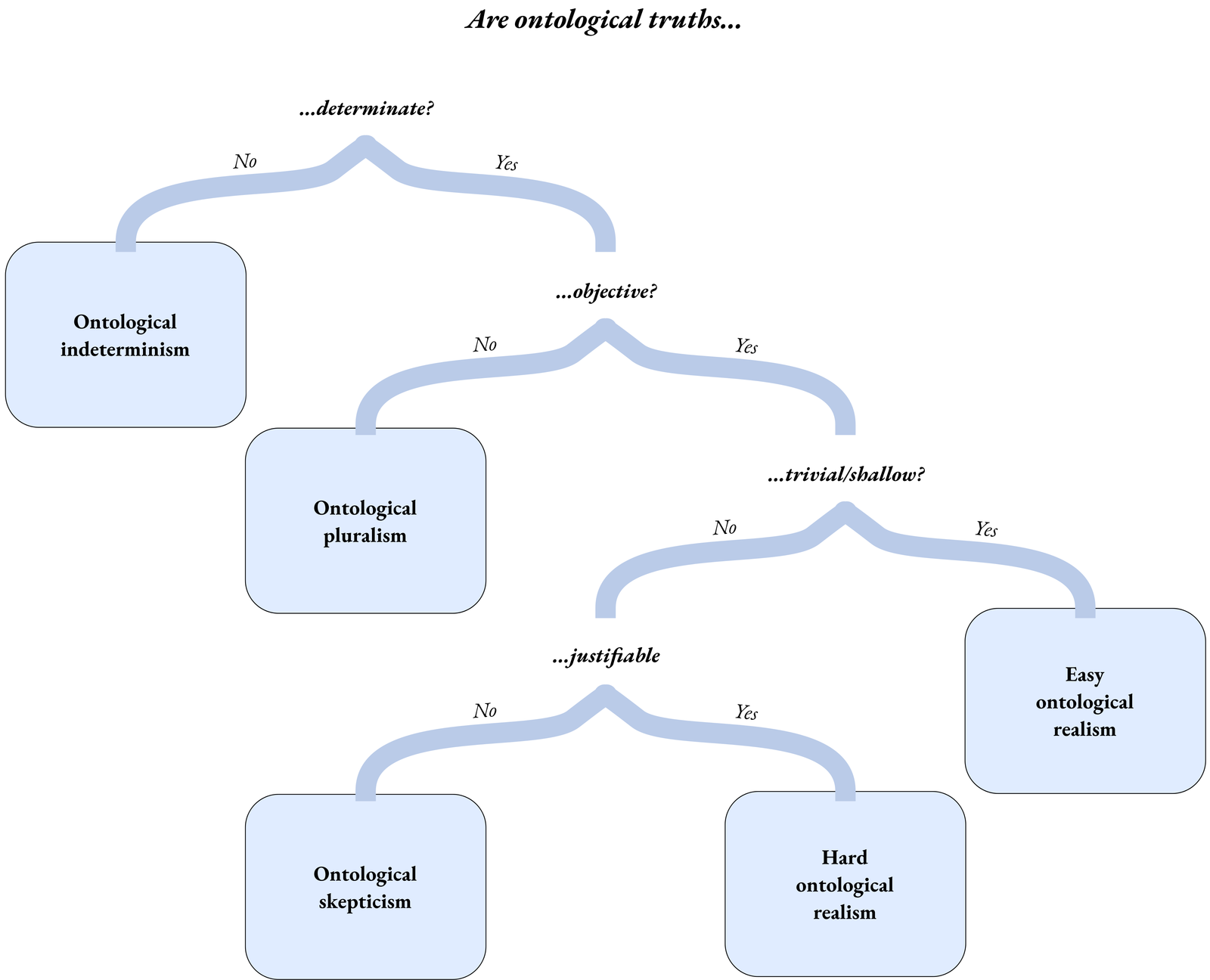
Hard ontological realism takes ontology seriously, does not believe it to be vacuous nor futile, and is ready to make objective, determinate and significant statements about being, that is, not only to pick out a "true" ontology, but to prove it beyond the realms of ordinary discourse or of practitioners’ intuition. Quine and Putnam have shown this attitude to be fully compatible with naturalist or scientific traditions in philosophy.
For instance, Quine’s extremely influential criterion of ontological commitment proposed that a theory is committed to those and only those entities to which the bound variables of the theory must be capable of referring in order that the affirmations made in the theory be true. Depending on the way it’s wielded, it has been variously interpreted as a prime example of easy or hard ontological realism.
Meta-ontology: what is existence?
Position: Hard ontological realism
Let’s remember the three lenses into existence. We need to start from meta-ontology: a summit where the vista is engrossing, but the air rarefied.
Metaphysics is concerned with the structure of the world. Ontology is about what, in our metaphysical discourse, actually exists. Meta-ontology asks the more uncomfortable question of what existence, or being, is. But before stepping in this poetically promising direction, we must face the perfectly reasonable possibility that the question be futile, shallow, or undecidable.
I will adopt a robustly realist stance in this work. Being cannot be a futile concept in my view. If it was, the whole edifice of metaphysics and most of theoretical philosophy would crumble to the ground. Only logical positivists of the strictest obedience could countenance such a minimalist view of philosophical work; as should be apparent by now, that’s not my position. It is harder to shake out the shallowness accusation: isn’t picking a set of ontological beliefs like choosing to do physics with meters and grams rather than feet and pounds? My inclination towards formalized systems expressed in mathematical language makes that conceit untenable: quantification scopes and the extension of functions become too instrumental for a model to be unscathed from a radical shift in ontological commitments. I also do not believe that ontological questions are undecidable. How, exactly, they can be decided is a different matter: I won’t adopt some Leibnizian credence that a priori reasoning would suffice. Yet whatever source of epistemic justification one accepts in a scientific context (verification, evidence, reliability, etc.), I believe might be applicable to ontological statements.
There must be some ways the world is that tell us our ontological assumptions were true (or false).