Sophia + Phronesis = Philosophy
The two uppermost levels of our theoria coordinate make up what is commonly known as philosophy. The astute reader will note I’m putting the adverb "commonly" to hard work here: amongst the numerous definitional disputes and ambiguities we shall encounter in these pages, those surrounding the word "philosophy" must take pride of place.
Not only is it nigh impossible to agree on a definition that’s not excessively revisionist (leading one’s favourite philosophers to be re-qualified as nothing but), even current practitioners have vastly divergent methods, objectives and subjects-matter.
Before plunging in the welcoming waters of metaphilosophy — let’s try not to drown there — it seems wise to remind ourselves of our aims in this section: to outline the structure of a map of knowledge. The question that emerges then is whether we can justify the presence of an independent domain of "philosophy" within our map: is there such a thing as "distinctly philosophical knowledge" at all? And how can we justify its special status, separate from scientific or practical knowledge?
This can be answered by metaphilosophy, which examines what philosophy may or may not be. The concept itself is not ancient but certainly, anyone who saw themselves as practicing philosophy must have been harbouring, even implicitly, an idea of what that activity is, of how it differs from the scientist’s, the engineer’s or the artist’s. The result is of course a kaleidoscope of views, for which I propose a typology. It is organized around two dichotomies:
Speculative vs Critical
I borrow these terms from C.D. Broad, even though I may use them a bit differently.
Broad defines critical philosophy along these lines: the analysis and definition of our fundamental concepts, and the clear statement and resolute criticism of our fundamental beliefs. Thinking of a character like Socrates, there is no doubt the activity thusly described is aligned with what has historically been labelled as his "philosophical" attitude.
On the other hand, the object of speculative philosophy is to take over the results of the various sciences, of the religious, ethical, aesthetic experiences of mankind, to reflect upon them, and to try to think out a view of Reality as a whole which shall do justice to all of them. This definition evokes the grand systems that Thomists, Leibnizo-Wolffians or Hegelians have embraced. Crucially, Broad makes the point that speculative philosophy is not of the slightest use without critical philosophy in place to analyze and define the concepts it strives to build upon.
Another way we could present this distinction is between first-order and second-order disciplines. Speculative philosophy is first-order as it seeks to generate original knowledge about the world; though it may have a special standing amongst them, it is on the same footing as the sciences. Critical philosophy produces second-order knowledge as it conducts a reflection about knowledge itself.
Inflationary vs Deflationary
This dichotomy does not establish a clear-cut criteria but rather a spectrum of attitudes. Among philosophers, one can find a surprisingly wide range of positions about the importance of philosophy vis-à-vis other areas of knowledge, and the range of topics that it should be preoccupied with. Interestingly, a form of "philosophical gravity" seems to always bring the needle back towards the center, or perhaps a form of cyclicality is at play.
Inflationism was on display for instance during the high scholastic period, when philosophy was put on a pedestal, well above the special sciences and just below theology (a discipline which reputedly only God Himself could master). Yet inflationary tendencies have come in check, first in the seventeenth century, then in the nineteenth, both times in the wake of a scientific golden age. Extreme deflationary attitudes are exemplified by physicist Stephen Hawking who claimed that "philosophy is dead" or by some followers of logical positivism who believed they could "finish off the topic" in a matter of years.
But philosophy is a persistent beast, it seems; the re-emergence of ontology or aesthetics within the analytic school in the last century was certainly unexpected to many. To quote Aristotle: "You say, one must philosophise. Then you must philosophise. You say, one should not philosophise. Then (to prove your contention), you must philosophise. In any case, you must philosophise."
Having introduced this two-dimensional typology, I’ll now examine each of the four combinations in turn.
Speculative/inflationary: systematic philosophy
Philosophy, in this guise, is to be placed alongside other sciences, as a form of first-level enquiry, since like them it contributes to the edifice of knowledge. We define the inflationary position as the claim that philosophical findings are not only different from scientific knowledge, but represent its foundation, or its apex, or sometimes both.
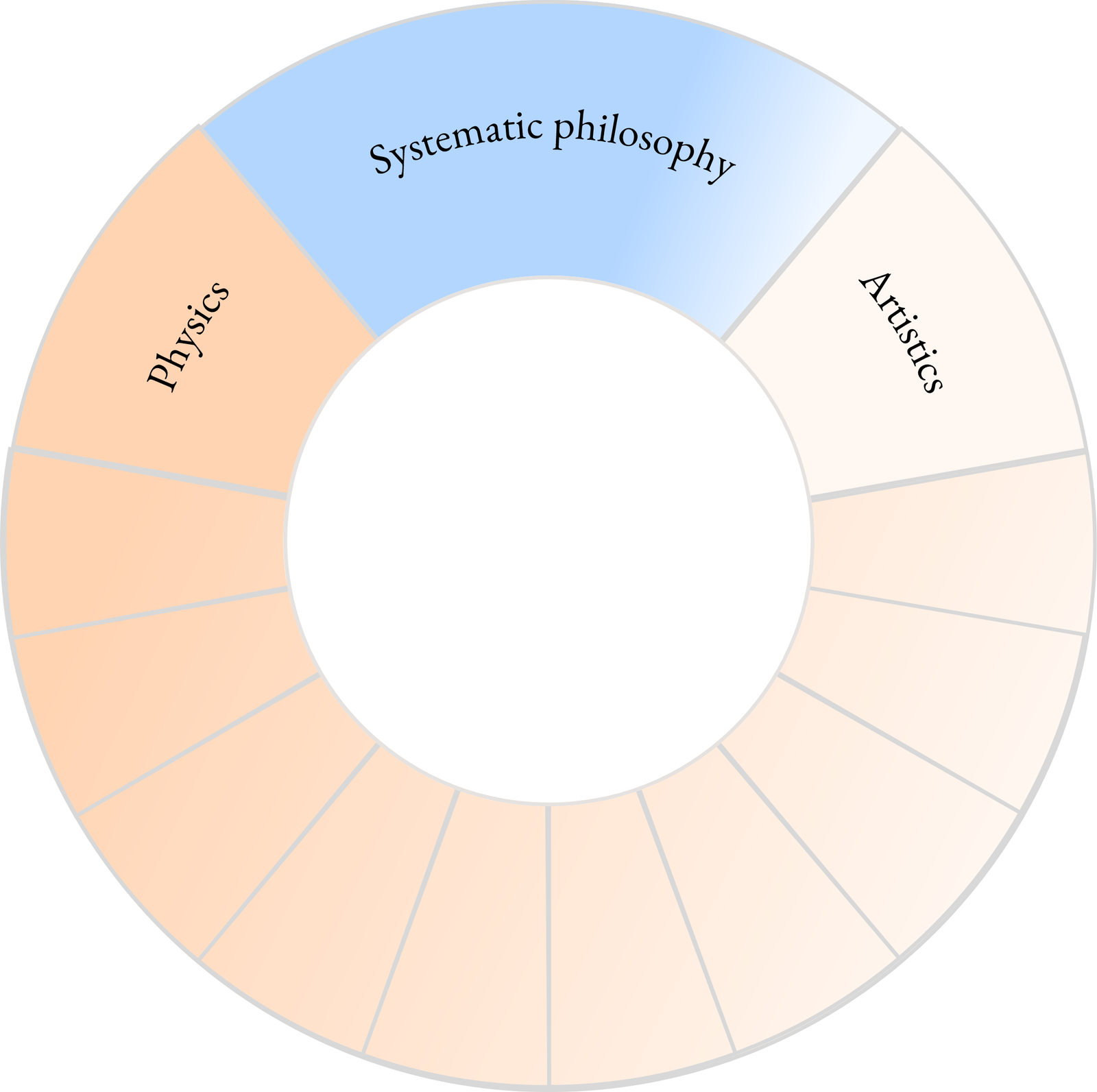
As a result, philosophy occupies a prominent, even a supreme position, amongst the sciences. To those who adopt this view, she is the "queen of sciences", the "mother of sciences", or (confusingly) the "science of sciences". Philosophical speculation is meant to furnish a general model for scientific thought, and to produce systematic knowledge itself. All of knowledge is then based upon a unified system of deductively connected necessary truths, derived from universal principles.
Such ambitions were on display in the grand systems of yore, which one encounters during any cursory perusal of historical philosophy: Aristotle’s Corpus, Aquinas’s Summa, Spinoza’s Tractatus or Leibniz’s Monadology. These thinkers saw philosophy as an expansive field that included the natural sciences (and more — in the eighteenth century, Christian Wolff still saw architecture and athletics as components of philosophy), but most had distinguished a sub-field (for instance Leibniz’s Philosophia Intellectualis) in which one would recognize the current scope of the discipline.
Aristotelian and Thomist systems
We can directly quote Aristotle, who asserted in his Metaphysics that "First Philosophy is superior to all the other theoretical sciences because it is concerned with the ultimate causes of all reality, not just the secondary causes of a part of reality. Generality and fundamentality: these are the two characteristics that for all these model-builders distinguished "core philosophy" from the special sciences. Thomist thinker Jacques Maritain handily summed up the corresponding attitude: philosophy, he says, "is concerned with everything, is a universal science... This does not mean that philosophy absorbs all the other sciences or is the sole science, of which all the rest are mere departments; nor is it itself absorbed by the other sciences, being no more than their systematic arrangement. Philosophy is not concerned with secondary causes, or proximate explanations: but on the contrary with first causes, highest principles or ultimate explanations. Of all branches of human knowledge, philosophy is the most sublime.".
Hegelian idealism
A resemblant but distinct approach started with Hegel. Its genesis lies in the rejection of Kant’s critical philosophy, of the Sturm und Drang movement’s proto-existential ideas, but also of the aforementioned systematic "metaphysical" approach. The latter, he argued, "regarded with envy the systematic structure of mathematics, and borrowed its method from [this] subordinate science". He thought that the foundations of science should belong to philosophical enquiry, not the other way around: "In the class of positive sciences, which have a rational basis and a rational beginning, philosophy claims that constituent as its own. The positive features remain the property of the sciences themselves."
Thus Hegel rejected the idea of a methodological unity between philosophy and science, inaugurating the era of subjectivity as key to the idiosyncrasy of philosophical truth. This did not entail a resignation to "unsystematic philosophy", which he thought "gave expression to personal peculiarities of mind". Hegel criticized "philosophical treatises [that] confine themselves to such an exposition of the opinions and sentiments of the author", at the risk of making "the truths of philosophy valueless, to be treated as baseless hypotheses or personal convictions". "Unless it is a system, a philosophy is not a scientific production.". In the clear principle of differentiation between scientific and philosophical enquiries which it draws, in the subordination of science that it aims to establish, Hegelian philosophy epitomizes the position we’ve set out to describe.
Classic and hermeneutic phenomenology
Another important example can be found in a polymorphous movement that bore fruit throughout the twentieth century: phenomenology. The original position of its founder, Edmund Husserl regarding the role of philosophy can seem strikingly similar to Hegel’s, even though their broader systems were quite different — at any rate, Husserl’s conceptions fit equally well within this section. Husserl’s "first philosophy", which he calls phenomenology, is conceived of as a "rigorous science", at least in its final form. However, its methods are sharply distinguished from the empirical sciences: it is to be instead an eidetic science that relies on phenomenological reduction to suspend judgment on the natural world and instead focus on subjective experience. While each special science operates in a regional ontology defined by a nexus of essences and presupposes the existence of the world, phenomenology investigates every kind of essence and tries to make sense of how the world’s reality is constituted in consciousness. As such it is both universal and foundational for the empirical sciences.
Husserl’s student Martin Heidegger developed his own version of phenomenology; in many fashions it broke with Husserlian views, but was hugely influential in its own right. Heidegger expressed in his own way the reason why philosophy, an enquiry seeped into the subjective perspective of conscious beings, was more fundamental than science: "We exist as "being-in-the-world," which means, among other things, that we always find ourselves inhabiting a "space of meaning" that we ourselves create. When we think scientifically of the universe or nature as containing our world, we are not thinking of the world in the proper philosophical sense as the space of meaning in which anything is intelligible. When we think of the world in this philosophical way, however, then we have to reverse the formulation and say that the universe or nature is within the world, for it is always within the world that the universe or nature is disclosed to us. In this way, the world as the space of meaning has priority in the order of philosophical inquiry and understanding over the universe as represented by empirical science." Any attempt to apply scientific methods to philosophical enquiries would be entirely oblivious to the priority of the world as the space of meaning; hence the need for specifically philosophical methods, especially transcendental and existential phenomenological ones, to understand it.
As to the relationship between philosophy and science, Heidegger is characteristally obscure, making two equally bold assertions in short order: "That philosophy is scientific is implied in its very concept" and "No, philosophy is not a science.". Sometimes the hesitation is apparent within the same quote: "Was the effort of modern philosophy from Descartes through Kant and Hegel up to Husserl to raise philosophy to the rank of science not only futile then, but completely wrong headed? Yes and no. Is the title "scientific philosophy" then as meaningless as the concept "wooden iron"? Yes and no." Here the idea of "scientific philosophy" can only be interpreted as referring to the eidetic phenomenological science, while the alternative is perhaps alluding to a more hermeneutic or edifying view of philosophy.
But ultimately, Heidegger seems to settle on a definition: that philosophy is the science of Being ((its "sole and proper theme"). To expound this idea, Heidegger goes back to the wellspring of Aristotelian, and even presocratic philosophy. Being is essentially different from a being, from beings. "All non-philosophical sciences have as their theme some being or beings.[...] They are posited by them in advance; they are a positum for them. All the propositions of the non-philosophical sciences, including those of mathematics, are positive propositions. [...] Positive sciences deal with that which is, with beings; that is to say, they always deal with specific domains, for instance, nature. [...] The beings of these domains are familiar to us. The object of philosophy however is not easy to grasp: since Being is not a being, it is not something, it doesn’t refer and is almost like nothing. This ontological difference betwen Being and being is fundamental for Heidegger and his main aspiration is to prove that Being is a meaningful concept.
Existentialism
This line of thinking in what has been called existential phenomenology has sometimes veered towards outright existentialism, which arguably wouldn’t belong in this section since it seems to consider the undeniably specific philosophical thought as separate from rather than foundational to the sciences. Karl Jaspers explained that the sciences are to be employed as a tool of philosophy. Philosophy is not to be ranged alongside them as merely another science. For even though it is linked to science and never occurs without it, philosophy is wholly different from science. Drawing a clear distinction with the goals of science — cognizance of the universe —, Jaspers said: philosophy grew in me through my finding myself in the midst of life itself. Philosophical thought is practical activity, although a unique kind of activity. The ultimate objective is to work out a methodology, which arises from the ground of a universal consciousness of Being and points up and illuminates Being.
Speculative/deflationary: naturalism and worldviews
In its inflationary version speculative philosophy cumulates the following characteristics: universality, fundamentality and priority (the idea that science shall bow before philosophical truths). Universality is generally uncontroversial; there are specialized philosophers, but few would deny the holistic nature of the discipline. Ideas of fundamentality and priority can however be refused, or simply ignored, giving rise to deflationary versions of speculative philosophy.
Naturalist philosophy
Proponents of naturalism generally hold that all of reality, including human life and culture, is exhausted by the natural world, and that all knowledge is derived a posteriori from human interactions with the world. This ontological/epistemological position gives rise to a methodological one, which dismisses the search for "philosophical foundations" of the sciences, regarding the basic principles of any science as part of that science itself. Insofar as naturalists allow for philosophy to remain independent, its correct place ought to be among the special sciences, not "above" nor "below" them.
Naturalists don’t assume, however, that there are no differences between philosophy and other sciences, but would generally consider them as superficial, and mostly due to the discrepancy in subject matter (just like the natural and social sciences may adopt different methods).
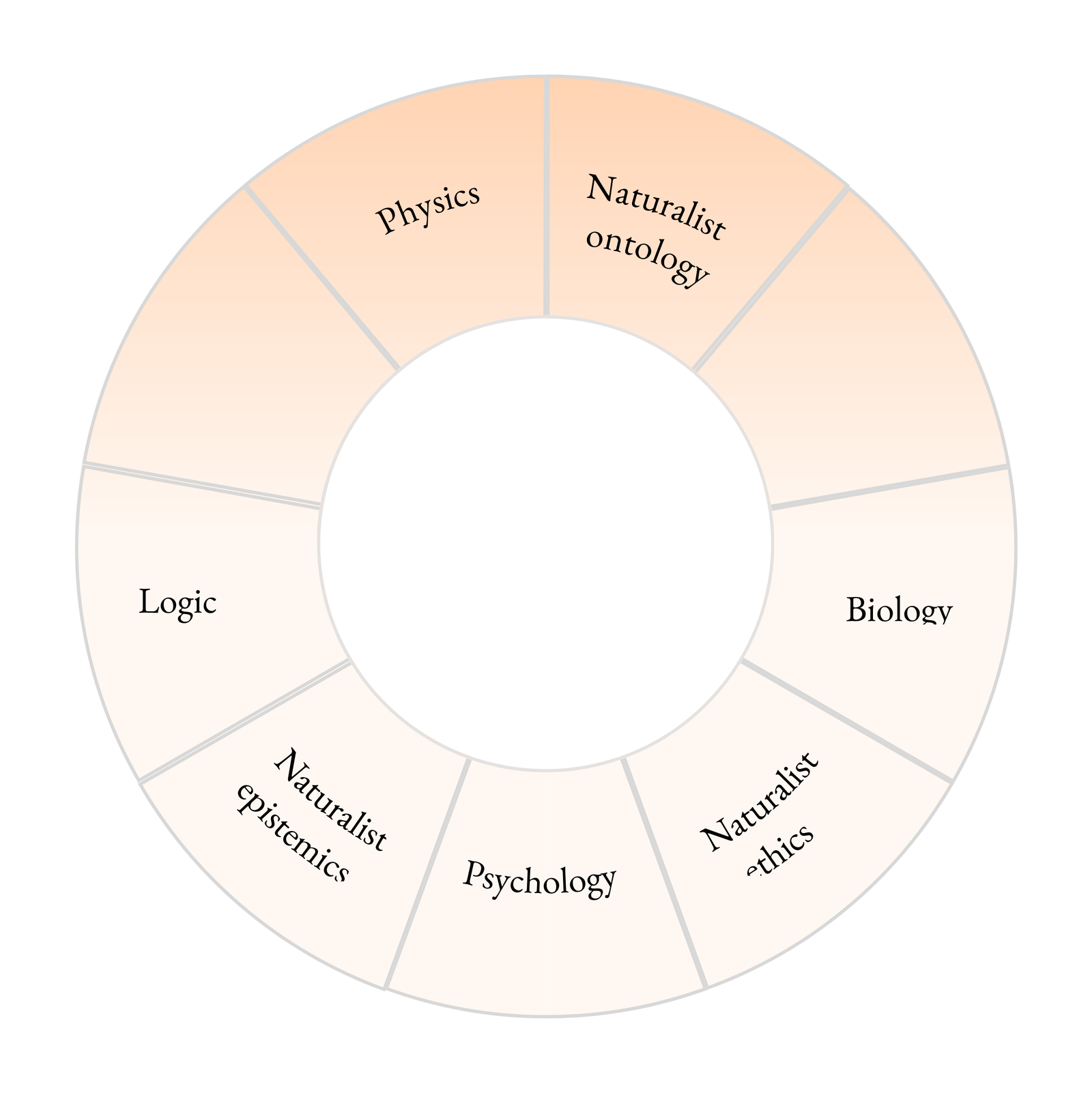
With some nuances, naturalism is consistent with Humean empiricism or American pragmatism. In the nineteenth century, it was epitomized by John Stuart Mill’s approach, sometimes known as psychologism, as the newly independent science of psychology came to be seen as the future "home" for a naturalized philosophy. Post-Kantian thinkers like Hermann von Helmholtz walked the same path and strived to naturalize Kant’s a priori as a form of innateness to be explained by psychophysical discoveries.
In the twentieth century, a naturalist stance amidst the analytic philosophy movement was defended by Willard Quine. Quine rejects the view that philosophy maintains some distinctive outlook or knowledge that separate it from other sciences, and which could further serve as an independent standpoint from which to critically assess or ground scientific methods and procedures. (To paraphrase a now proverbial idea: "Who wants to be the philosopher to tell physicists they’re doing physics wrong?"). Like his empiricist predecessors, Quine does not believe philosophy to be dead though, and recommends the pursuit of philosophical issues from within the available resources of science itself. If philosophical work is to contribute to human knowledge it must locate its concerns within this ongoing attempt to acquire successful knowledge of the world, and aspire to the very same scientific standards of clarity, utility and explanation. From this perspective, philosophical reflection cannot simply rely on the uncritical use of our everyday terms but will need to propose new ways of formulating its concerns based on the rigorous standards found in the sciences. With philosophy and science on a continuum, in a sense, philosophy becomes science for Quine.
We can see how the terms are exactly reversed between systematic and naturalist philosophy. For Hegel or Fichte, fundamental debates in biology such as vitalism vs mechanism would need to be solved by philosophers, using their own methods, distinct from the biologist’s. For naturalists such as Quine, a philosophical enquiry like epistemology could keep its independence, but needs to use results from the "best theories" whenever it can; should new theories be put forth and empirically confirmed, inconsistent philosophical results can be scrapped... and not the other way around.
Worldview philosophy
Another type of speculative philosophy can be deemed deflationary; it is characterized by the concept of Weltanschaaung (worldview). Unike naturalism, it does not prescribe a methodological subservience towards the natural sciences. It puts an emphasis on universality and sees a holistic approach as a key feature of philosophical knowledge. Philosophers shouldn’t see reality with the specialized stance of the scientist, the artist or the businessperson (who can end up seeing the world as simpler than it is), but the generality they strive for doesn’t imply the regal position propounded by the inflationary systems which we evoked. Philosophy does not have priority nor fundamentality; it is independent, but on a level with the other sciences.
Wilhelm Dilthey, who did more than anybody else to flesh out the Weltanschauung concept, was fond of calling the object of philosophical reflection the"riddle of life"—"i.e., the problems relating to birth and death, joy and sorrow, love and hate, the power and the weakness of man and his ambiguous position within nature". For Dilthey, philosophical argument cannot be divorced from the textual and contextual conditions of its historical emergence: the succession and the diversity of philosophical systems show those cannot be the source of reliable knowledge in themselves. However, they do help coalesce worldviews — comprehensive and unified perspectives on life, which Dilthey characterizes as a Weltbild (world-picture), a Lebenswürdigen (evaluation of life) and ideals of Lebensführung (conduct of life) . The real value of philosophy as a source of knowledge is thus as a Weltanschauunglehre, a doctrine of worldviews.
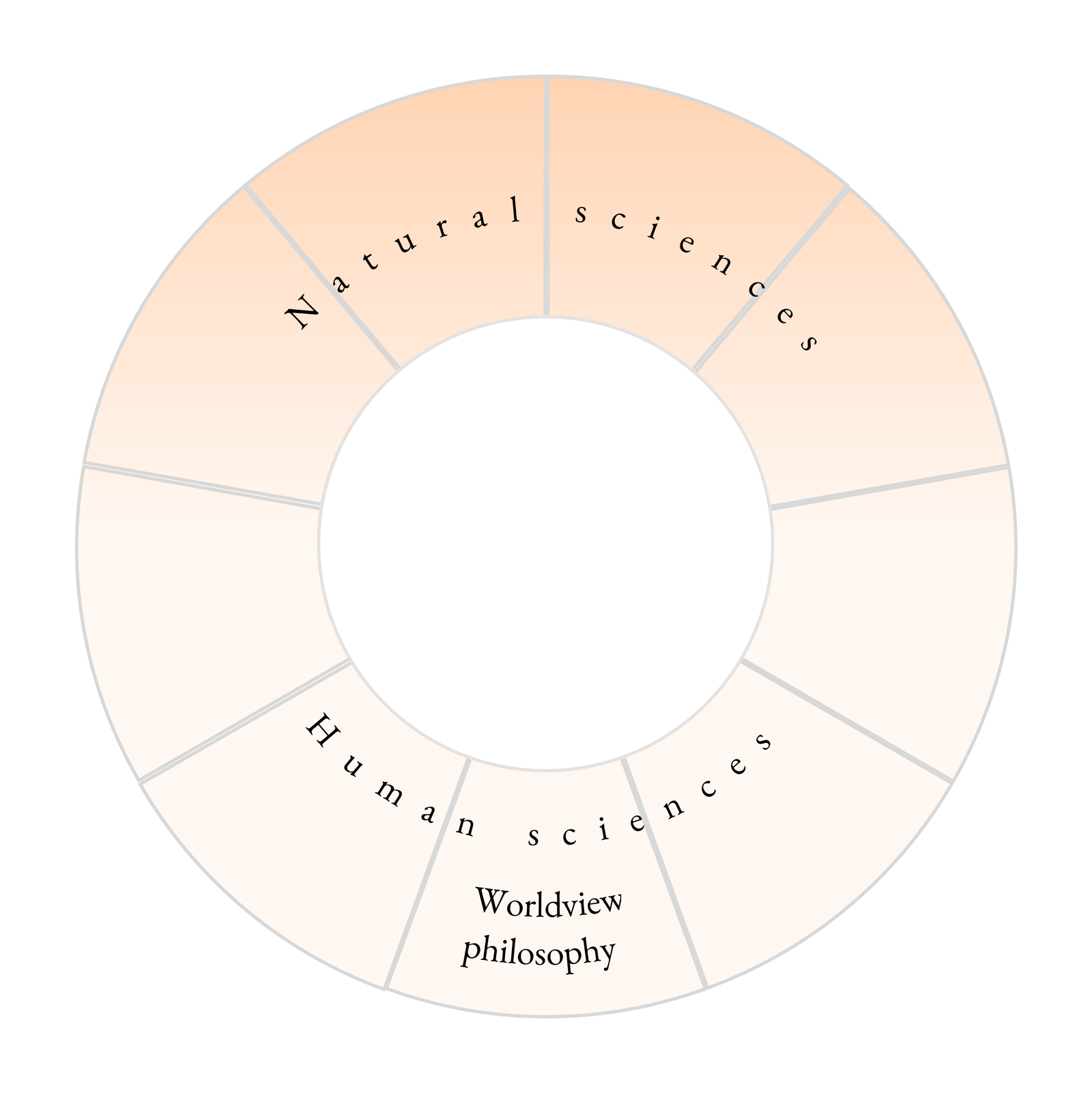
As we shall see, Dilthey also wrote of the Geisteswissenschaften, and he considered this doctrine of worldviews as belonging naturally to that group, as "a special case of methodological Verstehen in the human sciences, involving description, abstraction, analysis, typification, comparison, and generalization." While Dilthey’s initial vision aimed for this doctrine to identify laws and regularities akin to the findings of the natural sciences, he later jettisoned that model in favour of the emergent hermeneutical approach (theory of interpretation). Just as literary interpretations are gathered together to supply a text’s meaning, so too the collective Weltanschauungen can inform us about, said Dilthey, "the unfathomable depth of the world". With significant nuances, this general approach would inform a number of influential movements beyond philosophical hermeneutics, such as critical theory, structuralism or post-modern deconstruction.
Critical/inflationary: transcendental philosophy
Kant’s critical philosophy introduced the concept of transcendental knowledge, which "is occupied not so much with objects as with the mode of our knowledge of objects". This is consistent with our above definition of "critical philosophy" as a second-order enquiry.
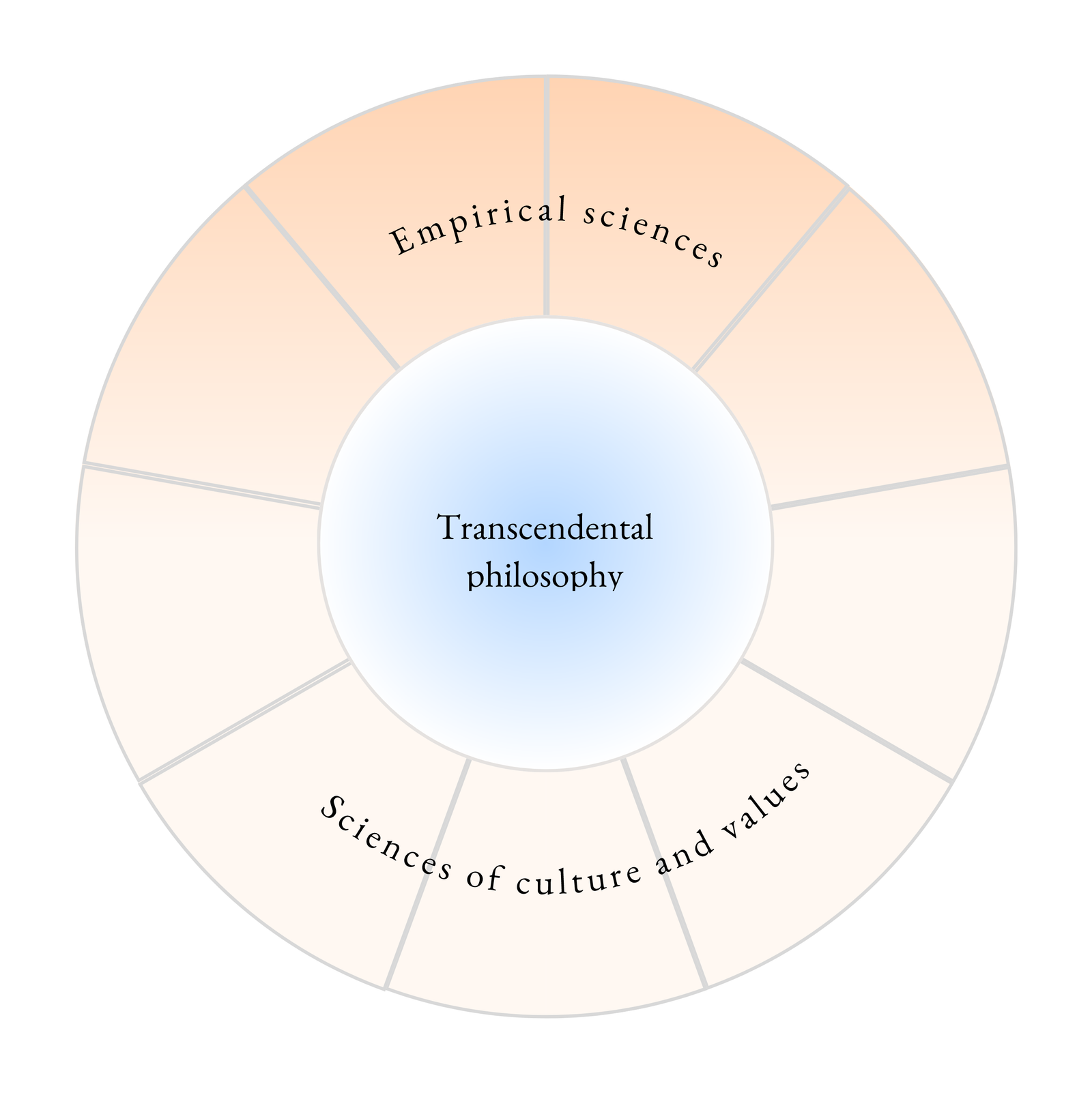
One century later, the "neo-Kantians" would reformulate Kant’s approach to find a via media between the avatars of a waning Hegelian idealism and the perceived psychologism of Millian empiricists — or even of post-Kantians like Helmholtz or Lange. Indeed, neo-Kantian philosophers did believe speculative metaphysics to be untenable amidst the rapid and startling progress of the positive sciences, and they equally rejected the dissolution of philosophy into a form of empirical psychology (and the progressive loss of a distinctive method and subject matter). At its core, this identity crisis was about reason: although its autonomy could not fall back onto a discredited Hegelian Geist, the neo-Kantians also refused to accept its reduction to psychological, and ultimately physical processes.
"Coming back to Kant", they took science, or more generally "knowing" (Erkenntnis) as their object of inquiry, confirming the second-order position of a discipline that becomes quaestio juris rather than quaestio facti, but also adopted the ambitious task of establishing the highest principles and laws (Gesetz) of rational understanding.
Contemporary historiography distinguishes between two main schools of neo-Kantianism, which both implemented this programme via a reformulation of Kant’s transcendental method, albeit in different way.
The Marburg school
This group took as a starting point the "fact of science", which is virtually equated with a law or theory, for instance Einstein’s General Relativity. In general philosophers should be concerned with the "best theories", which are by nature subject to change. The "critical" approach doesn’t mean that philosophy can cast doubt or reject theories; rather, it starts by taking them and their objectivity for granted.
Emulating Kant in his Prolegomena, Hermann Cohen explained that philosophy’s role is to articulate the a priori conditions (concepts, laws or norms) that are necessary for the "fact" to be objectively valid. Crucially, the fact of science is not a representation of the discoverer or knower’s mind, it is the objective content that lies before us in books. Therein lies the radical break with psychologism: the new a priori is wholly distinct from innateness and independent of any facts about human minds.
The initial goals of the school are thus fulfilled: the anchoring in "facts of science" acts as a check against aethereal speculation; their definition as objectively valid content is a bulwark against psychologist empiricism; philosophy’s autonomy from science as a unique second-order discipline is assured.
Cohen’s colleague Paul Natorp built on these foundations and expanded the starting point of philosophical enquiry to include all "facts of culture", including scientific theories, but also works of art, moral actions or social institutions.
The Southwest school
Philosophers from that school, on the other hand, put the emphasis on culture in a broad sense from the get go. Their approach to the transcendental question is teleological: given certain fundamental goals such as knowing the truth, doing good, or experiencing beauty, what set of norms is necessary to achieve those values?
What then confirms philosophical autonomy is not the subject matter itself but the method: for Wilhelm Windelband, the formal/teleological approach promoted by the school stands opposed to the factual/genetic explanations of the empirical sciences. There can be, and there are, "sciences of values" that apply genetic methods to derive knowledge about the acceptance and development of "factual values" in individuals’ life or throughout cultural history. But they shall not be conflated with critical philosophy, which reveals the grounds of normative appraisal and valid judgment.
Heinrich Rickert, who spearheaded the school, connected this vision of a philosophy of values to the concept of worldview. Indeed, unlike the specialized sciences, philosophy should be able to consider the world as a whole (Weltganze). Yet Rickert rejected Diltheyan views of Weltanschauung as the expression of existential intutions about the world. Instead of its obscure metaphysical origin, a worldview should be the goal of critical philosophy.
Critical/deflationary: logical philosophy
Frege and Wittgenstein’s proto-analytic views
The last style of philosophizing from our typology has been ever present as a strand of thought but only fully accomplished in the twentieth century. It followed in particular Ludwig Wittgenstein’s Tractactus Logico-Philosophicus, which described the discipline as such: "4.11 The totality of true propositions is the whole of natural science (or the whole corpus of the natural sciences). 4.111 Philosophy is not one of the natural sciences. (The word "philosophy" must mean something whose place is above or below the natural sciences, not beside them.) 4.112 Philosophy aims at the logical clarification of thoughts. Philosophy is not a body of doctrine but an activity. A philosophical work consists essentially of elucidations. Philosophy does not result in "philosophical propositions", but rather in the clarification of propositions. Without philosophy thoughts are, as it were, cloudy and indistinct: its task is to make them clear and to give them sharp boundaries."
Wittgenstein drew upon the strong anti-psychologism of Gottlob Frege, who insisted on a sharp distinction between patterns of inference employed by individuals — part of empirical psychology — and objectively valid arguments — the realm of logic. Wittgenstein further distanced philosophy from the empirical sciences and anchored it as a second-order enquiry. However, unlike the neo-Kantians, he denied philosophy any capacity to demonstrate the absolute validity or objectivity of norms and values. Instead he ended up demonetising whole swathes of historical philosophy and traditional lines of questioning as "meaningless" or "nonsense". The Tractatus describes philosophy broadly as an activity, but Wittgenstein would even characterize it, rather than as an inquiry, as a form of "therapy" destined to cure us of our linguistics diseases.
The Vienna Circle
This group of logical-empiricist thinkers espoused many of Wittgenstein’s views. Self-proclaimed proponents of "scientific philosophy", they did not think of it as an autonomous discipline but as a critical one, dependent upon the results of sciences, logic, and mathematics. Wielding their logically enforced principles like so many scythes, they cut down most philosophical problems and claims, turning apparent metaphysical questions into matters of linguistic efficacy.
While this vision substantially deflates the status of philosophy, it does not relegate her to the position of intellectual handmaiden of the sciences. Far from playing a passive or merely organizing part, the analytic work of philosophy — to analyze, clarify, and simplify the ground, structure, and results of empirical theorizing — was projected to play a significant role in the advance of knowledge by helping to diagnose, cure, and prevent outbreaks of pseudoproblems or "nonsense". Turning around Kant’s dictum, they claimed that philosophy without science is empty, and science without philosophy is blind.
Although they all adhered, broadly speaking, to this basic programme, members of the Vienna circle developed diverging sensibilities around these themes. It remained a matter of disagreement what type of distinctively philosophical insight, if any, should remain legitimate. We will examine some of these views, in the hope they may prove illuminating regarding the often overlooked diversity of thought within a movement that’s often perceived as monolithic.
Carnap and the "logic of science"
Rudolf Carnap, likely the most influent member of the group, insisted on both the negative and positive aspects of his approach to philosophy. Negatively, the effort to "analyze, clarify and simplify" often had the effect of labelling "unscientific speech" as meaningless or, conversely, of sending away synthetic claims identified as empirical towards the natural science they belong to. What is left, says Carnap, is the method of logical analysis. Positively then, philosophy is not marked for an imminent demise: Carnap envisions its transformation into the logic of science, a purely formal meta-linguistic discussion of all knowledge. This second-order discipline is not a science, but for him it will allow for the expression of truths about science, or about the formal meta-language itself.
Be that as it may, Carnap doesn’t veer into an altered form of neo-Kantianism. He clearly passes a verdict of meaninglessness on all "philosophy of norms or value", or in general any normative discipline.
To pure metaphysics, Carnap recognizes some importance, although it is not philosophical and even less so scientific, since its pronouncements are not true — and not even false either. Rather, he highlights its existential and (occasional) artistic contributions. Metaphysical statements "serve for the expression of the general attitude towards life. Carnap goes on to paint metaphysical investigations as mistaken, even deluded, attempts to express "harmonious feelings" about the world using concepts, arguments and polemics. In doing so, traditional philosophers have brought nothing of value to knowledge and something very inadequate for self-expression. "Metaphysicians are musicians without musical ability." One of them still finds favor with Carnap: it is Nietzsche, whom he praises for avoiding this error and openly embracing the poetic form in his most "metaphysical" works.
Schlick and Waismann: philosophy as an informal way to determine meaning
Moritz Schlick’s view differed in some significant ways from Carnap’s. He did agree that philosophy possessed a separate disciplinary identity from science ("Philosophy is not a science, even though it pervades all sciences"). But he did see philosophy as a strictly non-formal activity of meaning determination, that could not consist of a system of true assertions and could not produce knowledge: its search for the meaning of statements instead creates understanding, which Schlick says leads to wisdom.
The non-existence of "philosophical truth" should not be viewed as a demotion, however. Schlick goes out of his way to suggest that philosophy may still be honored as the "queen of the sciences", for it is nowhere written that the Queen of the Sciences must itself be a science, before insisting again that science is a system of cognition while we see in philosophy a system of acts. "By means of philosophy statements are explained, by means of science they are verified. The content, soul and spirit of science is lodged naturally in what in the last analysis its statements actually mean; the philosophical activity of giving meaning is therefore the Alpha and Omega of all scientific knowledge".
Another member of the group, Friedrich Waismann highlights the positive, yet non-formal, nature of the activity: "What is essential in philosophy is the breaking through to a deeper insight, which is something positive, not merely the dissipation of fog and the exposure of spurious problems. Insight cannot be lodged in a theorem, and it can therefore not be demonstrated. Philosophic arguments are, none of them, logically compelling: they screen what actually happens — the quiet and patient undermining of categories over the whole field of thought. Their purpose is to open our eyes, to bring us to see things in a new way, from a wider standpoint unobstructed by misunderstandings. [...] Logic constrains us while philosophy leaves us free: in a philosophic discussion we are led, step by step, to change our angle of vision, and this with our spontaneous agreement — a thing profoundly different from deducing theorems from a given set of premises. [...] The essence of philosophy lies in its freedom.
Neurath’s "unified science"
Our last example, Otto Neurath, arguably should not even belong in this section: under the banner of “unified science”, he rejects philosophy’s independence as a separate discipline from science.
However he does arrive at this conclusion from a different side compared to the naturalist philosophers. Those typically take as a starting point the possibility of making true claims about traditional philosophical problems, before ascertaining that it could be achieved using the methods of the empirical sciences. In contrast, Neurath adopts the logical-positivitist credo that most such problems are meaningless and that philosophy shall aim to clarify the meaning of concepts, but concludes that even this clarification activity itself is part and parcel of the sciences. "The objection, says Neurath, to the expression "philosophizing" is not merely terminological; [this activity] cannot be separated from the "scientific method", to which it belongs. They are inextricably intertwined.
Sophia vs Phronesis
The proposed list of levels doesn’t just have one dedicated to philosophy, but two. How come? The preceding discussions have surveyed the field from a high vantage point and insisted on universality as a key characteristic of philosophy. As Paul Grice put it: "despite its real or apparent division into departments, philosophy is one subject, a single discipline. By this I do not merely mean that between different areas of philosophy there are cross-references. [...] I mean (or hope I mean) something a good deal stronger than this, something more like the thesis that it is not possible to reach full understanding of, or high level proficiency in, any one department without a corresponding understanding and proficiency in the others.[...] Or, one might even dare to say, there is only one problem in philosophy, namely all of them."
This is indeed a key point: unlike scientists, philosophers cannot benefit from excessive specialization. Nevertheless, it is equally clear that philosophical inquiries can be, and are generally focused on some specific aspect of reality. That is the simple distinction we aim to operate here between "fundamental" and "applied" philosophy. Sophia — a nod to the etymology of "philosophy" — and phronesis are, appropriately, often translated as theoretical and practical wisdom. As to the wisdom concept, it should not be thought of as mutually exclusive with the kind of episteme one gains from science, but as a reference to the holistic and comprehensive nature of philosophy.
Without getting into details that shall be tackled later, fundamental philosophy may be traditionally divided into metaphysics, logic, epistemology and axiology; they are respectively preoccupied with reality, reasoning, knowledge and value. Applied philosophy builds on these exact blocks to focus on a specific area of concern. We can imagine two axes, with sophia on one (one division of philosophy in its full generality) and phronesis on the other (all divisions of philosophy applied to one subject matter).
Consider the philosophy of music: in studying it I can encounter the ontology of music (what is a musical performance? what is a melody?), the epistemology of music (how does one access knowledge and justify beliefs about music?), its ethics (what type of human action is composing music? does music influence society?) and of course its aesthetics. It is clear that not all areas will be equally weighted and that aesthetics will be the main locus of reflection.
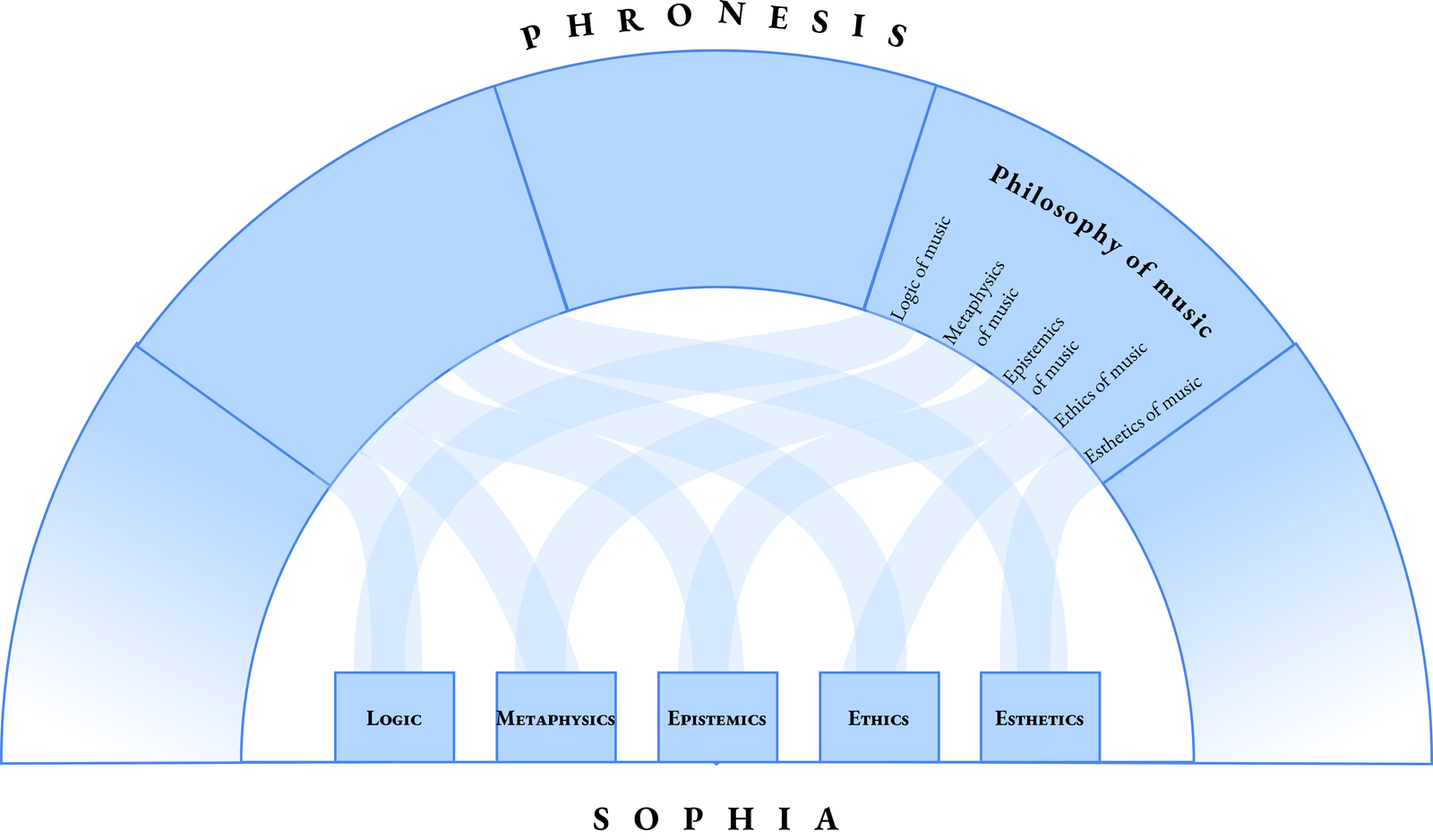
I’ll generalize this idea by introducing the concept of descendance: an especially noteworthy link between sophia and phronesis fields. But beyond this privileged relationship, every division of sophia will be relevant to every phronetic field. This interplay should be rewarding, illuminating, and ultimately strengthen the whole enterprise. The relationship between the two philosophy levels is less of a rigid arborescence, and more a holistic diffusion from the sophia core to the phronesis periphery.
Interlude: a temporary conclusion
In attempting to dispel some of the clouds that too often engulf the notion of philosophy, I’ve introduced some approaches that stand in contradiction with my initial presentation of the six planes. Adopting deflationary views would lead me to affirm that philosophical beliefs are not fundamentally distinct from scientific or practical beliefs. This would be a challenge to the classification I’ve started to expound, which introduced sophia and phronesis as separate from other levels.
I will adopt a mixed stance. As this book progresses, details will get fleshed out, but I can already say that my approach is generally pragmatic rather than doctrinal. I won’t even pick sides between the speculative and critical routes, as I think they both apply:
Phronesis-level disciplines, I would consider as essentially second-order endeavors. I do not line up with neo-Kantian conceits, which would contradict or restrict the above view too much (in neo-Kantianism, ontology finds itself entirely subsumed into epistemology). But bringing to mind C.D Broad’s more general definition, I would agree that the analytic, maieutic role of "philosophies of X" is undeniable. To be more precise, these disciplines harness the findings from the sophia level to perform their definitional and critical role vis-à-vis the sciences or more mundane knowledge.
For sophia-level disciplines, my approach will be largely realist. I will often commit to the existence of key entities such as properties, worlds, meaning or feelings. Fundamental investigations into their nature is the wont of basic philosophical disciplines like ontology, logic or epistemology, which will end up in sophia level. The natural and human sciences of course deal with abstract entities but take their existence as a brute fact and their nature as a non-question. That subject matter then sets apart sophia disciplines from that group, but the fact remains that they attempt, in my view, to find out true facts about the structure of the world, and as such belong to first-order enquiries. As a group, we can view them like a sort of formal science whose methods starkly differ from their natural brethren, and thus are very close to mathematics (at least in the way I would conceive of those methods).
That’s not all. Although the "respectable" motives may be theoretical, there are pragmatic advantages to this realist, philosophy-affirming position. Since my aim here is largely to classify, I shall think like a librarian, and favor a more granular approach that will help find any quantum of knowledge in a pointed category, rather than lose it in a somewhat homogeneous bog.
Consider the following: a librarian who’s a strict follower of the Vienna Circle goes rogue and decides to upend the traditional sorting scheme. Happening upon Jaspers’s work, he’d consider it an aggregate of meaningless statements, to be classified alongside religious mystics, or perhaps under the Poetry section. Meanwhile, Carnap’s works he would consider to be philosophical, but to be put under Science, perhaps in the same sub-division as Logic.
Conversely, a follower of Jaspers would, like the man himself, argue for his work to be put under an Ontology division, within an independent Philosophy section. Confronted with Carnap’s work, he would not agree with the content but would likely consider it to be philosophy of science or philosophical logic. Of note: though Carnap himself would probably consider metaphysics to be false and not a topic of inquiry, his own thinking on the topic could be placed there: "the overcoming of metaphysics is as metaphysical as the metaphysics it seeks to overcome".
The conservative approach heretofore exemplified by our Jaspersian librarian is the one that offers most depth and granularity for the purpose of my classificatory effort. I believe that the basic principles of my classification are strongly supported by the reasoning outlined in this book, but I’m not shy in admitting that pragmatic (and aesthetic!) considerations have played a role.
That is an uncomfortable position sometimes, but the best and most honest way to navigate the waters between a very corseted scheme and an overly lax pandemonium.