Prolegomena
Les Fleurs du Monde will precisely expose a universal system of classification.
A robust and justified system of categories is a condition precedent to the long-term progress of considered human thought. Mind you, the transparent expounding of such a system, in which I shall engage with les Fleurs du Monde, is not a necessity. Many a brilliant work of science or philosophy (perhaps most) defiantly dispense with such rigor. But the ensuing looseness, from the breezy freedom of inspired work, can soon turn into ornate jumble. Less scrupulous followers then spout confusion and conceptual infelicity onto an unsuspecting world.
This is one man’s attempt to gather various threads, some old, some new, from personal studies, and build his own classification of all things. Without further ado, let’s answer some natural questions that this statement of intent may raise.
What? — the object of this classification
If one thing is clear so far, it is that some act of classification will occur. Classification is a means to an end, and we shall soon talk more about the means and the ends. But a more natural question may be what will thus be classified: what is this book about?
Colloquially, the simplest answer may be: everything. Coming, perhaps, as a surprise, even that is not quite general enough: pernickety philosophers may not be satisfied with "every thing" and think it safer to include "all the stuff", as well as states, situations, worlds, phenomena...But let’s not infringe on discoveries to come. We’ll have ample time to walk through that wordly jungle and, hopefully, turn it into a French garden.
What I can already delineate, however, are three aspects which, before our investigations begin in earnest, will serve as the a priori frame of our classification. To present this key tenet, let me summon three important moments in the history of thought.
Pride of place goes to Aristotle. In his Organon and Metaphysics, the Stagirite assumes a robustly realist posture about the most general categories of being: those do not need to be spoken of, nor thought about to be. In that, they resemble animal genera or motion types, elsewhere in the Corpus Aristotelicum. The objects of Aristotle’s classifications are firmly encompassed in objective reality: what exists in our world.
Next stop on our tour is Emmanuel Kant’s tour de force. Building on the Cartesian revolution of "Cogito ergo sum", that placed the thinking subject at the center of metaphysical meditations, Kant’s take on categories is firmly conceptualist. Things cannot be known in themselves, only appearances and phenomena; what Kant seeks to classify are the types of judgment, or concepts of understanding, that are known a priori in the mind.
Lastly, Edmund Husserl’s phenomenology introduced, if not a full system of categories, a bevy of concepts to accompany his central notion of the lifeworld. That is, the world as it shows itself to human beings, who display the natural attitude. In order to know things, Husserl has sought to bracket that attitude away via the épochè. Yet he ultimately affirmed that an absolute sphere of subjectivity did represent a pre-reflective ground for any form of thought. In Max Weber’s hands, the lifeworld, beyond this perception-based definition, helped to conceive of human action through subjective meaning.
This all-too-brief vignette on three historical moments does not denote a progression; it displays three ever-present basic worldviews, harking back to a time when they happened to be in the limelight. My approach to classification won’t directly endorse Aristotle, Kant or Husserl, but their main tenets, thus summarized, will serve as the stepping stone to answer our question: what is this book about?
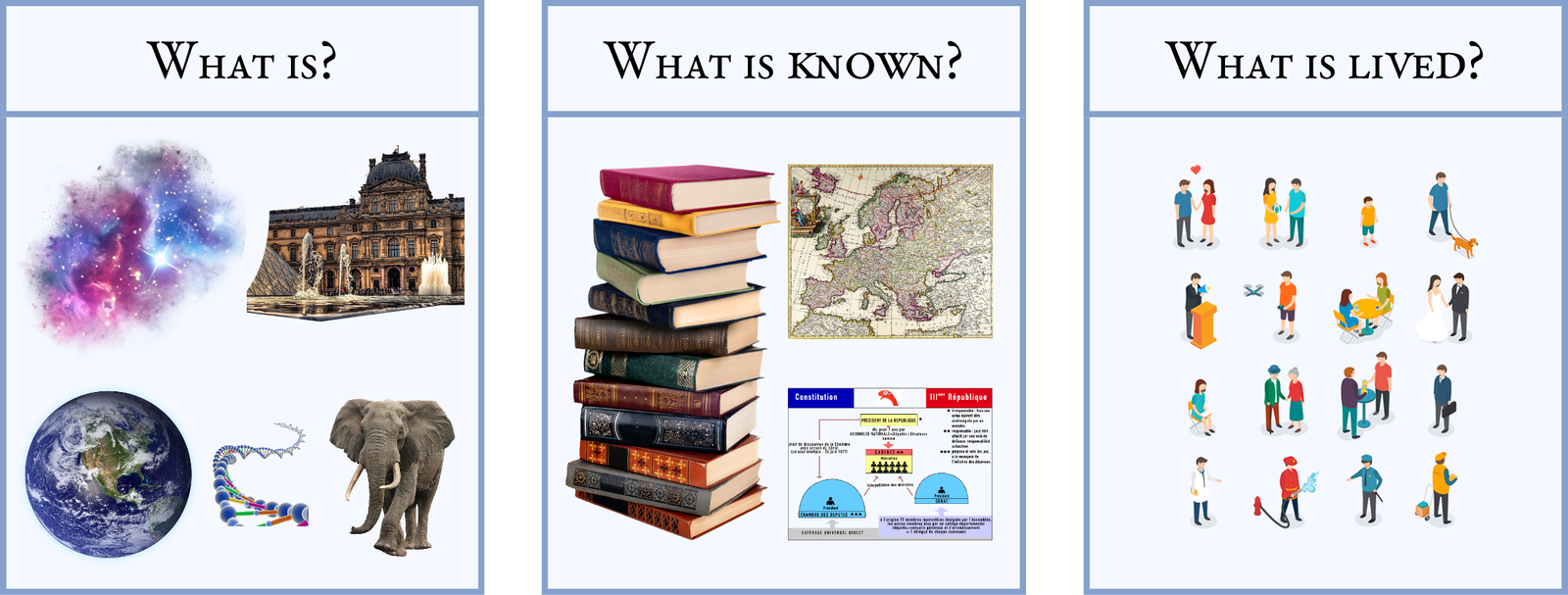
Well, the three aspects of classification we shall be exploring are:
The structure of the world:
Ontic classification of what is.
The content of knowledge:
Semantic classification of what is known, meant, thought, written, said...
The experience of life:
Phaneral classification of what is lived or experienced by human beings.
Why? — the aims of classification
A simple question beyond what I will classify is why I’m doing it. Why in the sense of what’s prompting me is easily addressed: the impetus is simply my personal interest in the topic and in the act of writing itself. Why in the sense "to what aim"? There lies the thornier problem. I’ll put the triad approach to good use again:
Esthetic aims: the simplest, perhaps the highest motive. Organizing is a creative act, and from human creation, beauty as a gauge of value is seldom absent.
Physics may still be seen, in some circles, as a purely practical endeavor, but we can draw a lesson from the twentieth-century surge of aesthetic discourse around that discipline. The revival of Noetherian approaches at the heart of our best theories have recast symmetries from a theoretical clutch to the generative core of physical models.
As was already well-known to mathematicians, the objects that help describe these symmetries delight the mind with their algebraic features. Lest we fall into mysticism, it must be clear those features have no bearing on verification. Scientists must accept that any theory can be supplanted, as ever more experimental data and theoretical conjectures come about. In particular, an aesthetically pleasing model can be replaced by an "ugly" one.
Yet, the fall from grace of a beautiful theory is often sorely felt by physicists, who may develop a sense of entitlement to aesthetic bliss: as grandiose attempts at aesthetic unification have fallen by the wayside, wobblier models still reign supreme.
In what follows, I shall then keep in mind the intrinsic aesthetic value of the classifications I will propose, but not as a way to feel self-satisfied or develop an undue sense of attachment. Au contraire, that self-awareness should inspire the author, but also guard him against a teleology of form rather than substance.
Epistemic aims: the act of classifying is not merely creative, it is also inquisitive, and as such is a scholarly pursuit.
The type of systematic reflection it requires is itself generative of new knowledge. Classifying things ("what is") leads to a renewed focus on definitions, often re-contextualizing deep-seated beliefs through a critical mindset. Classifying human knowledge can inspire metascientific research, or bring about results fields like Knowledge Organization or informatics. Classifying human actions and experiences can similarly enrich the human sciences.
If that seems a bit contrived, let me summon a slightly emphatic, but illustrative example with Mendeleyev’s periodic table. What started out as a classificatory effort based on known properties of chemical elements was immediately harnessed for its predictive powers. Simple conjectures did point experimental research in the right direction, the one that ultimately gave rise to a wealth of new knowledge.
Ethical aims: most prosaically, organizing can help bring about change to the way we do things. "Ethical" should not be taken here with its moral connotation, but rather as a synonym for "practical".
Academia, schools, industries, corporations...All human institutions rely on classifications, nomenclatures, terminology. Proposing a view that differs from received wisdom is not guaranteed to change much in the practical world. But it might. The mere prospect that scholarly innovations may induce positive change is surely worth exploring.
How? — the ways of classification
The book you’re holding constitutes a personal answer to this question: how can we classify all things?
My answer will make use of a geometric representation: a simplex. The 3-dimensional simplex is just another name for the regular tetrahedron, or triangular pyramid, thus called because of its simplicity and elegance (simplicissimus).
Remarkably, the simplex is also one of the five Platonic solids. In the eponymous dialogue by Plato, Timaeus extols the cooperation of the Intellect with "necessity" (in his parlance, an analog of a priori mathematical knowledge). He goes on to prove the existence of only five "perfect" shapes (convex, regular polyhedra), an interest of Plato’s which likely sprang from conversations with his friends Archytas and Theaetetus.
The simplex is the simplest of these five solids, and its usage a good echo of the very Platonist adequation between the outcome of our intellectual pursuits and the deep-seated structures of world. Going forward, I will sometimes call this structure "the Map".
Part I of this work, "To live and learn" considers the simplex longitudinally. We will slice it in six layers, and discuss what each of these layers are. We have seen that this book is about what is, what we know, and what we live. That progression underpins the separation between the six planes, from philosophy to lived experience, via science, technique, action.
Part II, "Composing the World", looks at the simplex transversally: it is concerned with what actually is in these slices. To answer that vast question, we first evoke familiar objects from the three realms (physical, mental, abstract). We then wonder which, if any, of those three is more fundamental than the others (outlining twenty-eight possible combinations).
Lastly, we get to the real task: building the whole world from the ground up. We start with the most basic question of all — that of existence — to then construct logic, mathematical objects, physical objects, mental states, possible and impossible worlds, truth, meaning, reasons, norms, values, and much more. By the end, the zoo of objects and concepts we had visited should be neatly ordered and explicated.
Part III, "Our Unfolding Universe" takes stock of these generalities about "the world" and steps into "our universe". For instance, the previous sections described what an physical object should be metaphysically, but did not distinguish between them: a dolphin, a speck of interstellar dust, a glucose molecule or the Sistine Chapel could be neat examples, but interchangeable ones.
We then need to append to the philosophical classification developed in Part II another one, that unveils the structure or our actual physico-mental universe. Its organizing principle, I argue, is akin to the idea of the "Great Chain" linking various levels of complexity, from elementary particles and galaxies to cultures and civilizations.
After exposing the general principles of that new classification, and in that process reaching preliminary conclusions about the meaning of the world, we examine each level one by one, sketching a universal history of sorts, from the Big Bang to the end times.
Part IV, "A Compendium of All Things" completes the journey. A discussion of the Unity of Science (natural and human) helps to show why the thirteen levels of complexity from Part III should translate into nineteen sciences, a refinement of the transversal structure. Extending those through the six planes from Part I, we find nineteen domains, the principal components of the world’s structure, bringing our pursuit to a temporary end.