Part IV
At last it is time to take stock, at last to embark on our journey of classification! For this, we shall of course draw on the teachings gleaned in each part of this work.
There is a 6-plane continuum covering what is known (the semantic content of knowledge, 4 planes), and what is lived (the phaneral experience of life, 2 planes).
Sophia (theoretical philosophy): first-order knowledge about things in the world.
Phronesis (practical philosophy): second-order knowledge, applying sophia to domains from the episteme level.
Episteme (theoretical science): first-order knowledge about our physico-mental universe.
Techne (practical science): second-order knowledge, applying episteme to aims borne out of poiesis-level activities.
Poiesis: human activity.
Praxis: human experience.
There are 8 storeys from the simplest formal structures at the root of our world, to those able to represent all of our concepts.
Meta-ontology: the concept of existence.
Mathesis Formalis: logical, ontological, mathematical foundations.
Ontology: simple objects from the three realms (physical, mental, abstract).
Mereology: complex objects from the three realms (physical, mental, abstract).
Metaphysics: ordinary objects (susbtance, essence, constitution).
Modality: possible worlds (nomically, metaphysically, logically).
Semantics: reference, truth and meaning.
Axiology: reason, norms and value.
There are 13 stages on the Scala Naturae that illuminate the structure of our actual concrete universe. To each we can associate an emerging concept, fundamental elements and a milieu.
Spacetime: fundamental quanta in the Universe.
Forces: elementary particles in the 4D Universe.
Matter: atoms in the transparent Universe.
Structure: elements in the cosmic foam.
Systems: molecules in the galaxy.
Globes: macromolecules in the planetary system.
Environment: materials in the geosphere.
Life: cells in the biosphere.
Mind: animals in the psychosphere.
Meaning: groups in the semiosphere.
Language: communities in the koinosphere.
Law: societies in the themiosphere.
Culture: civilizations in the noosphere.
Among the six planes, two are about first-order knowledge: sophia and episteme. We have discussed the distinction between philosophy and science in general terms, but as this study reaches its end, we are able to show a clear delineation, and to substantiate it: I propose that the 8 storeys be associated to sophia, and the 13 stages to episteme.
As they’re piled onto each other, the 8 storeys create objects that are more and more reminescent of our "human, all too human" Umwelt: counterfactuals, meanings and norms are the constant denizens of our thoughts. Yet, objects from the foundational layers are still nothing but abstracta, grinded by the implacable algebraic machinery from their formal foundations. "Dog" is a fine example of ordinary object, due to its sheer familiarity; but ordinary objects would still be things in a world without dogs, without humans, without matter, without much at all. The only characterization of the concrete, physico-mental universe in the 8 storeys is that it exists: the "code" predicate \(\kappa\) that traces a line between concrete and abstract objects is axiomatically imposed and is the reason we can tell apart ontology from mathematics; the theory of physics, mind and value \(\mathfrak{ToPMV}\) is just posited to exist, without details. The facts unearthed by this "ultimate science", tied to the actual world in its empirical sources, but untethered from it in its scope, I call sophia.
In contrast, the 13 stages unfold when we let that theory’s mathematical structures bloom into the concrete world’s metaphysical, semantic and axiological structures. "Dog" is not in actual fact just a useful example of ordinary object that can be used to teach more general metaphysics to human minds. It is also a natural sortal whose existence is grounded not only in \(\mathfrak{ToPMV}\)’s existence, but in its most minute aspects. That ur-object, that one mathematical structure from the infinite sea of possibilities, flowers into more and more elaborate assemblages of physical elements. Such objects, endowed with complex physical properties, but still rough phenomenal ones, can ultimately exemplify macro-mental properties, and enable the plucking of "advanced" abstracta, the most remarkable of which can be called: les fleurs de notre monde. All of this, I propose, is the remit of episteme.
Very well. Is our grand classification then to be a disjointed series of three one-dimensional axes: planes, storeys and stages? Not so. Even a common-sense perspective should make apparent the correspondence between the storeys of abstract structures and the stages of physico-mental emergence. One could readily agree that the study of norms and values is more relevant to law-based societies and to cultures than to atoms or molecules; that semantics has more to do with sign-based social exchange or language-using communities than with planets or galaxies. The deeper locus of that intuition can be rigorously identified from our previous musings: the interaction of physical complexity with a singular phenomenal entity which we’ve called the qualium field gives rise to increasingly nimble mental content, capable of plucking more and more complex abstracta.
That simple worldview makes the storey/stage correspondence entirely natural:
Meta-ontology and mathesis formalis (formal ontology) are foundational and beyond this correspondence.
Ontology pervades everything in the concrete universe, which by definition exists. Hence its correspondence starts at Stage 0 and extends to every stage beyond.
Mereology only intervenes in the universe when complex objects as such interact, emerging as a realisation of mereological union. Stage 2, starring nucleons as arguably the first stable form of composite objects, is the onset of the "building-blocks" construction of physical structures as opposed to the previous mode (loss of symmetry).
Metaphysics proper is centered around the concepts of substance, essence and constitution, leading to the crucial idea of ordinary object. Up to Stage 3, ordinary objects were hardly required to apprehend the world though, and could have stayed an unrealized abstract figment. However, galaxies on Stage 4, which we’ve presented as the first systems on a macro scale (as opposed to un-individuated stuff), and molecules, in many ways their micro-analog, are very much inaugurating the reign of the “ordinary” and of the natural kinds. With Stage 4, it can be said that metaphysics is taking over the universe from ontology.
Modality is the study of necessity and possibility. Self-reflective thinking about these concepts obviously does not occur before later stages on the Scala Naturae. But the ability of complex entities, even non-living, to recognize features of their environment and "behave" accordingly, is intimately linked to modality, which we could say accompanies the transition from the physical to the biological.
Semantics starts to manifest concretely with Stage 8 , when the mind emerges. With subjective minds come intentionality and mental content, which in Stage 9 come to be imprinted as physical occurrences and artifacts.
Axiology’s trace in the concrete universe is conspicuously evident in Stages 10 to 12. Reasons to act, feel or believe cannot be disentangled from the emergence of language and of social communities. The concept of norm is naturally evocative of law-based societies. And value, writ large, is the central tenet of any definition of culture.
The triangle of science: Nineteen domains
How to represent our classification then? The storey/stage correspondance on the one hand, the association of storeys and stages with the sophia and episteme planes on the other, paint a suggestive picture: two axes deployed onto parallel planes, with the horizontal dimension representing storeys and stages, and the vertical axis a progression across the planes of knowledge and experience.
Yet, that is not the final shape of the classification. The episteme plane, I argue, should not be an axis, or even a double axis (micro/mega dichotomy): it is best represented as a triangle. The reasons are intimately tied to a discussion of human sciences and in particular:
The holistic/individual dialectic.
The existence of three values (which in the sophia plane translates into three branches of axiology: ethics, epistemics and aesthetics).
The tripartition
We have established that the tripartition precludes a neat correspondence between one stage and one science. Instead we will identify nineteen sciences that can be represented as forming a triangle.
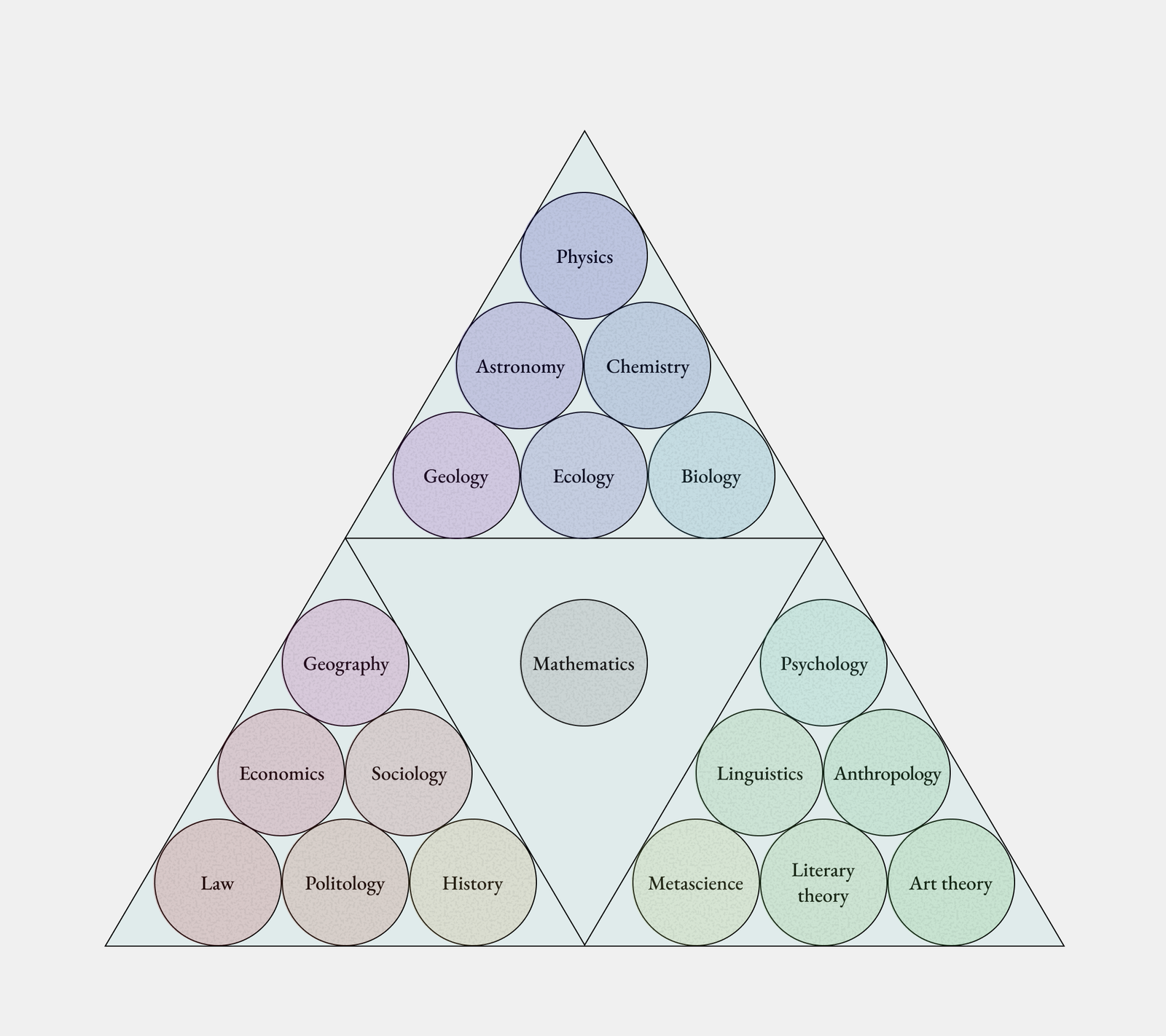
"Rows" in that triangle do not match with a single level of our 13-stages Scala Naturae (aka Chain of Being). They overlap with several of them (remember that sciences, and disciplines in general, are not fenced gardens with straight edges but rather clusters of knowledge).
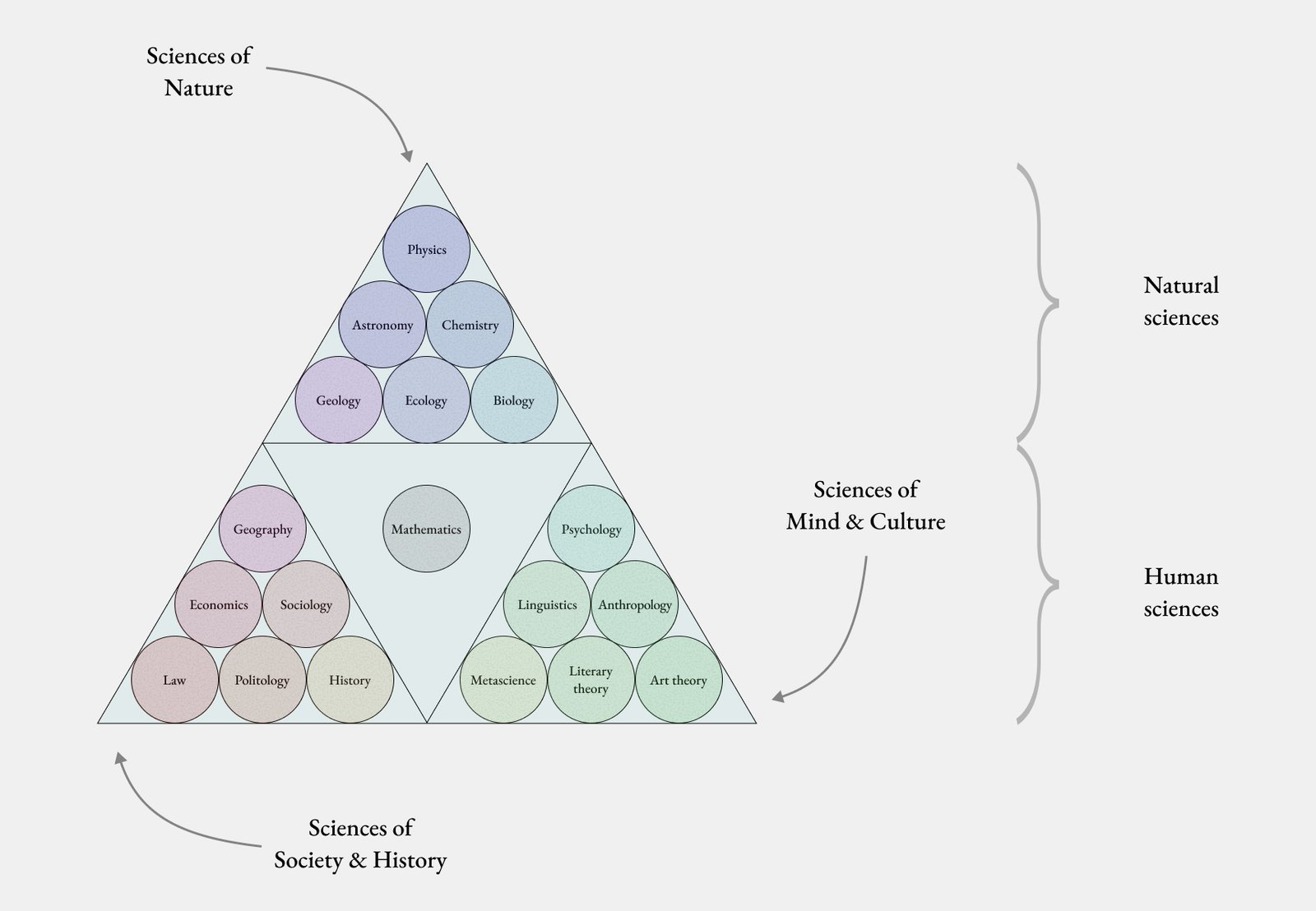
One formal science (mathematics) is an outlier, leaving eighteen which we will group into three smaller triangles of six sciences. Each of these domains will be discussed thoroughly in the next sections of this book. Here, we shall only give a list and a high-level overview and accept a terminology that more or less espouses everyday talk: rest assured that the many complexities will be dealt with in due time.
Six sciences of nature
The first sub-triangle covers the natural sciences. They are:
Physics
Astronomy
Chemistry
Geology
Ecology
Biology
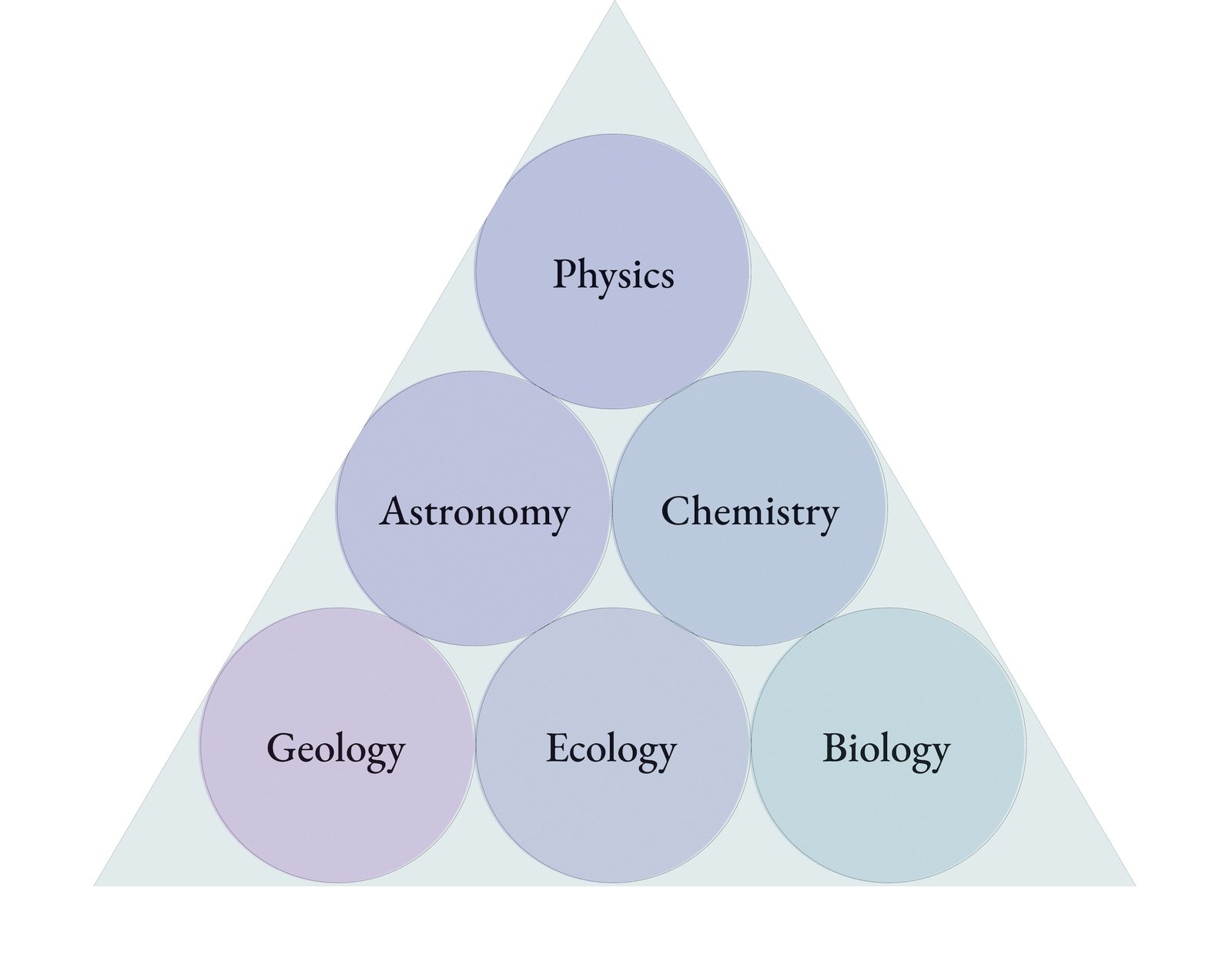
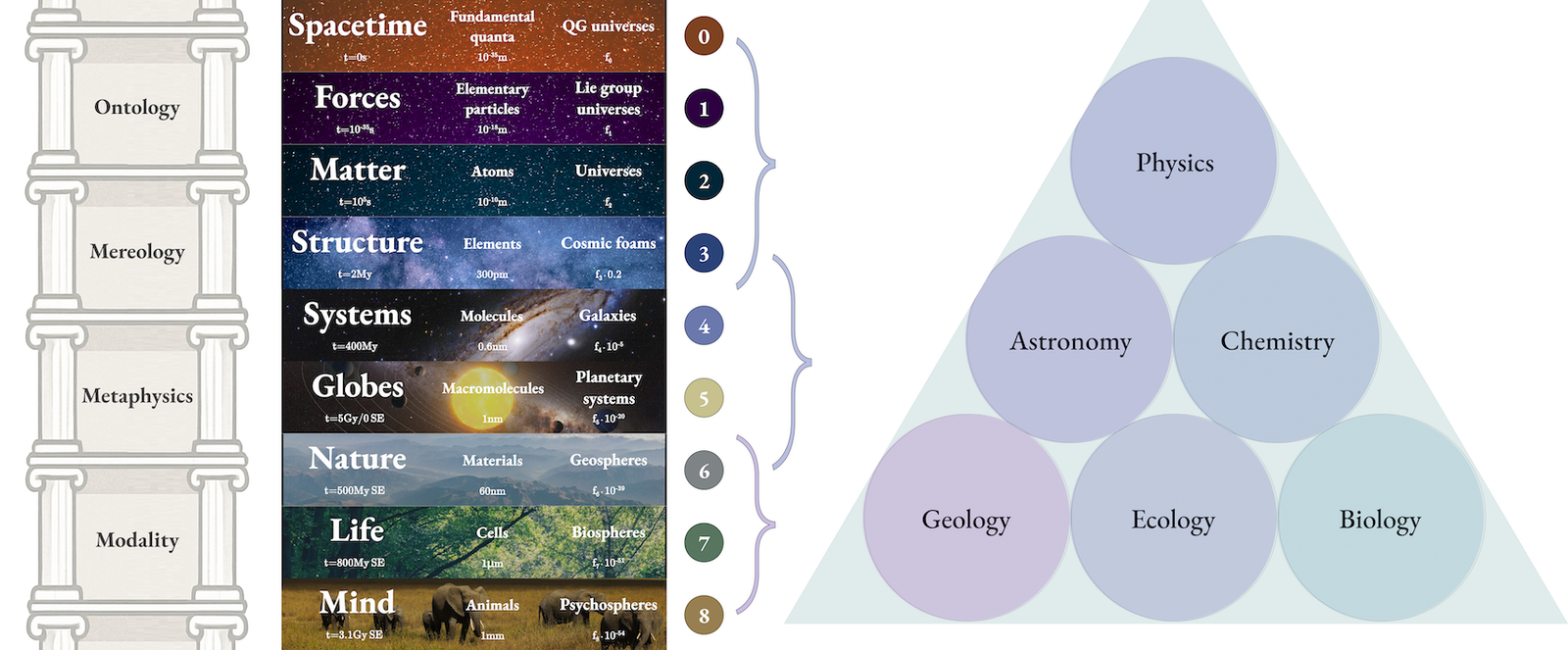
Each row corresponds to several stages on the Chain of Being:
Row 1 \(\Leftrightarrow\) Stages 0-3. Physics engulfs these stages both on the mega scale (the multiverse, universe and large-scale structures (cosmic foam)) and the micro scale (fundamental quanta, elementary particles, atoms, elements).
Row 2 \(\Leftrightarrow\) Stages 3-6. Astronomy corresponds to the mega scale (cosmic foam, galaxies, stars, planetary systems,planets) and chemistry to the micro scale (elements, molecules, macromolecules,materials).
Row 3 \(\Leftrightarrow\) Stages 6-8. Geology studies the mega scale (planets, geospheres, biospheres) and biology the micro scale (biomolecules, bio-agents, living cells, organisms). Ecology (writ large, in the expanded sense we give it) is at the junction of the two axes, principally at level 8, covering organisms from the exterior perspective, their behavior and their collective physical imprint at a larger scale.
Six sciences of society & history
The second sub-triangle covers a segment of the human sciences we’ll loosely call the sciences of society & history. They are:
Geography
Economics
Sociology
Law
Politology
History
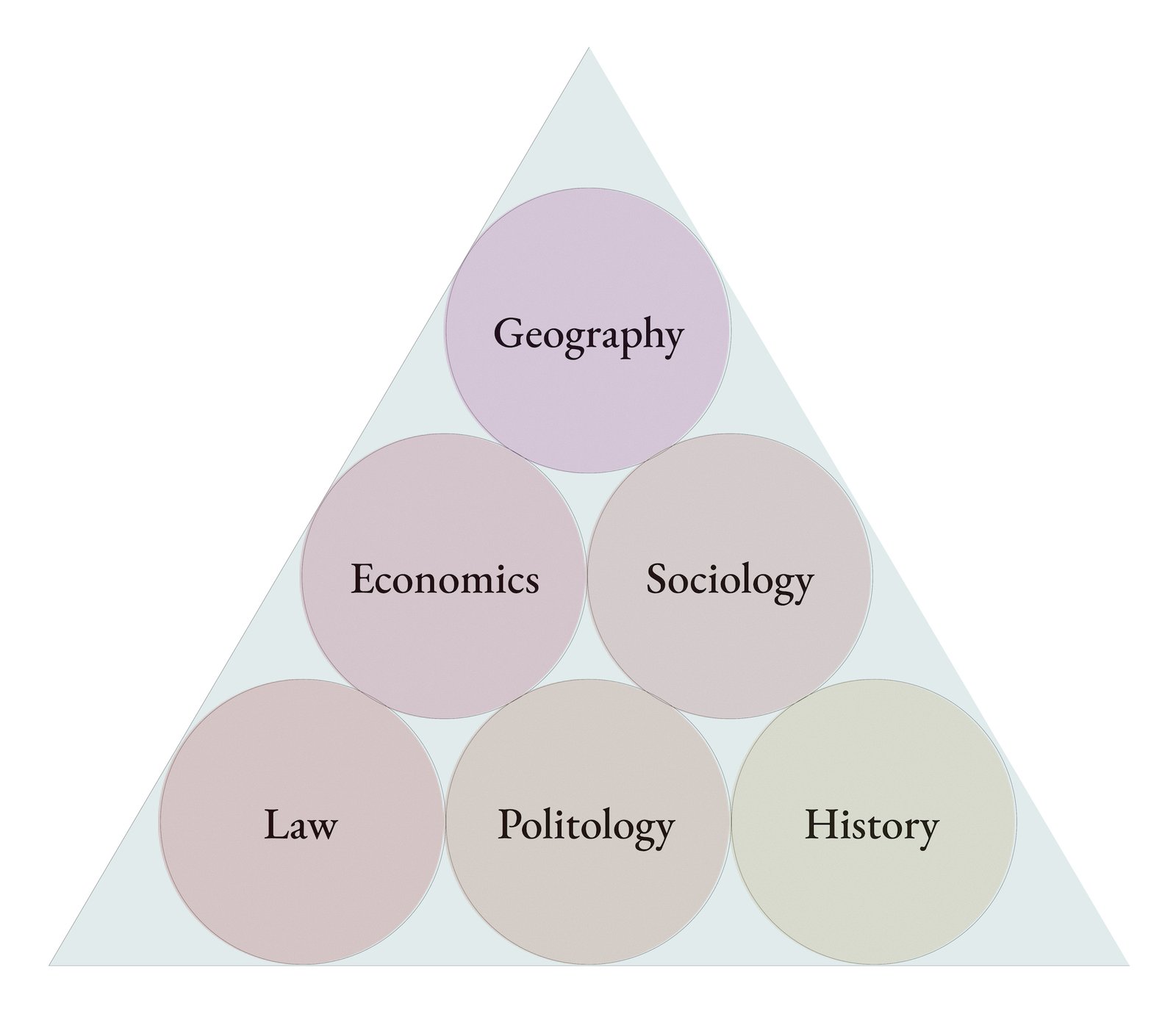
Each row corresponds to several stages on the Chain of Being:
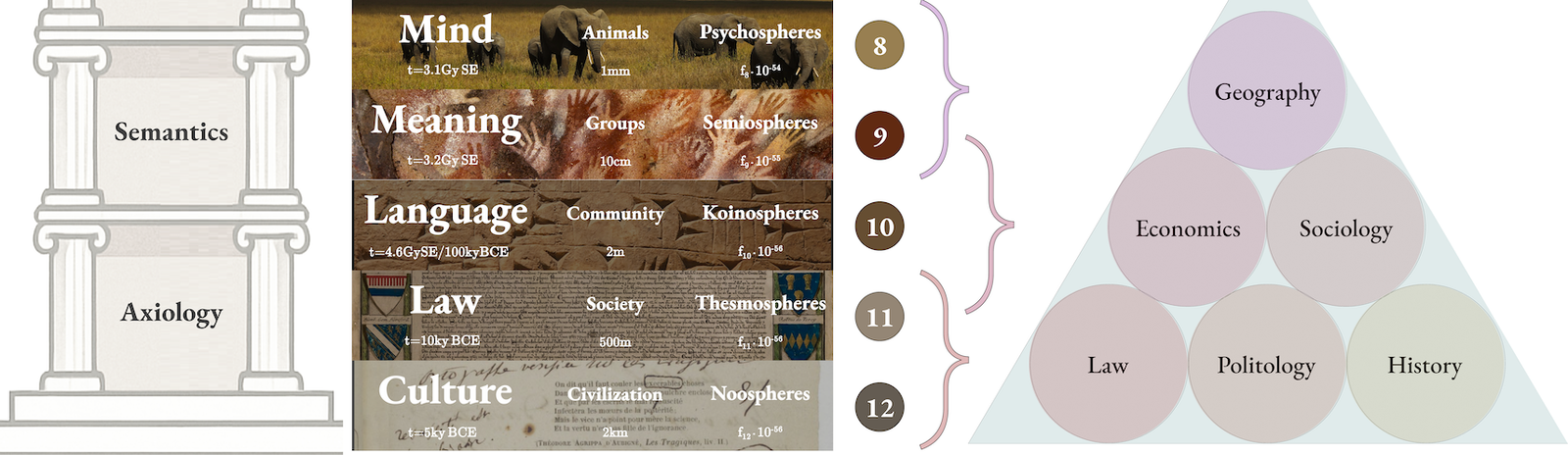
Row 1 \(\Leftrightarrow\) Stages 8-9. Geography studies the human sense of place, and ultimately the physical imprint of thinking human beings from the exterior perspective. The correspondence with Stage 8 illustrates the connection with eco-geography and the overlap with animal behavior, while Stage 9 unfurls the meaningful symbolic layers specific to thinking populations.
Row 2 \(\Leftrightarrow\) Stages 9-11. Sociology naturally goes beyond, and enfolds various levels of social organization, from groups and simple communities to society. Economics, as we shall see, is not merely the study of economic activity in a narrow sense, but that of choice and of human action,
Row 3 \(\Leftrightarrow\) Stages 11-12. Law, political science and history reach further and presuppose an understanding of linguistic, legal and cultural concepts. They connect to ethics, one aspect of axiology.
Six sciences of mind & culture
The third sub-triangle covers the other half of the human sciences: the sciences of mind & culture. They are:
Psychology
Linguistics
Anthropology
Metascience
Literary theory
Art theory
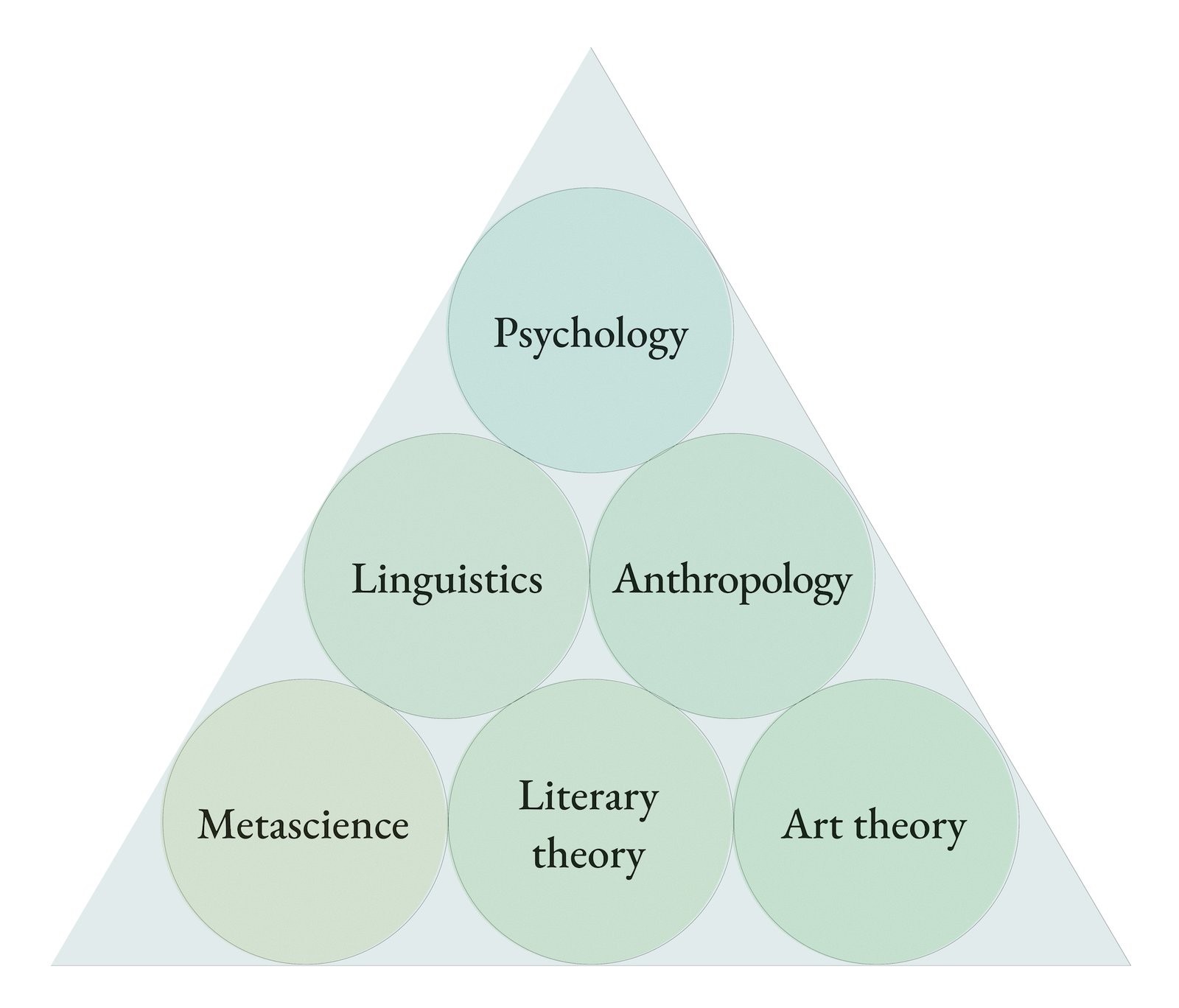
Each row corresponds to several stages on the Chain of Being:
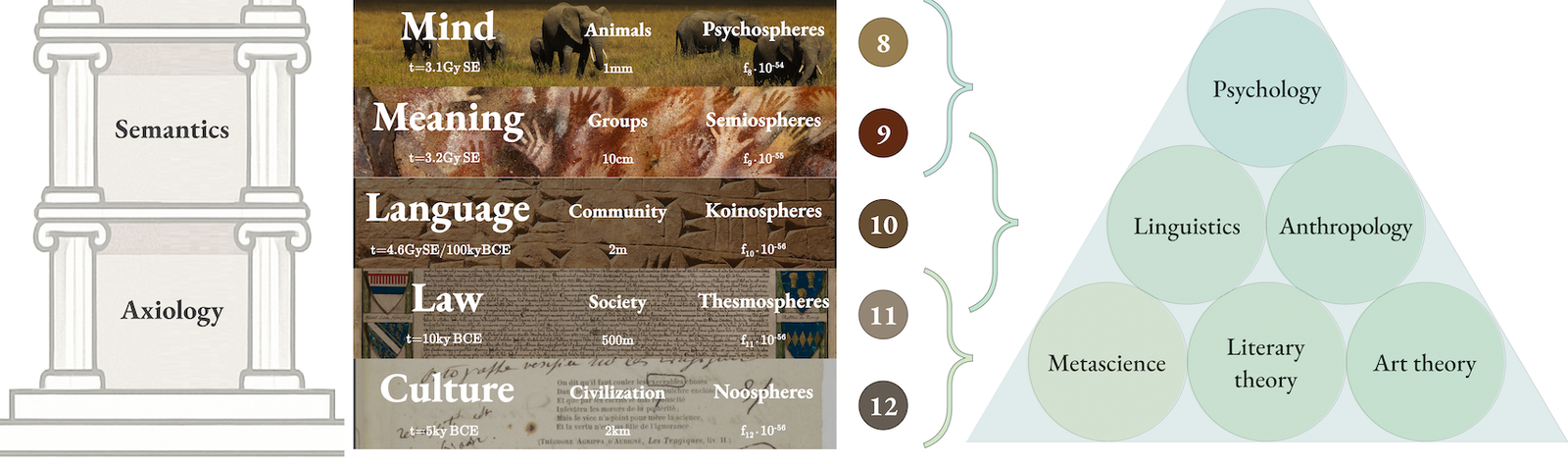
Row 1 \(\Leftrightarrow\) Stages 8-9. Psychology is the study of mind and behavior. Of course, advocates of panpsychism would ascribe a mental component to nearly all levels. But the idea of a macroscopic mind akin to ours emerges at best with complex organisms like animals. Psychology largely concerns composite mental states that involve semantic content.
Row 2 \(\Leftrightarrow\) Stages 9-11. That linguistics, the study of language, be centered around Stage 10, that of language, is not a surprise. Anthropology should be taken here as a study of culture, albeit more in the sense of symbolic systems from Stage 9 (Meaning) than in the civilizational sense from Stage 12 (the terminology will be thoroughly re-built in this work, precisely to avoid this type of confusion). The Law level at Stage 11 is not solely about the judicial or legal spheres either but more broadly about the concept of rules or norms, which are essential to both language and culture.
Row 3 \(\Leftrightarrow\) Stages 11-12. Metascience, literary theory and art theory have direct connections to the epistemic and aesthetic facets of axiology, as well as to Stages 11 ("Law" and normative systems in general) and 12 ("Culture" and intellectual systems).
One formal science
What is the situations of mathematics amongst episteme fields? Its rightful place among scientific topics has been a subject of some debate in the ninteenth century, with empiricist-minded practitioners heeding the direct use of mathematics in physical sciences and the related academic closeness between disciplines to make it a clear ’science’, albeit a peculiar one in many respects, while the humanities would be more likely to bundle this decidedly non-experimental endeavour with philosophy, a position made all the more intellectually attractive by the rise of logicism in the foundation of mathematics.
We will perform somewhat of a sidestep and remind the reader of our choice to make episteme akin to Wissenschaft rather than science in its most naturalistic sense, and consider this should allow us to elude controversy on the topic.
We will not argue, as it is sometimes attempted, that it precedes physics in a hypothetical "mathematics-physics-chemistry..." sequence. By virtue of its qualitative discrepancies, mathematics is at the same time above and at the center of other sciences.
Simplex Compendium: the Map of Everything
Bringing it all together
Are we now ready to come through with the initial promise of this book? We are.
The main tenets of our classification have been introduced in the preface, then sprinkled through this body of work, but still bear re-visiting.
One dimension of the map covers six planes, depicting the kind of things in it: what is known over four planes (philosophical & scientific knowledge), what is lived over two (action & experience).
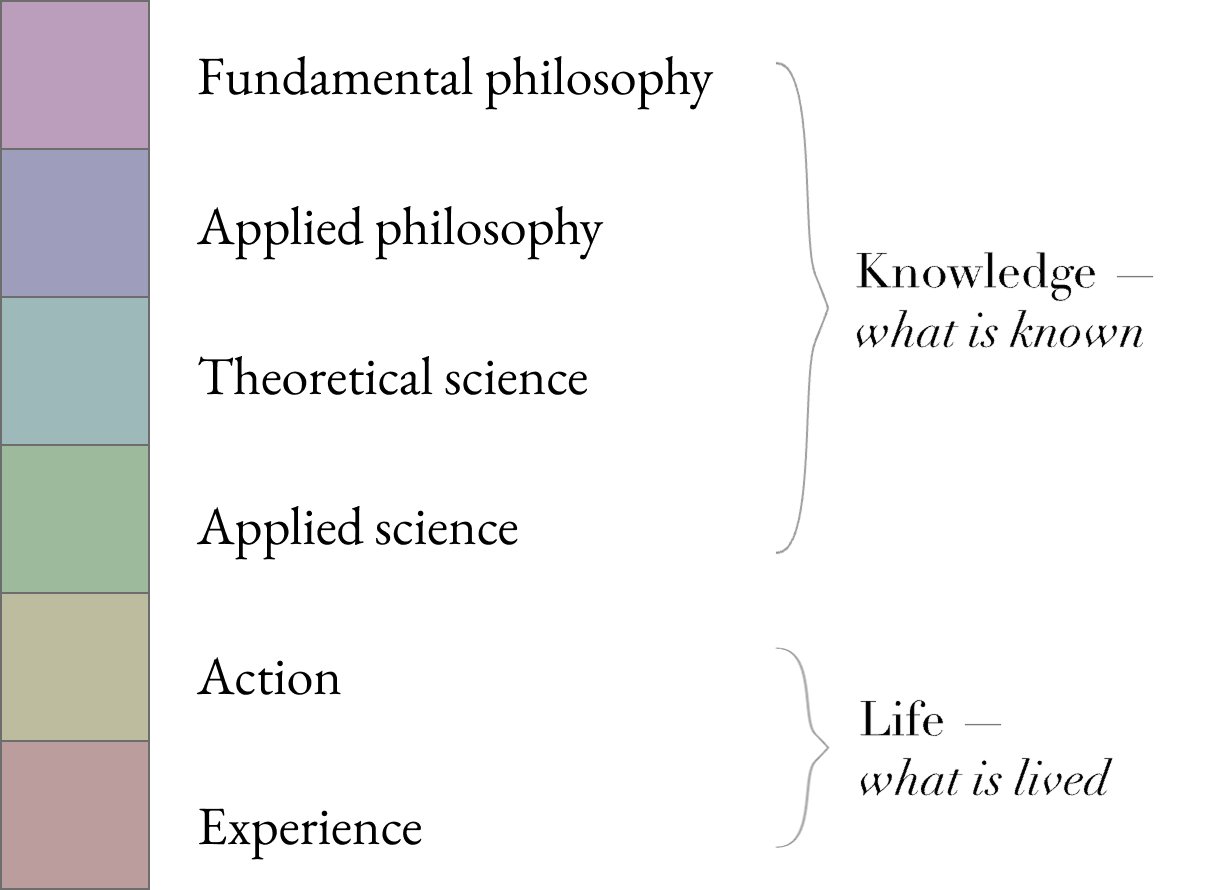
Six planes, from theory to life The other dimensions should span which domains things belong to (what is).
Eight storeys represent the construction of ever more complex abstract structures, from logic to values. Its locus in the planes dimension should be the top plane, sophia (fundamental philosophy).
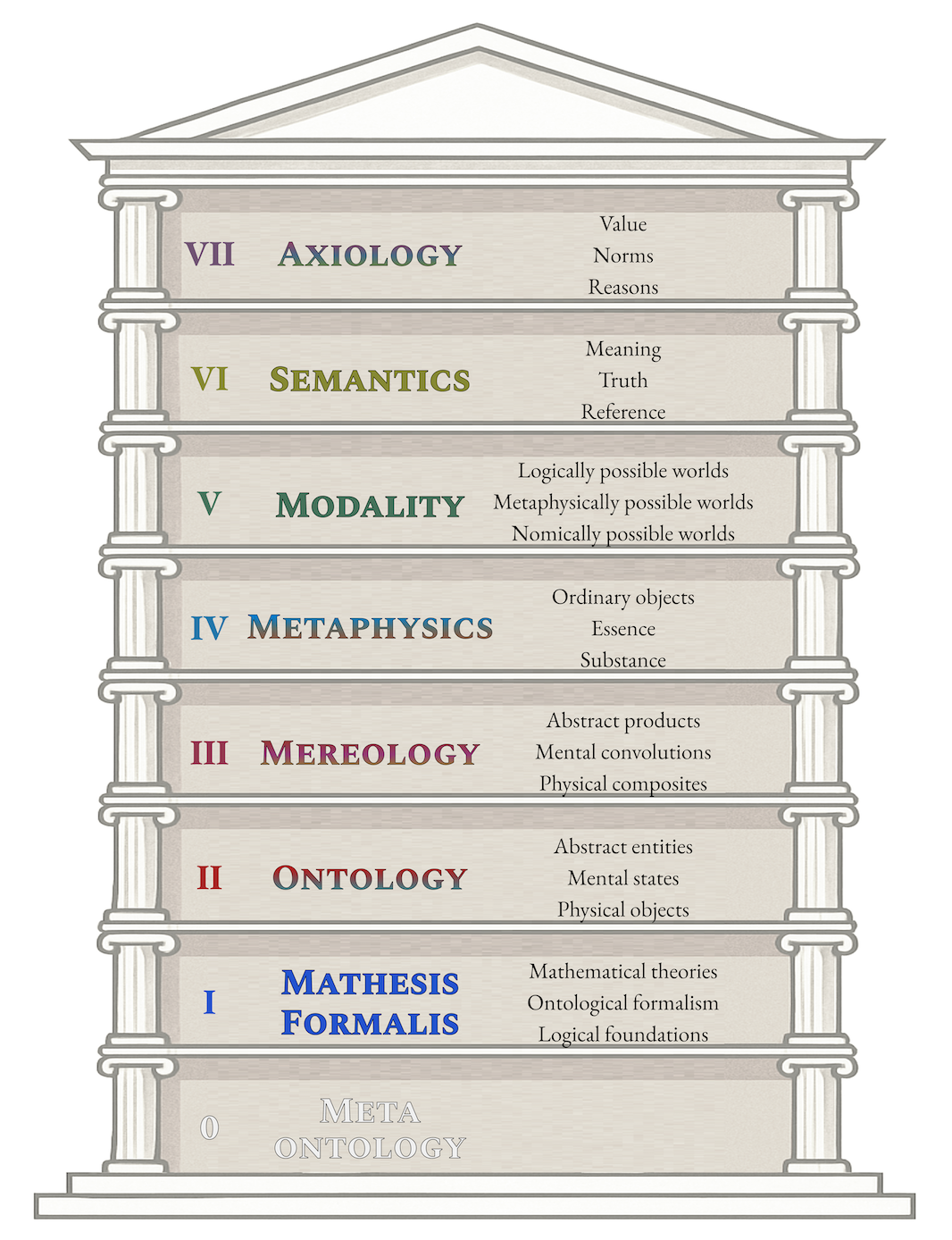
Eight storeys to build the world Thirteen stages represent the concrete structures of the world and the advent of complexity, from fundamental quanta and universes, to culture and civilizations. On the planes axis, they span all five levels below sophia.
We have shown that these thirteen stages are best translated to nineteen domains for our purposes, organized in a triangular fashion. Domains then deploy over two dimensions.

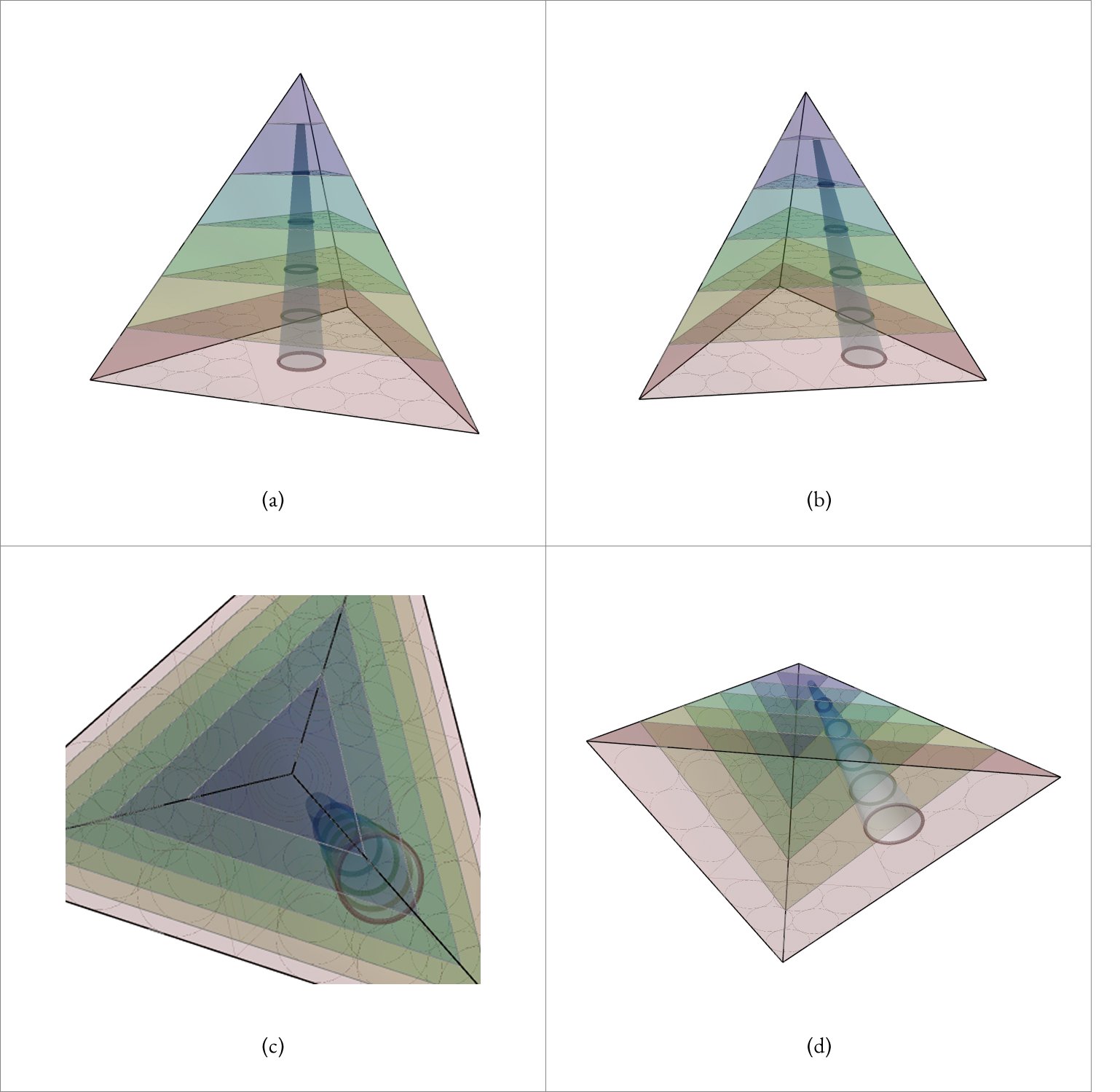
From 13 stages of the Great Chain to 19 domains The 6 planes span an axis (one dimension), the 19 domains span a triangle (two dimensions). Therefore, the Map of Everything will take the shape of a 3-simplex, in other words a regular tetrahedron, or triangular pyramid.
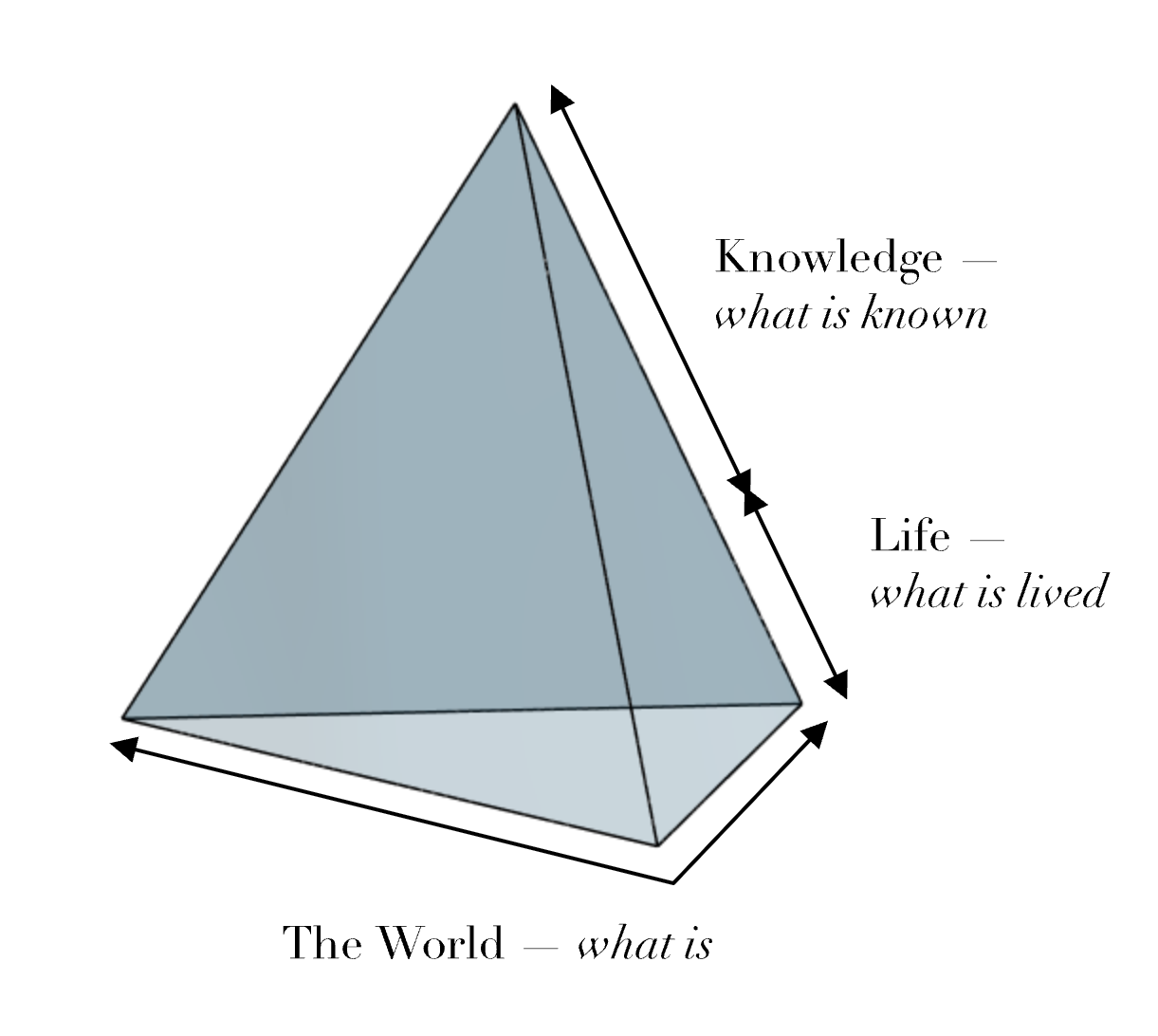
With this general structure in tow, we can start to flesh out the graphical representation of our Map of Everything. Since the 6 planes are deployed over one axis, they can be seen here as representing slices of the tetrahedron, as if we were cutting it longitudinally to make smaller and smaller pyramids.

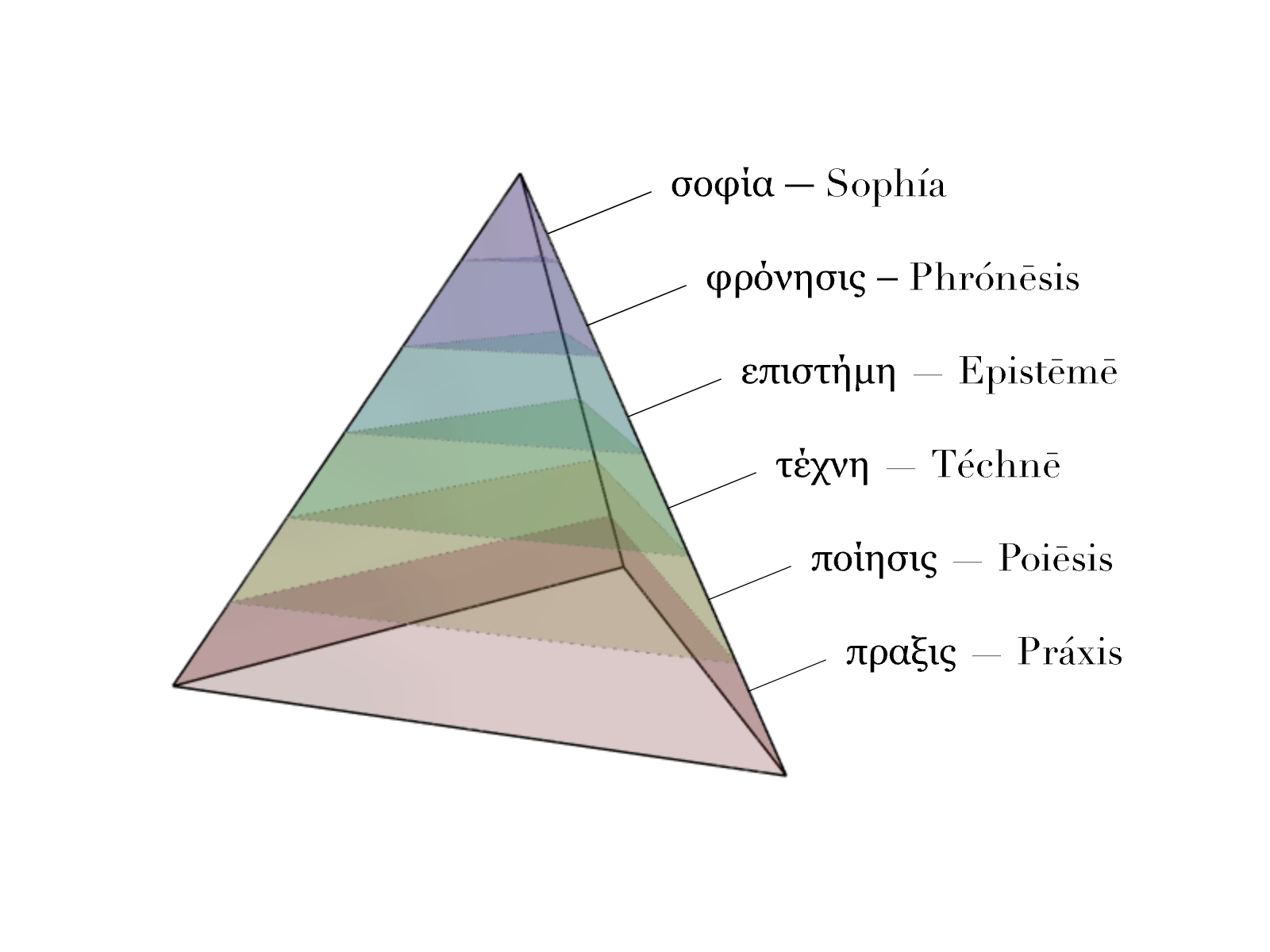
The 19 scientific domains of episteme are organized in the shape of a triangle. That is the reason we have picked the tetrahedron as our volume of choice: its cross-section following a parallel slice to a face is a triangle. We can then naturally map the episteme triangle and its 19 domains as such a cross-section, cut at the level of the episteme slice.
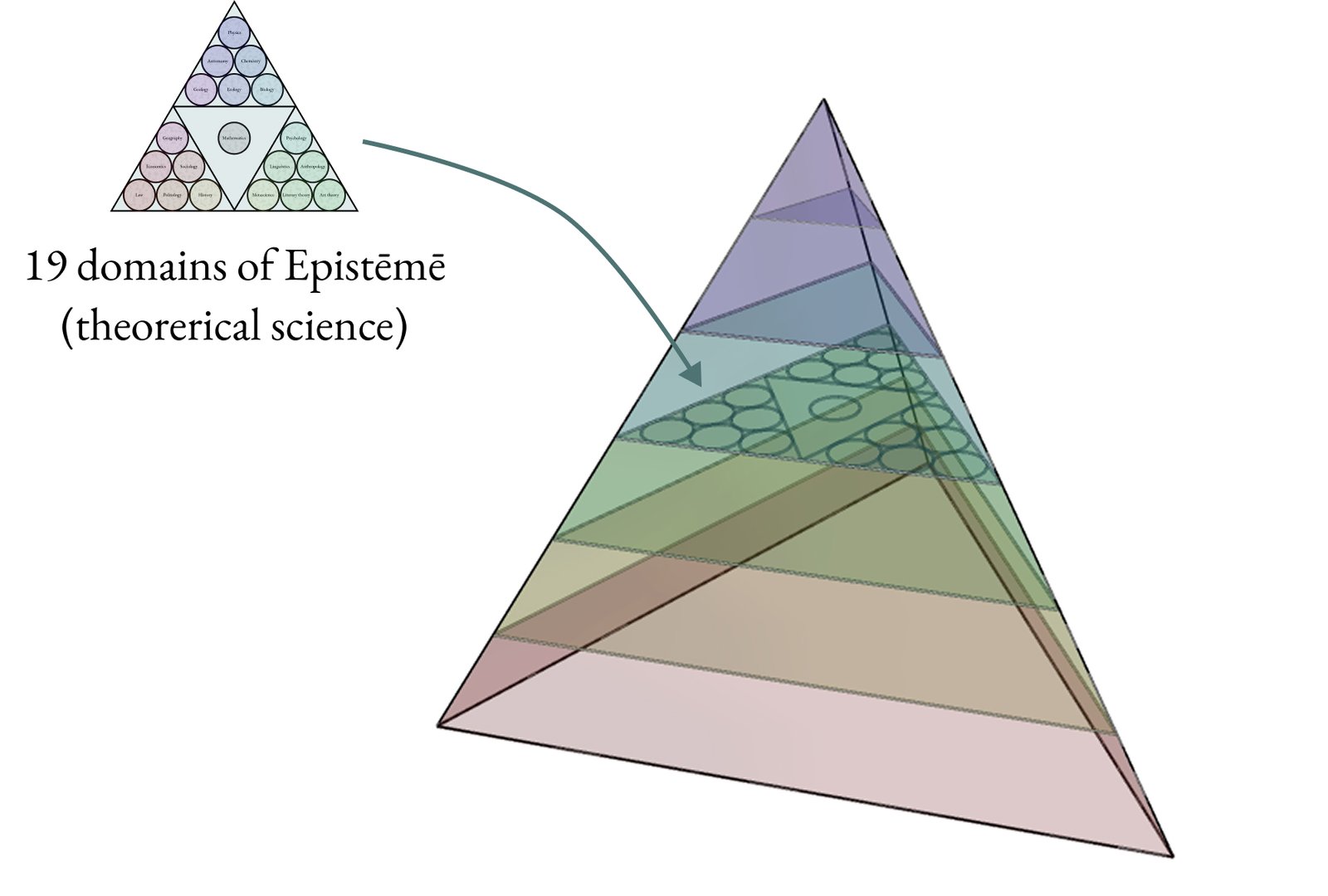
The next step is to recognize that the same domain mapping can be applied to other planes. For instance, we’ve established there are physical and literary "theoretical sciences" (in fact, poles or clusters within the space of knowledge rather than fenced disciplines). It is sensible to project the same idea onto techne: undeniably, there is a notion of physical applied science, as well as of literary applied knowledge (such as criticism or analysis).
Backing up in the other direction, the domains can also be transposed to the phronesis plane. Way back, in our discussion of applied philosophy, we have shown how that level of analysis takes the form of a "philosophy of X", which diffracts the disciplines of theoretical philosophy (metaphysics, ethics, aesthetics...) onto a hypothetical domain of "X". To continue our example, the philosophy of physical objects and phenomena, and the philosophy of literature are familiar fields.
As may be guessed from the comment above, we cannot back up the domains all the way to sophia level. Theoretical philosophy deals with the metaphysics, ethics, aesthetics... of abstract, non-specific entities (regardless of the fact that concrete examples can nourish its posits or make its expositions more palatable). That plane can then not be broken down into domains from the dimension of what is.
Below the techne level, we find poiesis (activities) and praxis (life experience). The physical domain can easily be prolonged into physical activities (the manipulation or transformation of physical objects) and experience (humans are physical objects themselves). That is equally true of the literary, and of all other domains.
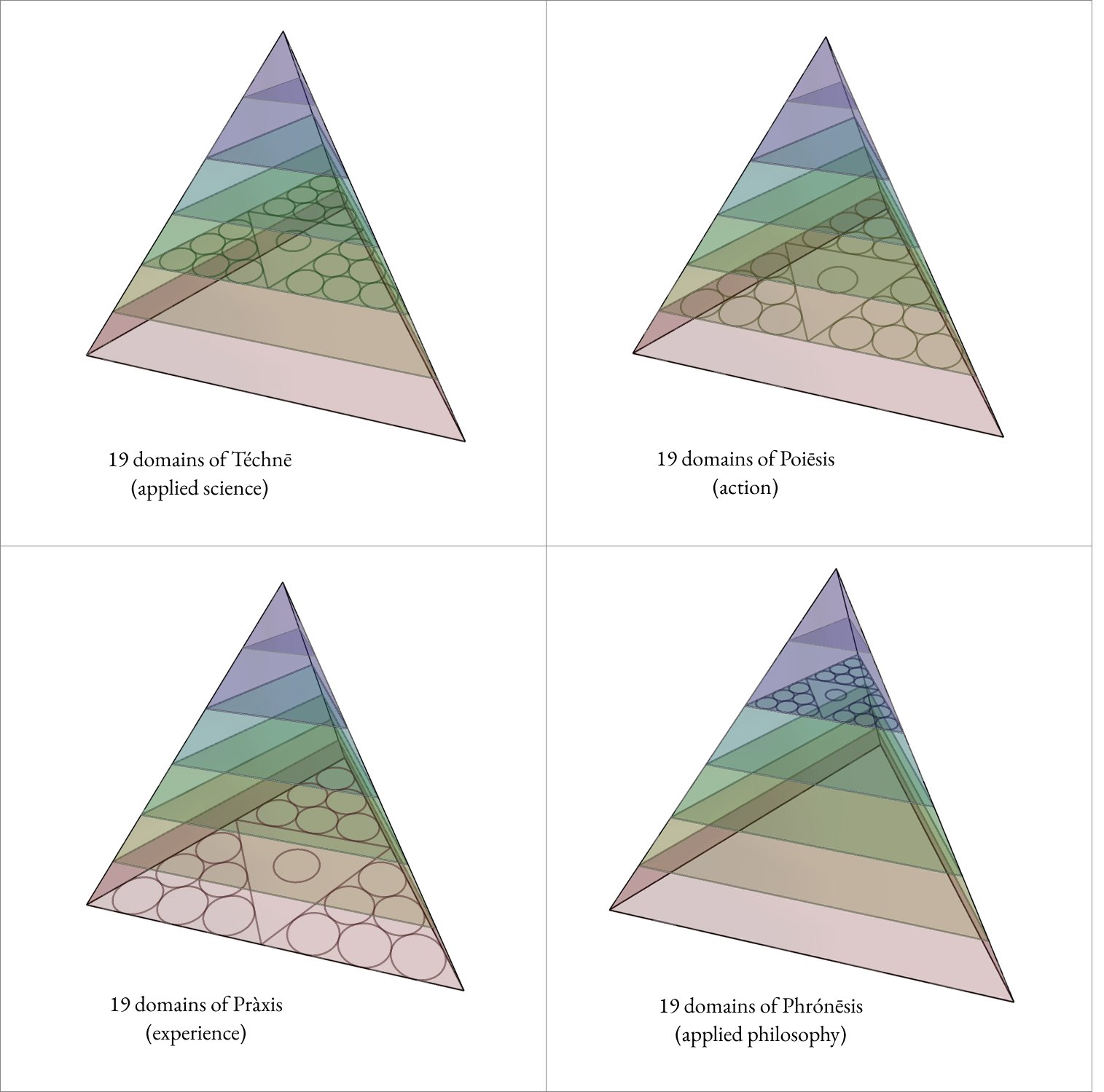
We have then imprinted our 6-slices tetrahedron with 5 triangular cross section, one for each slice but the top one.
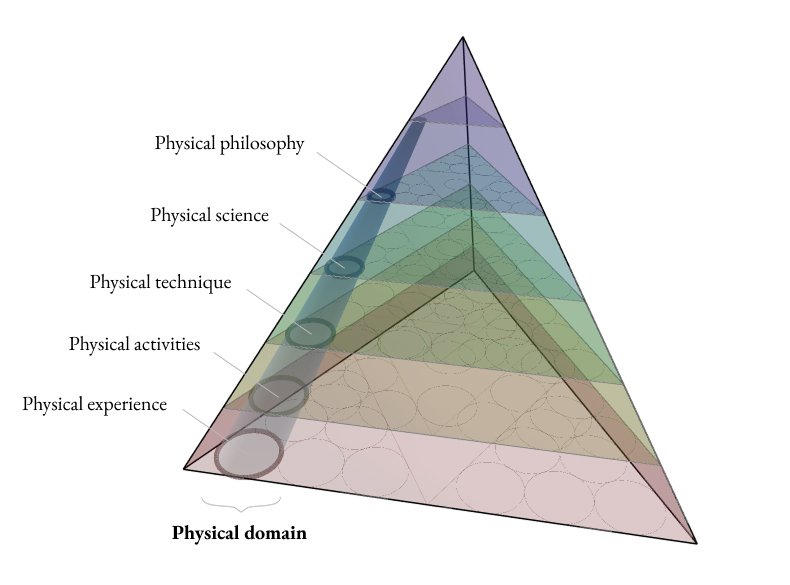
Now, let’s switch perspectives. We’ve been adding the 19 domains as a group to each of the 5 planes. Now, let’s look at one domain. Each single domain is a small circle among 18 others in a larger triangle. To follow one domain through its incarnations in 5 planes is to draw a conical frustum (a truncated cone, with its top sliced off).
To avoid confusion, we will now call that plane-transcending, transversal volume the domain, while the circles (cross-section of the domain frustum) are given names that clearly identify them in relation to their position in the 6-planes spectrum.
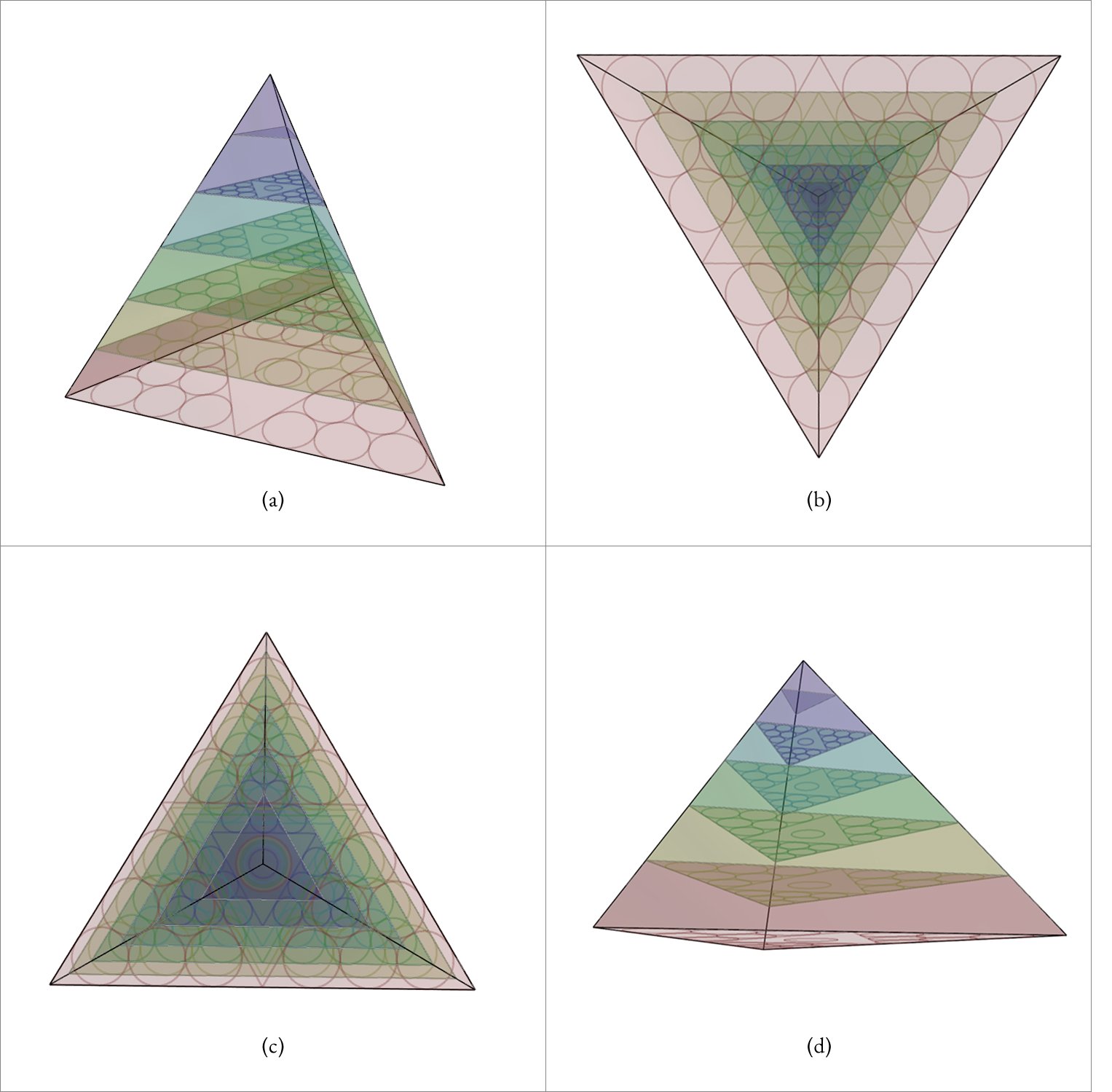
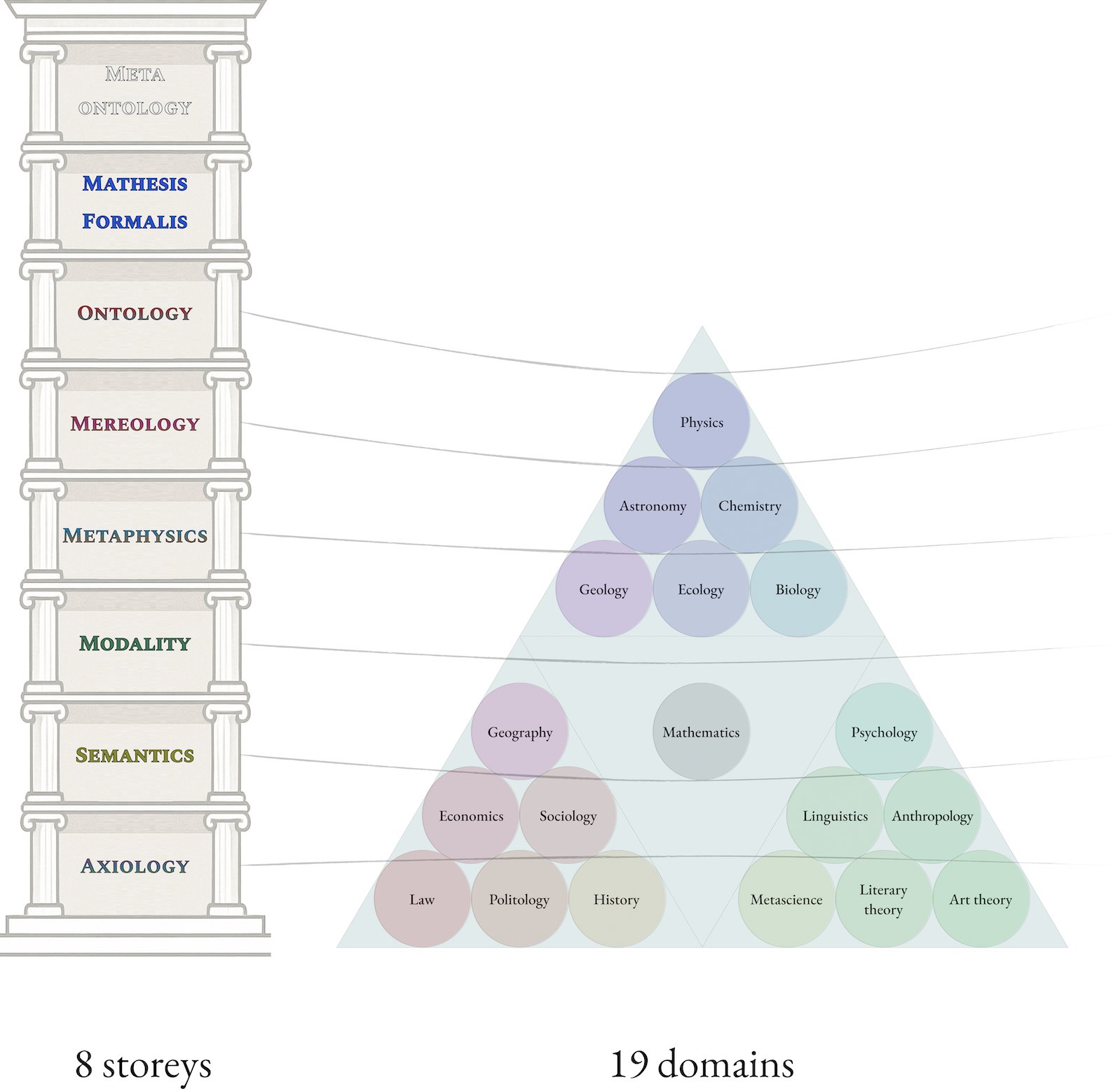
The last elements needed to complete our map of Everything are the eight storeys of the abstract world. The order followed by our presentation so far has been to connect the eight storeys to the thirteen stages, at the outset of this part of the book (“A Compendium of All Things”). Then, in introducing the nineteen domains, we have explicitly showed how they proceed from the nineteen stages. This allows to represent these three sequences side-by-side.

Transitively, we can draw a correspondence between the eight storeys and the nineteen domains. Meta-ontology, Mathesis Formalis and Ontology are all “above and beyond” the domains and not part of that correspondence. The five other storeys, from metrology to axiology, all fit in the gaps between the six rows of domains.
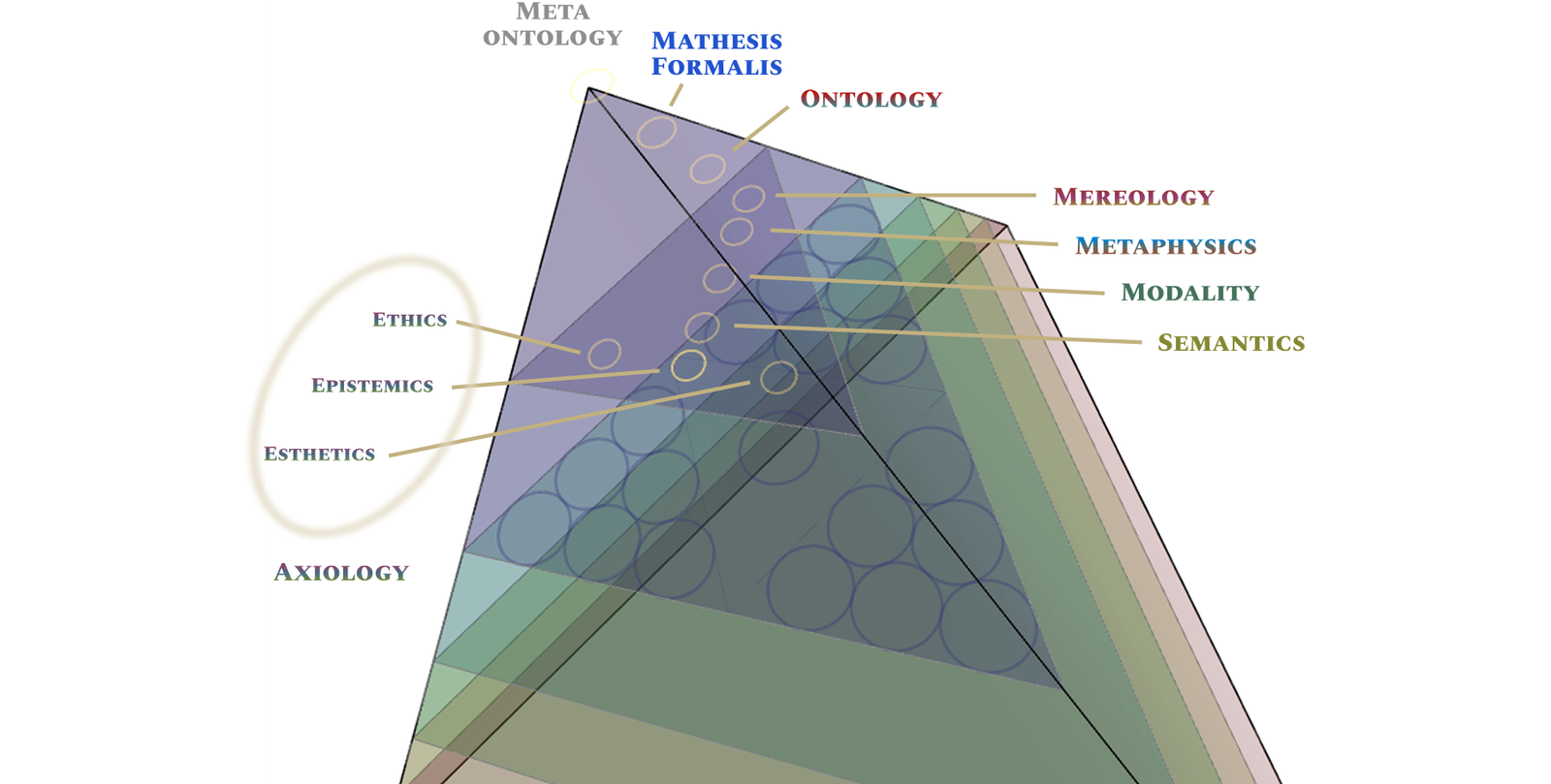
We have mentioned that the proper locus for the representation of our eight storeys in the Map is the sophia plane. So it shall be. They will be represented as eight golden circles.
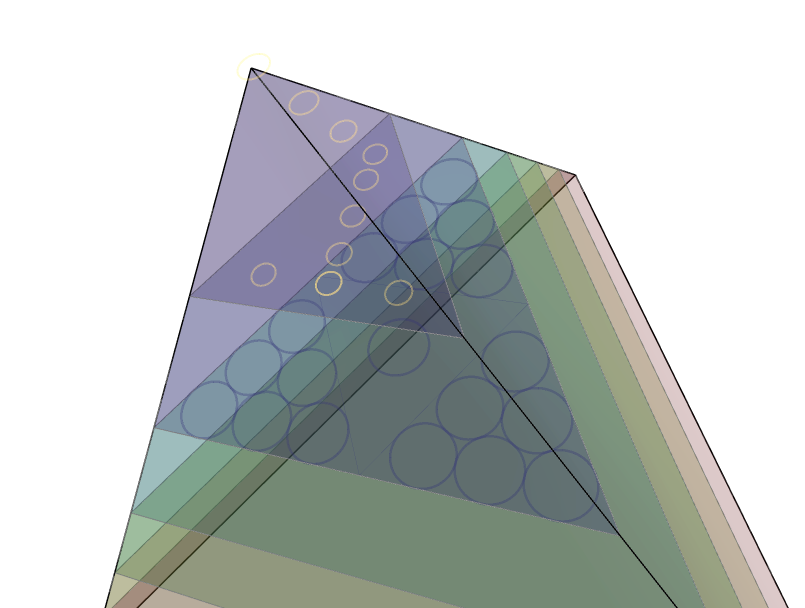
Mereology, Metaphysics, Modality and Semantics are placed according to the the principle just explained: between the corresponding row of domains, represented in the below triangles. Axiology follows them, but is divided into its three components, reflecting the three Values: ethics, epistemics and aesthetics. Meta-ontology, Mathesis Formalis and Ontology are “above and beyond and thus higher within the sophia plane: meta-ontology at the very tip of the pyramid, Mathesis Formalis and Ontology then following linearly on a segment that ends with mereology.
A slow amalgamation of philosophical positions into a coherent whole has allowed me to complete this Map of Everything, a graphical representation of, and, we shall hope, a practical aide to the exploration of our universal, structured Compendium of all things. The end result of a long maturation process and of many twist and turns, it is no small pleasure for this author to indulge in its sight. Let us then show it under a few more angles, which should also make the reader more familiar with its appearance.


Constitutive elements of the nineteen domains
With the Map of Everything drawn at last, the rest of this book will be dedicated to exploring each of the nineteen domains. We shall execute that plan by following a rigorous pattern: each domain has twelve constitutive elements to be discussed in turn.
A note on neologisms
The section dedicated to a given domain will always start with an explanation of that domain’s naming. So far in this work, I have used precise terminology to a reasonable extent, and neologisms almost none at all. As in everything, there is a trade-off involved here: to build one’s own neologisms helps satisfy an author’s taste for precision (think of Peirce or Heidegger), but can make reading his prose a burden at time, made lighter only by an intimate commerce with his oeuvre; conversely, designating novel concepts with only existing philosophical terms of the art or layman’s terms can lull the reader in a sense of false security, from which misunderstandings and graver sins are borne.
I have still preferred the latter approach, making the case for my conventions and pre-empting such misunderstandings through the prudent highlighting of linguistic pitfalls around the terms I have been using. But at a point when the Map is, if not complete (what ever is?), at least fleshed out, I feel it necessary to give its sections and distinguished loci their own, unique, signifiers. Not that these neologisms were built to avoid any intersection with the English dictionary. Some of them (a minority) mirror well-known everyday words, which inevitably maintains a degree of possible confusion: “ecology”, “cosmology” are among them. The difference with using only everyday terms however, is the stricture of their construction. Anyone who, as a child, has felt betrayed that grown-ups ensured most sciences ended with “-logy”, but that we should only laud astronomy rather than infamous astrology, will hopefully appreciate the warm embrace of a well-organized system of neologisms such as the one I’ll be introducing here.
The principle is simple: each domain will be given a prefix, whilst each of its constitutive elements will be associated to a suffix. That is the age-old pattern that gave us disciplines’ or practices’ names like “geology”, “pyrotechny”, “spectroscopy” or “astrometry”.
Another choice: that of using Ancient Greek roots for all prefixes and suffixes. Its enforcement is largely conduced on aesthetic grounds. A quick dive through etymologies would show you the ubiquity of modern words with co-habiting Greek and Latin roots, and there would be no harm in arbitrarily mixing Greek with Chinese, Sanskrit or old Saxon. Arbitrarily as well, following my own fancy, I decide to restrict my search to the vast expanse of Ancient Greek.
Each domain’s prefix will then be introduced in due time. The concept of domain itself has its suffix: -chora, which literally means “domain” or “district”.
A name, or rather a prefix, is then one constitutive element of a domain. There are five more constitutive elements that are self-explanatory. Indeed we have defined a domain as a volume within our map that intersects with the five lower planes. Each of the resulting five sub-domains are constitutive elements that need to be named and described. What each of these five planes represent has been abundantly discussed already, so we need only introduce the relevant suffixes.
To the applied philosophy plane, the suffix -sophy, a reminder of its belonging to the broader philosophical domain.
To the theoretical science plane, the suffix -logy, drawing clearly from our own language.
To the applied science plane, the suffix -techny, which requires no explanation.
To the activity plane, the suffix -urgy, from ergon (to work), which we can find under that guise in words like “metallurgy”.
To the experience plane, the suffix -praxy, self-explanatorily.
The theoria planes: objects, events, concepts
Let’s move on to three constitutive elements that are revelant from the theoria planes (philosophy & science) already.
The first one is the object. We have talked at length about ordinary objects and how that notion is distinct from raw physical objects. I propose to follow the example of a segment of the artistic domain: music, as a way to illustrate our reasoning. Consider an LP record: at a given moment in time, there are multiple heaps of elementary particles (or wavefunctions, or spacetime bumps... anyway: the raw physical objects) that can constitute an persistent, ordinary object from the ordinary domain. From that perspective, the LP is nothing but a vinyl disc with certain physical properties. But it is also a sound storage medium that can encodes the sounds of a specific musical performance or construction: those are properties from the musical domain. Since the LP exemplifies them, that makes it an object of the musical domain. The LP can also be bought and sold and has economic value, marking its belonging to the economic domain, and so on... Ultimately, to identify the objects associated with a specific domain is part of studying the ontology of that domain. Objects associated to a domain will have a specific suffix: -atoms. The word means "insecable": that which cannot be divided. Obviously it is quite queer to think of the atoms from atomic physics in that way, since they are famously extremely secable, and contain many more elementary particles. But that is what makes it a particularly adept term for our purposes here. Of course, an LP can also be divided into molecules, electrons, and so on. But an LP taken as a musical object ("musical atom") is the base unit of any musical theory or philosophy, just what atoms were meant to be in Democrites’s idea of purely atomic physics.
Next, we have events. From a layman’s perspective, the distinction with objects is straightforward: objects are things that exist, while events are things that happen. Obviously, a rigorous delineation is not that easiy to establish. An object persists in time (so it can be seen as existing in spacetime) and its properties can change, while an event occurs over period of time and sees the properties of various object change. A teacup breaking is intuitively an event, but to what extent does it differ from the temporal section of the object "teacup" directly around breaking time? In the end, we can accept there is no fundamental discrepancy at play, but a spectrum whereby, roughly speaking, an object is a thing with crisp spatial boundaries and vague temporal boundaries, while an even has crisp temporal but vague spatial boundaries... The important point to take away is that events (in our construal of the term) and objects are metaphysically akin, both grounded in the physico-mental universe, and raised to "ordinary" status by some abstraction or relative identity (there are different kind of events like there are different kinds of objects, and we can look at different happenstances in strict spatio-temporal terms as "the same event", depending on which lens we are using). In any case, in this chapter and for the discussion of domains, we shall not overthink the metaphysics of events, and instead use the everyday notion. For music, an example of relevant event would be a performance, the playing of a record, the composing of a piece. The suffix for events is -plasis, from the Classical Greek for "formation", "combination", the most seminal type of event.
Lastly, we need concepts. While objects and events are abstract entities derived through equivalence from a physico-mental ground, concepts are straightforwardly abstract words attached to a given domain. In the case of music, this could include ideas like a piece of music, a melody, harmony, performance, etc. Of course, there is a nexus of relationships between objects, events and concepts, since the latter can be abstracted from the former, or conversely define kinds that help individuate them. The corresponding suffix is -noia, which is derivation from nous, meaning "intelligence", which can be found in words like dianoia or pronoia.
The poiesis plane: artifacts, edifices
Within the poiesis plane, which spans human activities, we need two more constitutive elements. They are also ordinary objects, but this time, involved in the said activities (whereas the "atomic" objects described above, as good denizens of the theoria plane were fundamentally "passive" and independent of any human imprint).
The first type of element is artifacts. In the musical domain, a vinyl record is a typical object, in this case the physical receptacle of several musical pieces. Examples of musical artifacts, however, would include musical instruments electronic production apparatus, and the likes. The key distinction is that artifacts have an aim: to bring more objects (of that domain) into existence, or to bring about more events. By contrast, objects and events are ends in themselves and need not result in any further production or activity. The suffix associated to artifacts will be -ergons, another derivative of the Greek word for "work" (after -urgy).
The second type is edifices. Just like artifacts are what can bring objects and events into being, edifices are where that happens. Typically, they belong to the set outlined by the common-usage definition: that of human-made enclosed buildings. In the case of music, these could be concert halls or recording studios. The suffix here will be -dome, depicting the edifice as the palace, temple or house of the domain (from the word domos).
Like before, it is worth insisting that both artifacts and edifices are ordinary objects, connected to specific kinds. What we refer to as "the Abbey Road Studio" can be construed as a physical building (thus an ordinary object of the physical domain), as the embodiment of an economic unit, part of a larger enterprise (object of the economic domain), or as per our example here, as a recording studio prone to create records, press them, elicit performances, making an artifact of the artistic domain.
It is also important to acknowledge the relationship is not bilateral. Object and events can be made with artifacts in edifices, but that need not be the case. The wind can generate a melody, a legitimate musical object, but absent human-prompted teleology and action, the wind is not a muscial instrument and cannot be seen as an artifact. By analogy, tools are physical artifacts because they have been designed and intended by humans. If any object that could affect other physical entities in their physical properties was an artifact, then everything in the universe would be, making the idea inoperable and to congruents with objects in the general sense.
The praxis plane: personas
On the praxis plane of human experience, we shall introduce a last constitutive element: that of personas. The concept deserves some unfolding.
Human beings are obviously living their life both in the active mode from poiesis (making, producing, acting) and the passive one from praxis (experiencing, being, undergoing). The former defines us as agents, and that is directly linked with the definiton of activities (-urgy) in the poiesis plane. If we define such activities for music the be the playing, composing and producing of musical pieces, then the corresponding "agent" roles will be musicians, composers and music producers. It seems that a specific constitutive element would be redundant.
That is not the case, however for the experient, passive, role. It does include the consumer and user roles that naturally arise from the applied nature of human activities (musical activities make musical objects to be consumed by musical experients, that is: listeners). However personas go beyond that simple layer to encompass a whole facet of humanity, present in every individual. Take the physical domain: the activity plane includes such as endeavor as the manufacturing of man-made objects. Directly connected to that activity is the experience of using the objects in question. But beyond that, human beings simply are physical entities. That brute fact of being a physical object oneself is what makes the physical persona. Obviously, to manipulate man-made objects, as an experience, is a sub-set of the more generic persona experience, which manifests every time the physicality of the human experience is at play.
Weaving the constitutive elements together
We have clearly exposed a pattern that is bound to be generalized to every domain.
The applied philosophy from phronesis plane (-sophy) helps identify the constitutive objects (-atoms), events (-plases) and concepts (-noia) of the domain.
Objects and events can be studied, using the concepts, by theoretical science (-logy).
To adjoin theoretical knowledge with human aims yields applied knowledge. That pursuit is the focus of applied science (-techny).
In turn, the vision from applied science is realized by human activities (-urgy), using artifacts (-ergons) in edifices (-domes).
The output of human activities enables humans to be personas (-anthropes) in the domain at hand and thus to live the relevant experience (-praxy).
Sub-divisions and cross-pollinations
In describing the nineteen domains and their constitutive elements, we will often resort to further typologies, showing various branches within. That is a good opportunity to remind ourselves that in general, this classification is not laying out a patchwork of crisply delineated parts. The various graphics in these books may suggest as much, but that is stricly to make them more legible. In fact, each domain, each constituve element, each sub-division thereof, are more akin to clusters, or poles of attraction, with an undeniable topological fuzziness.
An important case of sub-division is what we may call the cross-pollinations between domains. We are familiar with the fact that sub-divisions of a science like physics include such disciplines as biophysics, astrophysics, geophysics, which, at the semantic level already, present themselves as crossings with other disciplines. These could exist on different planes, but we will focus on scientific cross-pollinations in particular. They are often described colloquially as "science X applied to science Y", but it is more helpful to consider it: "the study by science X of objects, events, artifacts, edifices and/or personas from domain Y in their capacity as objects from domain X". For instance, "physics applied to biology" is quite vague. "The study by physics of biological objects and processes" is more precise but still misleading. Biological objects are of course grounded in specific physical entities (e.g. the elementary particles that make them up), but also exemplify specific biological kinds and as such are endowed with all sorts of biological properties and relations which are entirely senseless from a physical perspective. Therefore the objects of biophysics are not biological objects, they are physical objects who share their physico-mental imprint with counterpart biological objects. This definition will become even more invaluable in the context of the human sciences, as we’ll see. Expanding cross-pollinations to span the study of artifacts, edifices and personas is also germane to our goals. Circling back to the example of music, the "physics of music" can then alternately designate the study of musical pieces in their expression as soundwaves, or of musical instruments through their physical characteristics.
Terminology-wise, we will follow a the existing pattern that is apparent with terms like "astrochemistry" or "sociobiology", combine prefixes from the two domains at play, and adjoin the suffix -logy. However we will be careful about the order of our prefixes. Such combinations, in our vernacular, have sometimes been fixed by usage, with a fairly hapazard choice of which prefix shall come first. Yet, we can agree that the cross-disciplinary matrix is not symmetric, and therefore that order is paramount: the artistic study of political artifacts and edifices is not the same as the political study of art works and institutions..