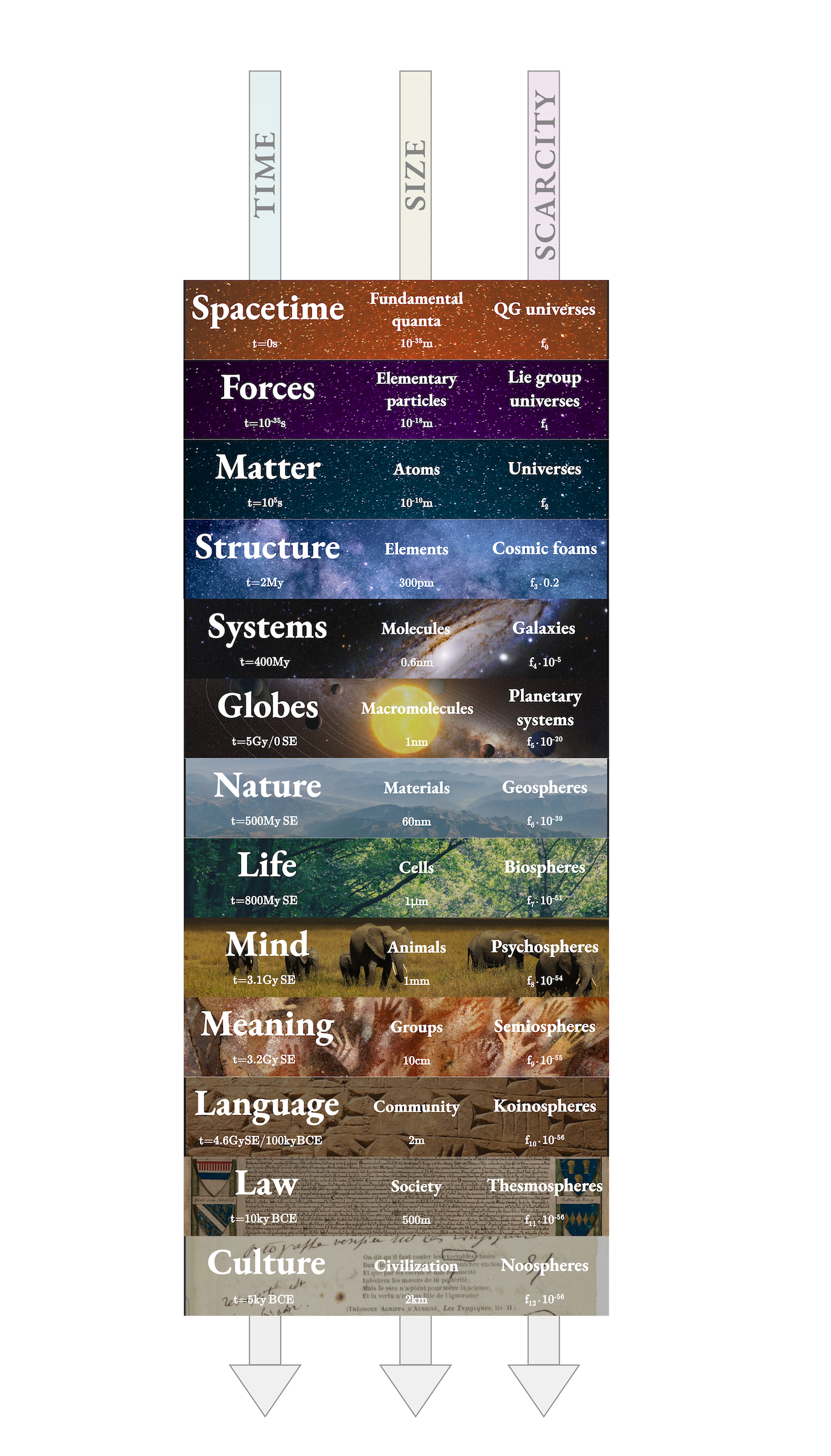
The Great Chain: Thirteen stages of evolution
Alexander Pope, Essay on
Man See, through this air, this ocean, and this
earth,
All matter quick, and bursting into birth.
Above, how high, progressive life may go!
Around, how wide! how deep extend below?
Vast chain of being! which from God began,
Natures ethereal, human, angel, man,
Beast, bird, fish, insect, what no eye can see,
No glass can reach; from Infinite to thee,
From thee to nothing.[...]
All nature is but art, unknown to thee;
All chance, direction, which thou canst not see;
All discord, harmony not understood;
All partial evil, universal good:
And, spite of pride in erring reason’s spite,
One truth is clear, “whatever is, is right".
To begin the next part of this work, let’s take heed of what’s been achieved so far.
Part I (the 6 levels) focused on what is known and what is lived, exploring the nuances between philosophy and science, between theoretical and practical knowledge, between action and life: that structure constitutes the vertical dimension of the classification I’m attempting here.
The next and deepest step is to work out the planar structure: what is. Part II approached that question from the most fundamental level, identifying the realms of existence, to end up with a comprehensive (if sketched) formalization of ontology (the eight storeys).
Step by step, we’ve ascended from basic questions about existence to:
Logic and mathematical objects (mathesis formalis)
The fundamental realms of the physical, the mental and the abstract (ontology)
Object composition and the basic structures that govern it (mereology)
Ordinary objects (metaphysics)
Possible worlds (modality)
Reference, truth and meaning (semantics)
Reason, norms and value (axiology)
Of course, for that progression to be intelligible, we’ve introduced a slew of real-life examples. Yet Part II was operating at the most general level, which considered the actual world to be distinguished by the author and readers’ presence therein, but its conclusions were not in any way germane to it.
In part III we will truly engage with the actual world, our world as it concretely exists in its physico-mental realization. The structures that we in our daily lives interact with, or that scientific disciplines try to illuminate, will not be used as placeholders or examples anymore: they will be the very object of classification. And the way we shall apprehend this is through stages.
Stages of organization
Natural reality presents itself in layers. We’ve had such an inkling earlier, showing how some facts can be a ground for, emerge from, or be reducible to others. It seems that everywhere we look, the complexity of the world can be tamed if we decompose it into a superposition of many levels. Those don’t just co-exist side-by-side, they participate in a tremendous hierarchical order. Glucose, dolphins, diamonds, London, Saturn, are all ordinary objects or kinds in a metaphysical sense, yet they intuitively belong to distinct levels.
That is not exactly a novel idea. Hierarchical depictions of nature can be traced back to the earliest days of ancient natural philosophy, with prominent representatives in Aristotle’s graded scale to the neoplatonist scala naturae, which would progressively transform, under medieval scholasticism, into what Arthur Lovejoy called the Great Chain of Being. Levels-based worldviews extend beyond that storied record in the Western world, cutting across cultures and eras to form a truly perennial aspect of philosophy.
Although the advent of modern science has put the traditional Chain of Being, like so many philosophical tenets, under serious strain, the kernel in this idea is as relevant as ever. It still appears to be a fruitful way to perform metaphysics’ core mission of "carving the world at the joints".
Sequencing principles
My proposal for a theory of levels will make use of both some traditional organizing principles as well as more innovative ones. In this section I will present six principles that have appeared, usually in a separate fashion, in similar theories. I will try to show how they can all be combined.
Complexity
Emergence of value and complexity
The first organizing principle corresponds to the perennial features I was evoking. Most ancient versions of the chain take a similar form to what we still find in 1920 in Samuel Alexander’s emergentist works:
Space-time
Matter
Life
Mind
Deity
This hierarchy takes a clearly normative tinge: there’s a clear sense that climbing this ladder brings us to some form of superior value, or, the ancients would say, of perfection and plenitude. The neoplatonist conceit that levels should move from the meagerest, least worthy type of entities, to some god-like ens perfectissimus was accepted essentially without question for centuries. The word hierarchy itself, whose invention is credited to Pseudo-Dionysius is a neologism from Greek, built out of hieros (sacred) and arkhia (rule).
But a scale of increasing value alone would just turn a list into a gradation. What makes it a layered structure in the way that we mean here is that, as Lovejoy puts it, "each higher order possesses all the powers of those below it in the scale and an additional differentiating one of its own". In other words, the emergence of a key quality bringing additional value is what secures the transition to a higher level.
Along that line, an angel or a god wouldn’t be an entirely "orthogonal" being to man; it would exhibit the same qualities and powers, but also others that can be deployed on a totally different plane (in this case a spiritual one). In the traditional conception, an angel could conjure a physical appearance and live like a human being, but of course it is what it can do beyond which is notable.
Besides the traditional progression from minerals to plants, animals, humans and onto spiritual entities, the hierarchical mania has manifested within every one of these broad levels. Animals were frequently organized in a similar manner, with simple beings of little agency, like oysters, at the bottom, and apex predators like lions at the top (and crowned as "kings"). Diamonds similarly stood at the top of a mineral hierarchy that also reflected other forms of value (aesthetic, economic...) but used some emergent quality as the rationale (like hardness).
This approach has been severely compromised by the paradigms of modern science. The discovery of how complex the living and material realms are, and how many U-turns, unexpected mergers and branchings their development has witnessed, have made the idea of identifying a scale of "perfection" too simplistic, and overly influenced by specifically human views on value.
But it has progressively morphed into a criteria of complexity. With levels of organization, entities are deemed to become elaborate, compounding the same structure observable in lower-level entities with another layer of organization. It is consistent in spirit with the traditional version, since complex entities are normally seen as "good" or "valuable" in some way, or at the very least as deserving attention, if not exactly admiration. It is also consistent at a high level with an important part of the natural chain. The gradation from rocks to living beings to thinking agents was previously attributed to the adjunction of emergent qualities via some immaterial fluid (a vital spark, a soul...). Modern biology has decisively rejected vitalism, and shown that specifically biological properties could be explained by the complexity of the underlying biochemical processes. Likewise, physicalism and connex doctrines (such as our own panpsychic monism) typically argue that mental activity can be explained by a nexus of complex physical or biological activities.
There have been many technical attempts to define complexity, to which a whole discipline is dedicated, but this should be understood here in the most general sense. Douglas Foskett explained that idea succintly, saying that the world of things evolves from the simple towards the complex by an accumulation of properties, and that, at a succession of levels, these aggregations reach new degrees of complexity and become new wholes, with individual and unique identities."
A good example of complexity-based classification of material entities is given by Joachim Forsche in 1965:
Elementary particles
Atoms
Molecules
Polymeres
Macromolecules
Viruses
Cells
Organisms
Organisms with central nervous system
Specific human structure
Note that it eschews lots of the other traditional tenets of organizing levels, which we will explore in due time. Viruses are not parts of cells, nor did they appear before them, nor are they always bigger than macromolecules. Yet in terms of complexity they are correctly placed in between macromolecules and cells, which makes this specific ladder intuitively intelligible.
Grounding, reduction & more
Another modern idea has prospered on the back of the scala naturae: not only are higher levels assumed to be complex than lower ones, that complexity can be explained, at least in principle, through an understanding of facts at lower levels, and of the laws governing them.
One will of course recognize in this theme the central tenet of inter-level metaphysics, a key conceit in the philosophy of science, which we’ve explored at length already, describing a gradation between supervenience, emergence, functional reduction, bridge-law reduction.
Auguste Comte, with his extremely influential classification of scientific disciplines, has laid the groundwork for more rigorous approaches to reduction:"we can divide [phenomena] into a small number of categories, arranged so that the study of each category is founded on a knowledge of the principal laws of the preceding one, and is the foundation for the study of the following one. The order is determined by the degree of simplicity, or what amounts to the same thing, of generality in the phenomena, resulting in successive dependencies, and consequently greater or less difficulty in study. A priori we can decide that the most simple phenomena, those least complicated by others, are necessarily the most general."
Comte’s resulting classification of phenomena might seem banal, but it serves as both the bassi for most subsequent descriptions of the levels of organization, it also makes a bold theoretical leap by extending the scope of scientific reduction.
Physical
Chemical
Physiological
Social
By jumping from physiological phenomena to the new science of sociology which he’s calling for, Comte was positing that descriptions of society must, at the positive stage, take the shape of a form of social physics, whose individual atoms are entirely determined by physiological laws. As imperfect and simplistic as that wish now seems, it clearly introduced a fruitful new paradigm that has bearing on what a layered approach to the world must include: reduction offers a rigorous justification for placing an entity "above" another.
The initial form of Comte’s idea may seem to cater to the positive, strictly materialistic worldview in vogue at the time (the 1830s) as a reaction to Hegelian idealism. Comte himself would later towards an original blend of positivism and spirituality (penning a "positivist catechism") and attempted to classify manifestations of the mind, but didn’t get to offer a unified view. Later on, the mental and cultural levels have largely been included, although strict reduction might not be the right tool, and a more general form of grounding prove more malleable.
James K. Feibleman, in 1954, introduced the following ladder:
Physical (cause-and-effect)
Chemical (combination-rearrangement)
Biological (sensitivity-reactivity)
Psychological (stimulus-response)
Cultural (contact-adaptation)
Reduction is by now an entrenched idea in the natural sciences, but the mere possibility of grounding the mental, the social or the cultural in the natural, or in each other, is a difficult endeavor, which is at the heart of the present work.
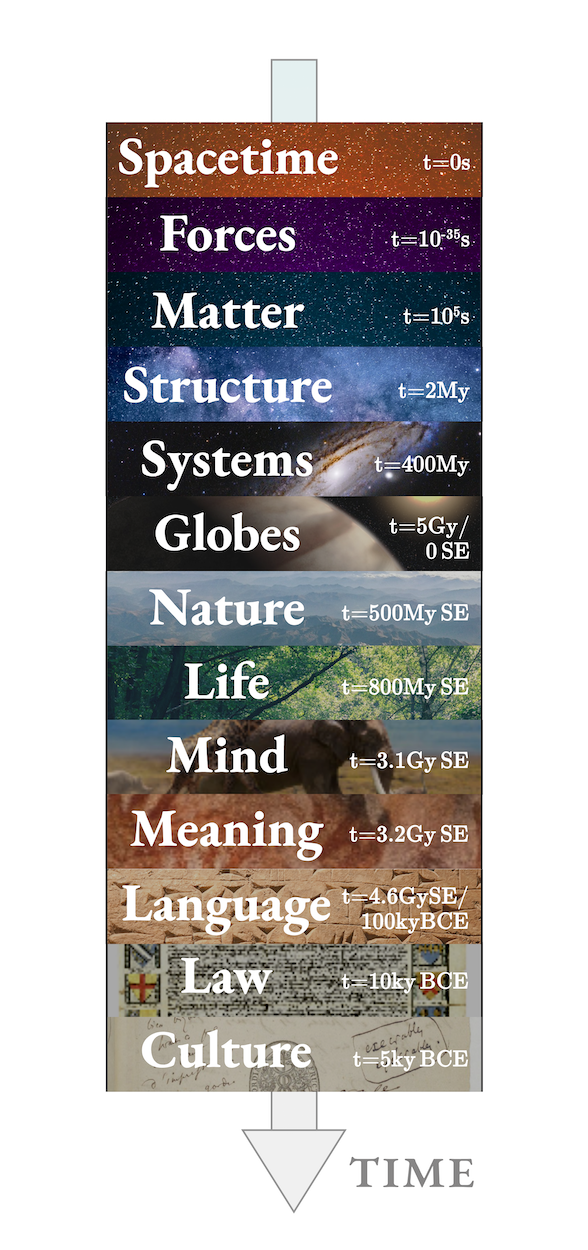
Time
Historical progression
Starting in the eighteenth century, concurrent developments in the sciences have led those to move away from the purported description of an eternal order to a historical approach. The early findings of paleontology were a driving element in the depiction of zoology and botany as a "natural history", which would of course culminate with the rise of evolutionary ideas through the work of various thinkers, none of which of course as earth-shatteringly influential as Charles Darwin, or course. The emergence of modern geology under the impulsion of Charles Lyell is another case of time playing a powerful explanatory role for longstanding but hitherto mysterious observations.
In effect, this led to a "temporalization" of the chain of Being, which again was put in prominence by Auguste Comte, this time with his "law of three stages" regarding the development of human tought: "each of our principal conceptions, each branch of our knowledge, passes successively through three different theoretical stages: the theological or fictitous, the metaphysical or abstract, and the scientific or positive."
This law not only states that each branch of knowledge develops through a necessary order, it adds that these developments do not need to take place synchronously and allows the coexistence of different states at the same time within a society. In other words, the consequences of the law are both diachronic (explaining the phases that physics or biology have gone through) and synchronic (explaining why physics and sociology today are very different: they are at different stages.
Even more, Comte claims that since the starting point for both individual and collective education is necessarily the same (presumably, a blank slate), "the principal phases of the individual represent the epochs of the species." This idea that ontogeny (the genesis of an individual) recapitulates phylogeny (the history of the genus) is another one that is debatable in practice and far from universal, but extremely fertile in the history of thought.
In the specific domain of the human mind, this was brilliantly put by Karl Mannheim in 1924: "Although the encroaching civilizational way of knowing increasingly drives these mythical and magical elements out of everyday practical knowledge, mythical and magical components do nevertheless survive in our everyday knowledge of life even today. [...] The consciousness of the individual, then, may be likened to a petrification of past ages in the history of consciousness, and just as geology can reconstruct the history of the earth’ crust, so the career of consciousness is preserved in stratified layers in the make-up of the individual consciousness of the present." Even in the socio-cultural realm then, elements that have arisen in different historical eras continue to co-exist, in juxtaposition with each other.
Evolutionary selection
The temporal dimension gained prominence in the natural sciences in many ways, but as we’ve noted, none was as consequential as the rise of evolutionary thought. Darwin’s theory distinguishes itself amongst other historical approaches by the elegance of the underlying mechanisms: traits are inherited but undergo small variations randomly over time (through genetic mutation, as we understand it now); individuals with certain traits show a level of fitness which will statistically result in the selection of that trait, effectively making a random mutation part of the dominant gene pool over time. This process is deemed to explain the tremendous diversity and complexity that humans have witnessed in the living world.
Evolution morphed form a purely biological theory to a more general aspect of scientific thought, a process that is often associated with Herbert Spencer. His own definition of evolution is general enough that it is reminescent of the complexity criterion: "Evolution is an integration of matter and concomitant dissipation of motion; during which the matter passes from an indefinite, incoherent homogeneity to a definite, coherent heterogeneity."
Spencer was outspoken about the applicability of evolutionary principles to sociology, but also to psychology, as shown in this extract:"I need hardly say that this evolution of composite feelings through the progressive integration of psychical states are connected in experience, is effected by the inheritance of continually-accumulating modifications. The law of development of the mental activities considered under their cognitive aspect, equally applies to them considered under their emotional aspect."
One interesting consequence of adopting an evolutionary framework in this study of level is the selection aspect. It is reasonably consistent with a more general understanding of complexity. Seeing the emergence thereof as a temporal process, it is sensible to imagine that the universe may need many "tries" to achieve the more complex system (or in a less anthropomorphic way, that the minute conditions required may be fairly rare). All stars may have been surrounded by a cloud of dust shortly after their life started, but only some let a full planetary system bloom. If we found life on numerous planets besides Earth, we would also expect that minority of them, if any, have seen the emergence of intelligent species.
Another principle in defining levels would then be that the higher we go, the fewer representative entities we will encounter of a given level of organization.
Space
Parthood & membership
The idea that levels of organization form nested hierarchies where lower-level entities compose higher-level ones has become a cornerstone of all levels worldviews.
Alfred Whitehead, in 1929, called that "the ultimate metaphysical principle", explaining that "the novel [composite] entity is at once the togetherness of the ’many’ which it finds, and also it is one among the disjunctive ’many’ which it leaves; it is a novel entity, disjunctively among the many entities which it synthesizes. The many become one, and are increased by one. In their natures, entities are disjunctively ’many’ in process of passage into conjunctive unity."
The part-whole relation is epitomized in many modern scientific discoveries, which generalized atomistic relations between different-sized entities, and sometimes used mereological composition as a stupendously successful way to explain the emergence of higher-level properties. The most striking examples that come to mind being the elucidation of thermodynamics through a statistical model of atom mechanics, of biological phenomena by biochemistry, or of countless macroscopic properties of common materials by quantum mechanics.
For a classic example of such layering, we can consider this contribution from George P. Conger in 1925:
Material realm
Energies
Electrons
Atoms
Molecules
Astronomical masses, or bodies
Solar systems
Star clusters
Galaxies
Universes
Biological realm
Organic compounds
Infra-cellular organisms
Unicellular organisms
Multicellular organisms
Plant-and-animal groups
Families or tribes
Nations
"The Great Society"
Neuropsychological realm
Specialized cells
Nervous areas
Reflex arcs
Complex reflexes
Instinctive emotional complexes
Sentiments
Values
Personalities
This example makes it evident that different types of relations can be lumped together under the "part-whole" moniker. It is not always clear whether the proposed ladders are homogeneous in metaphysical terms (a reflex arc is a physical entity, but a complex reflex is an action) or what the exact type of ontological dependency is (a molecule is fully characterised by its atom components — remove one and you have a different molecule; but removing one start from a galaxy or one family from a nation doesn’t change their identity, making those a structured collection of individual members, rather than a whole made of essential parts).
Individual size
This is a quasi corollary of the previous entry, as relates to the physical realm. If entities at one level are parts of higher-level entities, or members thereof, then entities at higher levels of organization ought to be larger.
The increasing awareness of microscopic structures and of the vastness of the universe, in step with the invention of the corresponding instruments, has certainly driven the revival of the levels worldview. The realization that similar structures repeat at vastly different scales could only lead to focus on organizational patterns. More generally, the level-integrative approach might help alleviate the vertigo that seizes us whenever we try to get a grip on the sheer scale of the physical world... even limiting ourselves to the observable universe, the dilation from Planck volume to Hubble sphere is hard enough to fathom for a human mind.
My principles: a manifesto
The classic sequencing principles that I’ve presented so far are sometimes hard to combine in a consistent manner, and the resulting lists can seem disjointed. Since the goal of this work is to present a novel approach that would resolve these age-old issues, I need to present some of the additional principles that I’m proposing to guide us.
Monism & panpsychism
A first pitfall we should be trying to avoid is a category mistake that is an unfortunate fixture in levels classification. At a high level, most modern ones end up looking something like this:
\[\text{Physical — Chemical — Biological — Psychological — Social - Cultural}\]
In this naive presentation, an astute reader would likely be confused by the ostensibly diverse ontological realms at play here. "The physical, chemical, biological" intuitively refers to natural kinds, and ultimately to the physical entities that exemplify them. "The psychological" is often understood in terms of mental states. Social and cultural levels often call for an abstract ontology (with objects such as institutions or customs).
At first sight, it may seem we’re facing a dilemma, and need to sacrifice either the linearity of the chain, or some key hierarchical inclusions. The former approach would lead to consider some domains in the above as categorically orthogonal, and ultimately to use several levels sequences. The latter would entail that a unique sequence may be kept, but at the cost of part-whole integration, size gradation, etc. — the linkage between different domains would be strictly grounded in historical or logical connections.
My inclination has always been to keep the unity of the world apparent through a unique sequence of levels, but I do not think that giving up on spatial integration is unavoidable.
My own classification of levels will refer to physical entities from top to bottom. To be more precise, since we’ve adopted a syncretic approach to panpsychic monism, the levels will be represented by physico-mental entities. The connection between the "natural" and the psychological levels is then more consistent, if not seamless. There is at least no hard discontinuity between physical entities on the one hand (cells, animals, humans) and mental states on the other. Instead we’re moving from a series of objects with no discernable consciousness, to the physico-mental complex that is an advanced animal.
The sleight of hand is in how to move from "exterior" phenomenal properties to the interiority of subjective minds, but I’ve made it abundantly clear that the canvas I’ve proposed does not resolve that "hard problem". However, it is equally welcoming to a future mental mereology that would lay the ground for a proper theory of consciousness, as to a full-blown physicalism, that would simply conclude that there can be no discontinutiy between the physical and the psychological, given that the latter fully reduces to the former.
Moving to the socio-cultural levels might seem more difficult. Colloquially, terms like "rock" or "human" apply in philosophy to concrete entities, while "society" or "culture" refer to abstracta. However, that is another form of Sorites problem where the discontinuity is hard to locate, let alone justify. As we’ve seen when we developed this formal ontology, most objects that we refer to as prima facie physical are actually ordinary objects, therefore part of the abstract realm: equivalence classes over the physical universe. Conversely, we could conceive of a socio-cultural concept (for instance a country) as an ordinary object. With the right definitions, we could in principle reverse-engineer a set of physical entities from the end result (the concept that we aim to match with the ordinary object) and the relevant identity relation.
The flexibility that is gained from the scope of objects we’re dealing with (physico-mental entities that deploy in space and time, allowing the physical component to be an event or any other form of spacetime "slice") and from mereological universalism (allowing us to select arbitrary unions from other objects) is paramount in making that method sound.
We could take the example of a social institution, the Louvre museum. Assuming we’re building up the social institution levels from the human being level, then the physical manifestation of any institution must be some collection of humans. Which means it is not what intuition would nudge us towards: a building and the art pieces inside. Loosely speaking, we are instead looking at the collection of all humans who have visited, read about, worked at, managed the Louvre during the time it has been a museum. Furthermore this collection of humans is not just about flesh and bones, it is about the thoughts they had and generally speaking the mental state they were in, at the moment they had "Louvre-thoughts".
To visualize, think of our universe as a big piece of spacetime cake. The sum total of humanity is a reunion of all human physico-mental manifestations, like so many raisins in that pudding. The concrete projection of "the Louvre" is yet another tiny sub-set of that, uniting some micro-parts of a (relatively) small number of raisins. Of course that concrete projection alone doesn’t make the Louvre what it is — it is the identity relation that helps raise it to the more abstract level of an ordinary object. And since thoughts themselves have content and a complex semantic component, we’re already up several levels of abstraction...
I believe this representation, although it may seem counter-intuitive, helps unify the world in a way others don’t, and decisively rejects the deceit that is often lurking around the shroudy realm of ordinary objects. It forces us to be honest, and when talking of seemingly "very physical" entities like molecules, to acknowledge that the fundamental physical object itself is quite distinct from the role played by the epitome of the chemical level, and is in fact only a mere aspect of it.
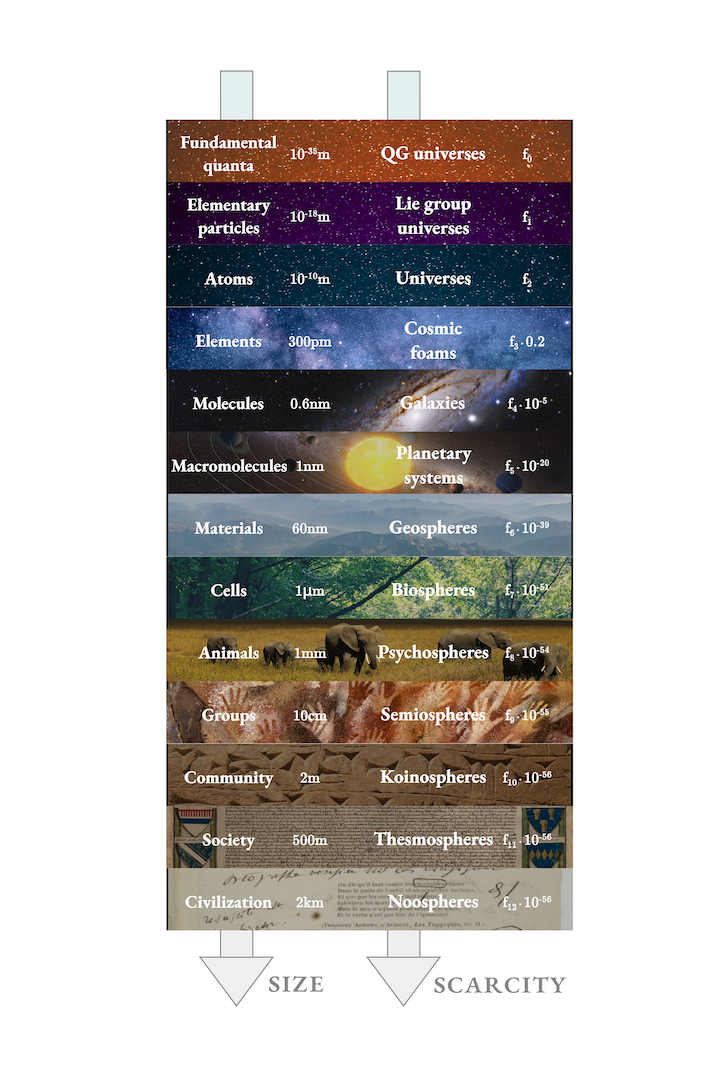
A double axis of scale
The second principle I’d like to introduce aims to cure the ailment of the spatial sequencing approach. As I explained, the discovery of more and more structures at various scales has had a powerful effect on human imagination.
A purely spatial approach would yield this type of output: \[\text{Atom — Molecule — Living being — Biosphere — Planet — Galaxy — Universe}\]
The obvious issue is that sorting by size is not at all consistent with sequencing by time or complexity. Human beings are more complex than both atoms and galaxies; human beings also appeared after both atoms and galaxies. It seems that the spatial ladder is then painting a non-monotonous picture. By moving from the very small to the very large, we are at first going through more and more complex and more and more recent entitites, then through simpler and simpler, more and more ancient ones again.
The suggestion is then to use time as a primary scale (complexity is harder to quantify), and to represent spatial integration via two axes. The first axis represents an increasing sequence in terms of time, complexity and size, looking somewhat like this: \[\text{Atom — Molecule — Cell — Multicellular being — ...}\] The second axis reflects progression in time and in complexity too, but structures of decreasing size: \[\text{Universe — Galaxy — Star — Planet — ...}\]
Am I now doing what I vowed not to: to eschew the unified approach in favor of several disjointed views of levels? Far from it: as the next subsections will show, the key part is now to show how structures from the two axes interact with each other.
Production in a mesosphere
The aspect I would like to not only introduce but put firmly in the spotlight is the thermodynamic aspect of organization.
We know that entropy in a closed system always increases — not so much a "fundamental law" as the mathematical consequence of having an "arrow of time" at all. Entropy is not exactly a "measure of disorder", although the concepts are closely linked. It is more exact to represent it as a measure of uniformity. When cold milk is poured in piping hot coffee, the resulting beverage is uniformly lukewarm: entropy has increased.
Indeed, our lived experience teaches us that complex, heterogeneous structures, if they’re left alone long enough, do turn into more simple "stuff". Living bodies turn to dust, one way or another; abandoned buildings becomes ruins; books decay until they’re illegible...
Yet, the universe also teaches us the exact opposite, constantly! I’ve spent much time above commenting on the rise of complexity, assuming as an obvious posit that it had increased through time. A human being is more ordered than a cloud of space dust, and therefore it has lower entropy, yet it has evolved from that space dust!
The reason the second law is not broken is of course that a human is not a closed system. Entropy inexorably increases in the universe as a whole, but it can decrease locally. Since the appearance of life on Earth, it has arguably been continuously decreasing on our planet. That is because on a higher echelon, that of our Solar System, entropy in massively increasing, thanks to the Sun’s activity.
That, in itself, deserves some explanation. The Sun is a big ball of plasma undergoing nuclear fusion. For the most part, it takes hydrogen nuclei (one single proton) and turns them into Helium (two protons, two neutrons). The latter is obviously a more ordered form of matter, since each of the bound nucleons need to have specific energy levels. Indeed, an isolated Helium nucleus has lower entropy than four Hydrogen nuclei. But another key output of that nuclear process is the tremendous amount of radiation emitted by the Sun! Neutrinos, but also, of course, photons: the sunlight we get to bask in every day of our life.
As it turns out, converting the kinetic energy of pressurized Hydrogen into the heat of a uniform radiation is an entropy boost that more than compensates all the entropy-lowering events happening in the Solar system (Hydrogen turning into Helium, planets forming, life evolving, human beings writing books, etc.). All the complexity that we witness at the surface of the Earth is then permitted by the radiating energy from the Sun, which is true in more ways than one: entropy-wise, as we’ve just seen, but also in causal terms, since solar rays not only serve as an energy source for plants and other living beings, they’re also the impetus for the all-important genetic mutations that are a pre-condition for the evolution process.
As we see, the ladder of complexity cannot be ambled along passively, just marvelling at the "ethereal" emergence of order. We need to understand at each level what is the entropy-boosting milieu where that emergence can take place, and what production process the lower-level entity is undergoing. We will call that milieu the mesosphere, since it falls right between the higher-scale environment, and the higher-level (complexity-wise) milieu that follows on the coattails of the entity thereby created. For instance, our planet, seen as a geological entity, is the mesosphere relatively to the emergence of life. The Solar system and the galaxies are higher-scale entities which transitively are also home to life, but are "mega" rather than "meso", being wider lenses than necessary. The biosphere is a higher-level (complexity-wise) and lower-scale (spatially) than the planet, but we can see that it’s not the mesosphere, since it is ontologically dependent on life — therefore it cannot be the relevant milieu for the original appearance of life.
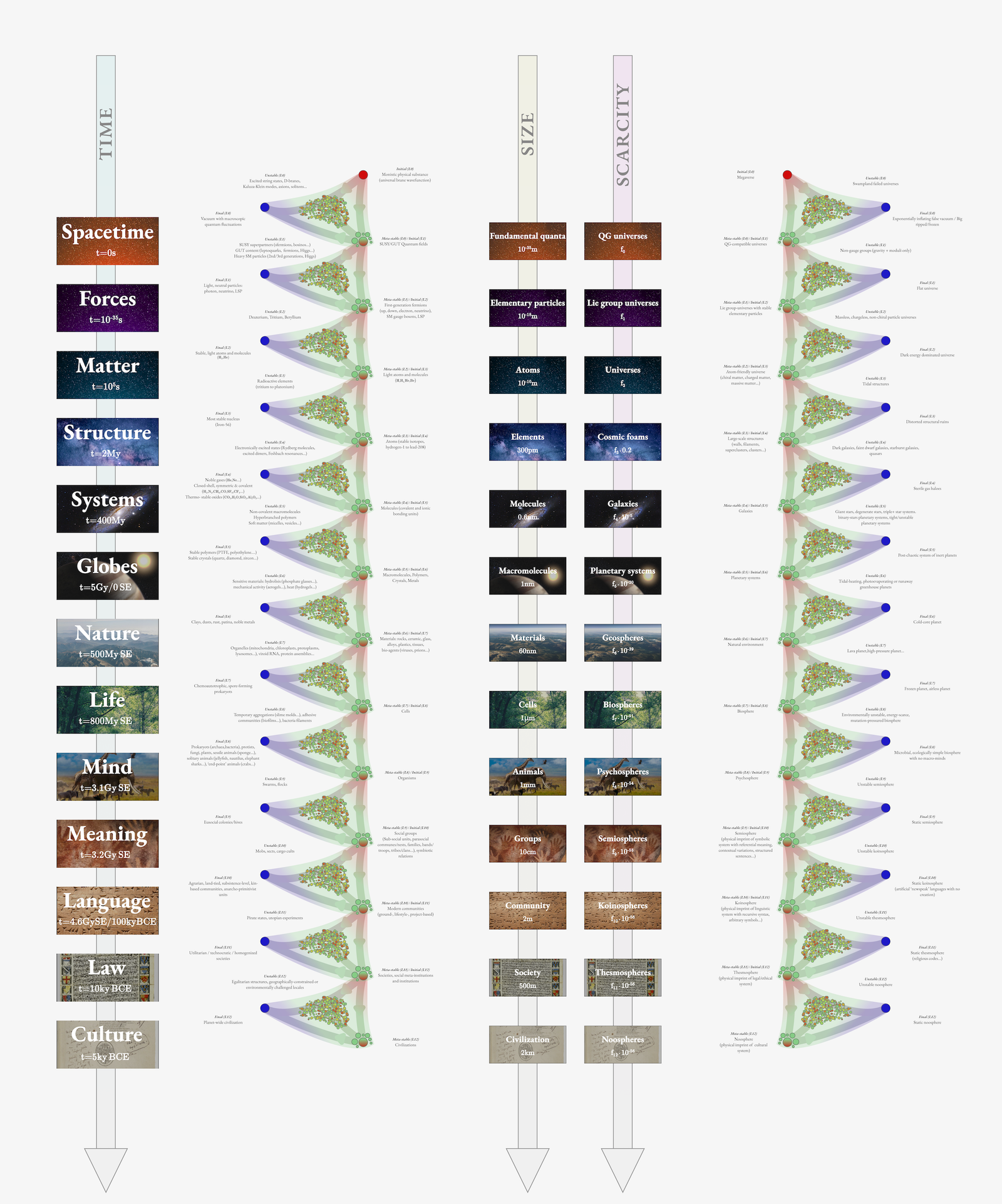
Meta-stability and final states (an axis of rarity)
This thermodynamic picture should also encourage us to consider the idea of equilibrium. The principle I’d like to expound is as follows: at a given level, the condition for the emergence of a higher level of complexity is that both the basic entities that will make up the higher level and the mesosphere where that production will happen be in a state of metastable equilibrium.
The following are usually distinguished:
Stable equilibrium corresponds to a state of maximum entropy that is either an absolute maximum or a local one that would require a very large infusion of energy to transition to another state.
Metastable equilibrium is a local maximum of entropy that can be pushed into a transition with moderate levels of energy, or would spontaneously transtion but over a very long timeframe.
Unstable equilibrium is a state that would not persist on a long timescale.
An example will help: let’s consider on the axis of "the small" the level of atoms, or more precisely nuclei. Atoms are produced in stars and other astronomical bodies, so those can be considered the natural mesosphere: we place ourselves at that level on the axis of "the large".
It’s important to understand that the notion of equilibrium is level-dependent. What an "insignificant", "moderate" or "large" level of energy is, does not hinge on the type of energy levels we experience here on Earth, nor does it relate to universe-level extrema: a "large" level should be understood as what we would find in a star (propitious conditions for nuclear fusion).

Let’s briefly recapitulate the production process at play here, not to go on a long tangent, but to really consolidate the more theoretical groundwork we’re laying out.
Initial elements: at the time the first stars appear, we can find nuclei of the simplest sort: almost exclusively Hydrogen (single protons rather than an nucleus, in fact) or light elements like Helium or Lithium (atomic numbers 2 and 3), a by-product of the Big Bang nucleosynthesis.
Production: Heavier elements up to Iron (atomic number 26) can be produced in stars’ core. All remaining naturally occurring elements (up to Plutonium, atomic number 94) are the result of a catastrophic event that concludes or follows a star’s lifespan (e.g. a supernova, or neutron star merger).
Unstable elements: Most elements have naturally occurring isotopes that undergo radioactive decay, for instance Carbon-14, which decays into Nitrogen. Some elements are primordially radioactive (they don’t have any stable isotope). Over time they follow a decay series: for instance, over a long period, Uranium-238 will transmute several times and stabilize as Lead-206.
Metastable elements:There are 251 so-called "stable nuclei", which don’t undergo radioactive decay (or if they do, their half-life is higher than ten thousand times the age of the universe). That includes most of the ordinary matters surrounding us (Carbon-12, Oxygen-16...).
Stable element: Most "stable nuclei" are in fact only metastable: they can eschew transmutation for a very long time without any energy inflow. In fact, much longer than our universe is likely to last (or before other effects, quantum or gravitational woulc come into play). So they’re likely to prove acutally stable. But they are not necessarily so. Elements heavier than Iron that are not radioactive can still undergo \(\alpha\) decay, double-beta decay or spontaneous fission, or other extremely infrequent nuclear processes. Elements lighter than Iron can undergo cold fusion to grow heavier. The point of convergence of either process is the only stable element, the one with highest nuclear binding energy: Iron-56. That nucleus cannot undergo a fusion nor a fission. If the universe never ended and never experience higher average energy levels than today (for instance, in a Big Crunch scenario), then all nuclear matter would be Iron-56. It’s estimated that process would only be complete after \(10^{1500}\) years, an unfathomable duration...
This example should demonstrate a pattern that we will find time and time again. From the basic state can emerge many complex structures, most of which are transient and unstable. Only the metastable ones are at the same time durable enough and prone enough to change to allow for the emergence of an even higher level of complexity. In contrast, the stable states represent the entropic fate of the world. Everything has decayed into dull uniformity, whence nothing else can emerge. Chemistry can thrive with carbon, nitrogen, oxygen atoms... In a world of iron, the most complex structure you’re bound to get is a big metal sphere!
Complexity, like life, then must be a parenthesis in the vast fabric of time, and be always on edge: metastable, sure, but over shorter and shorter timelines.

Emergence of perfection as plucking of abstracta
One last aspect is an important foundation the whole edifice. There’s a type of physical object that is occasionally, and quite awkwardly included as a level in itself: \[\text{Physical — Chemical — Mineral — Artefacts — Biological — Human — Mentefacts...}\]
Carlo Gnoli’s work on Integrative Levels, among others, had correct deemed artefacts and mentefacts to be worthy of their own category in an ontology. But to incorporate them as part of the levels ladder can feel odd.
Artefacts are definitely more complex that most naturally occuring objects, but incredibly less so than the products of biological evolution. A clock beats a rock, sure, but even a single cell is several orders of magnitude more "advanced". Yet the clock is ontologically dependent on its creator, humanity, each member of which is itself much more complex than a cell. Trying to force artifacts in this classification seems to break down the relationship between time and complexity.
So, instead of objects, we should in this case focus on the process, namely the plucking of abstracta. A key question in metaphysics that we’ve encountered time and time again is how physico-mental entitities can get to know the abstract realm. Notwithstanding the exact answer, there is a correspondence between physico-mental levels on the ladder we are building now and abstract levels. Hominids got to develop proto-human language, plucking content from the Third Realm. Modern civilization created arts and norms that pluck value to mesh it into the complex linguistic framework it had been using, and enshrine it in physical artefacts. Content and value have always existed: they are necessary and out of space and time. But they physico-mental manifestations (thoughts, utterances, objects...) are not independent levels; instead they are connected to the specific levels who do the plucking.
The meaning of the world
I’ve presented the different principles which I shall try to abide by when presenting my levels of organization. But before launching into that new venture, I’d like to take stock and offer a tentative outlook on what one may call, a bit emphatically, the way of the world, or the meaning of life.
Abstracta are necessary, omnipresent and eternal.
Physico-mental complexity is fleeting and marginal.
The plucking of distinguished abstracta by complex concrete structures is the finality of the universe.
To endorse, as I have, Platonism, can be dispiriting. That all mathematical objects exist is quite convenient. But that all possible and conceivable abstracta do, is less of an attractive proposition: can we marvel at the Sistine Chapel, Mozart’s concertos, or Baudelaire’s poems, if they (and the thoughts and feelings they elicit) are mere embodiments of an unfathomably complex abstract entity that always was? Even more, if there is an unlimited manifold of unseen, unheard, untold chapels, concertos and poems?
Yet, dismay or relativism would be unwarranted. It is the meeting between the plenitude and eternity of the abstract realm and the ephemeral complexity of our world that gives it true meaning. The value of La Recherche, of Abbey Road or of Le Souvenir does not lie in books, records or a painting, nor does it reside in the abstract representations that contain their various informational, semantic and axiological layers. Their value is in the connection between ourselves, transient shadows in the universe’s cauldron, and the everlasting abstracta through the looking glass.
The chain
Each level will now be briefly described in terms of their place in the spatial, temporal and equilibrium progressions. Levels are labelled with numerals, and adjoined with, for entities from the "micro" axis, an \(\epsilon\), and for those from the "mega" axis, an \(\Omega\).