Six planes
Part I of this book will depict the longitudinal structure of the Map. To put it another way, we will travel along the simplex from its basis to its tip. In doing so, we will encounter six layers called planes These six planes will cover two aspects of our classification: the semantic, or what is known (four planes) and the phaneral, or what is lived (two planes).
These two adjectives, first of all, may seem entirely obscure or at least very questionable. And indeed, their choice is predicated upon conclusions that shall only be reached at the end of this journey! All I can do now is to briefly sketch my reasons.
"Semantic" may seem out of place, since it normally refers to what is meant, not what is known. But through our study of semantics, we will accept that meaning is two-dimensional, and that its metaphysical nature (relative to how things are) is thoroughly entangled with its epistemic nature (relative to what is known).
As to "phaneral", it’s a neologism based on phaneron, a term I borrow from Peirce. I’m not using it for the sake of innovation, but as a substitute for other terms we could be tempted to place here in relation to "what is lived". "Phenomenal" would not be far off the mark; the prominence acquired by phenomenology writ large in the history of philosophy has broadened the meaning of that term from Kant’s usage, roughly limited to sensory perceptions, to a more generic attribute of the subjective. Unfortunately, a concurrent vogue has developed in analytic philosophy of mind, where "phenomenal" denotes a range of mental states that relate to subjectivity, but in a comparatively narrow way. Lest I may invite perplexity, I preferred to dispense with using that term in this context. Peirce’s invention of "phaneroscopy" is quite prescient as to what phenomenology would be, and thus a decent fit for what we want to convey: a concept to denote all that is imagined, felt, thought, desired, done, lived through.
Another question may arise about the grouping we’re performing. I described three aspects of classification: what is, what is known, what is lived. But the sole aspect of what is gets a transversal representation (lengthwise), which is two-dimensional, while the other two, lumped together, only get a longitudinal representation (cross-wise), which is one-dimensional. Indeed the causal feedback between these aspects is such that it makes sense to represent them on a continuum. What is known influences what things are done or what experiences are lived. But things are known in the first place because of actions and experiences. We will come back on this at length.
Let’s now recede from generalities and present those six planes. To frame my model, I’ve relied on two series of Aristotelian concepts.
Theoria, Poiesis & Praxis
This tripartite categorization features the three types of human activities according to Aristotle. Theoria is typically characterized as the actualization of knowledge through reflection. It is exalted by Aristotle as the most continuous, pleasant, self-sufficient, and leisurely activity available to humans. If taken to the degree of a "supreme virtue", theoria could bring "perfect happiness". Poiesis is literally the act of making, of bringing to the world something that wasn’t. Praxis covers human actions that are their own end, the "shaping of man by man"; for Aristotle, political or ethical actions would be prime examples.
This ternary movement improves on the simplistic dualism between "theory and practice", which my description of what we know and what we do could seem to imply. Theoria is well-suited to represent the former while both poiesis and praxis, contingent and practical in nature, seem a better fit for lived human experience. But another pairing emerges: Theoria and praxis are both an end unto themselves, an actuality (energeia) that only tends to its own improvement; poiesis also involves energeia, but ergon, the final product, is what the activity tends towards.
The intellectual virtues — Sophia, Phronesis, Episteme & Techne
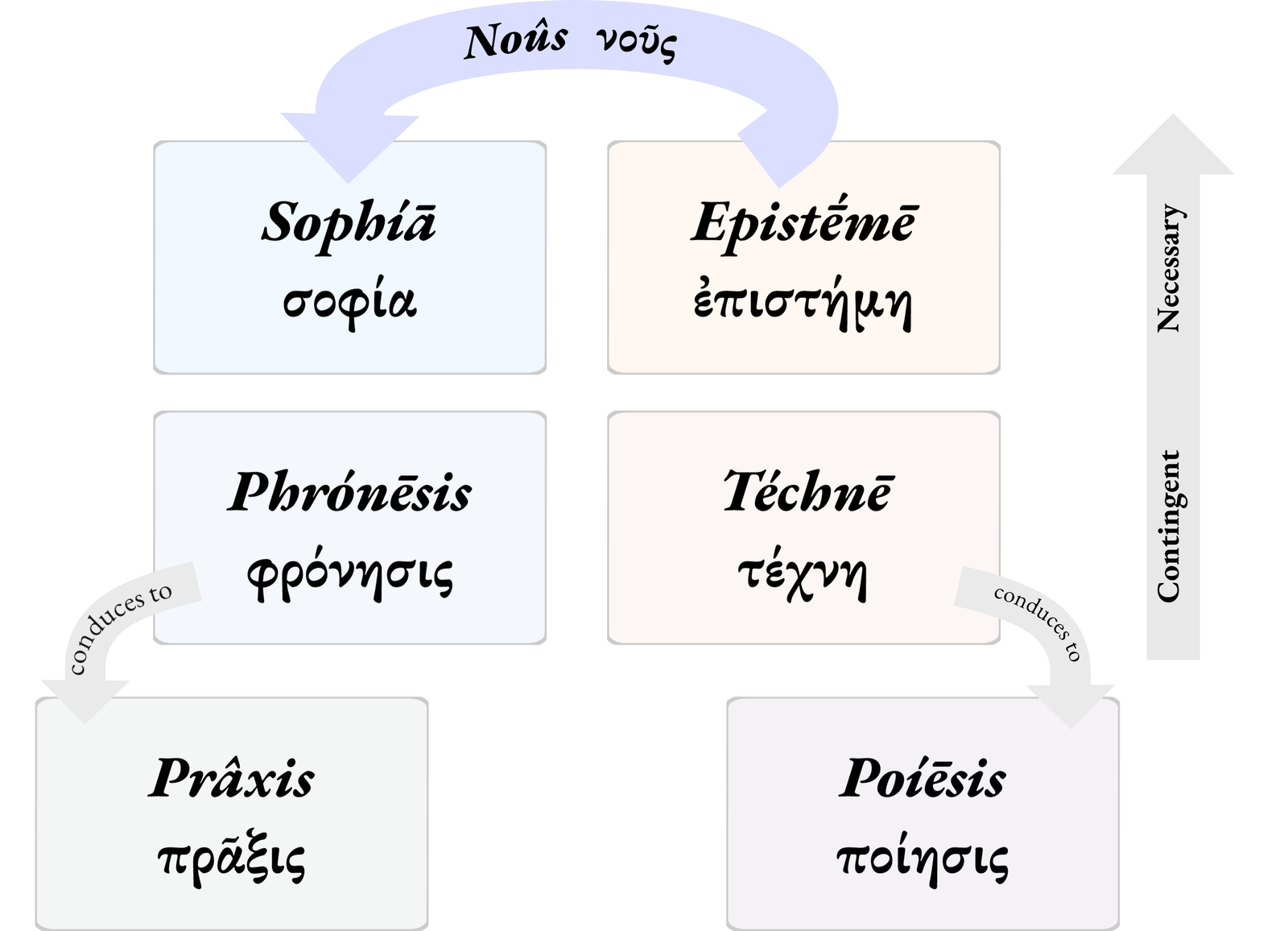
They are introduced in Aristotle’s Ethics (Book VI). One may wonder why these virtues of thought (dianoia) are introduced in a work that’s ostensibly about moral philosophy. Aristotle frames his Ethics around the concept of human good, of which happiness (eudaimonia) is the ultimate state. To reach it, humans must live according to the most complete aretai (virtues), among which are the intellectual virtues.
Episteme and techne are commonly translated as "science" and "art" (or "craft") respectively, which could harbour some misleading notions based on our current usage of these terms. Aristotle seeks to distinguish between two types of knowledge: scientific knowledge is necessary and considers "things which could not be otherwise"; technical knowledge is contingent, focusing on "things which could be otherwise", and leads to a disposition towards genesis (engendering), which manifests through poiesis.
Sophia, "wisdom", is clearly presented as superior to episteme but is only fleetingly described by Aristotle. The wise man is said to use scientific knowledge and "intuitive reason" (nous) to gain a knowledge of principal, primary truths, and of how to use them. Phronesis, practical wisdom, can be said to be to sophia what techne is to episteme. But where techne is conducive to "production", phronesis governs actions and is similarly linked to praxis.
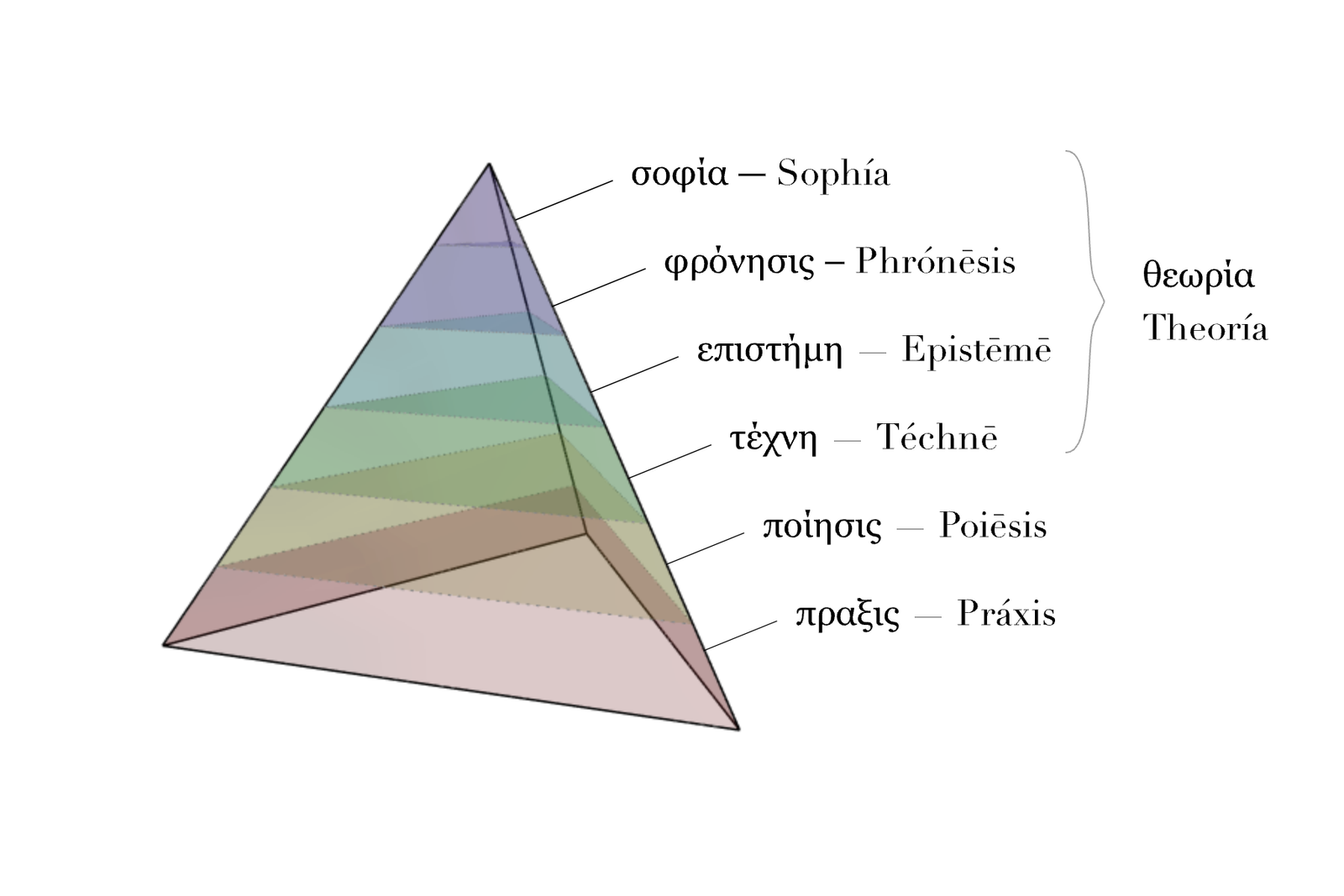
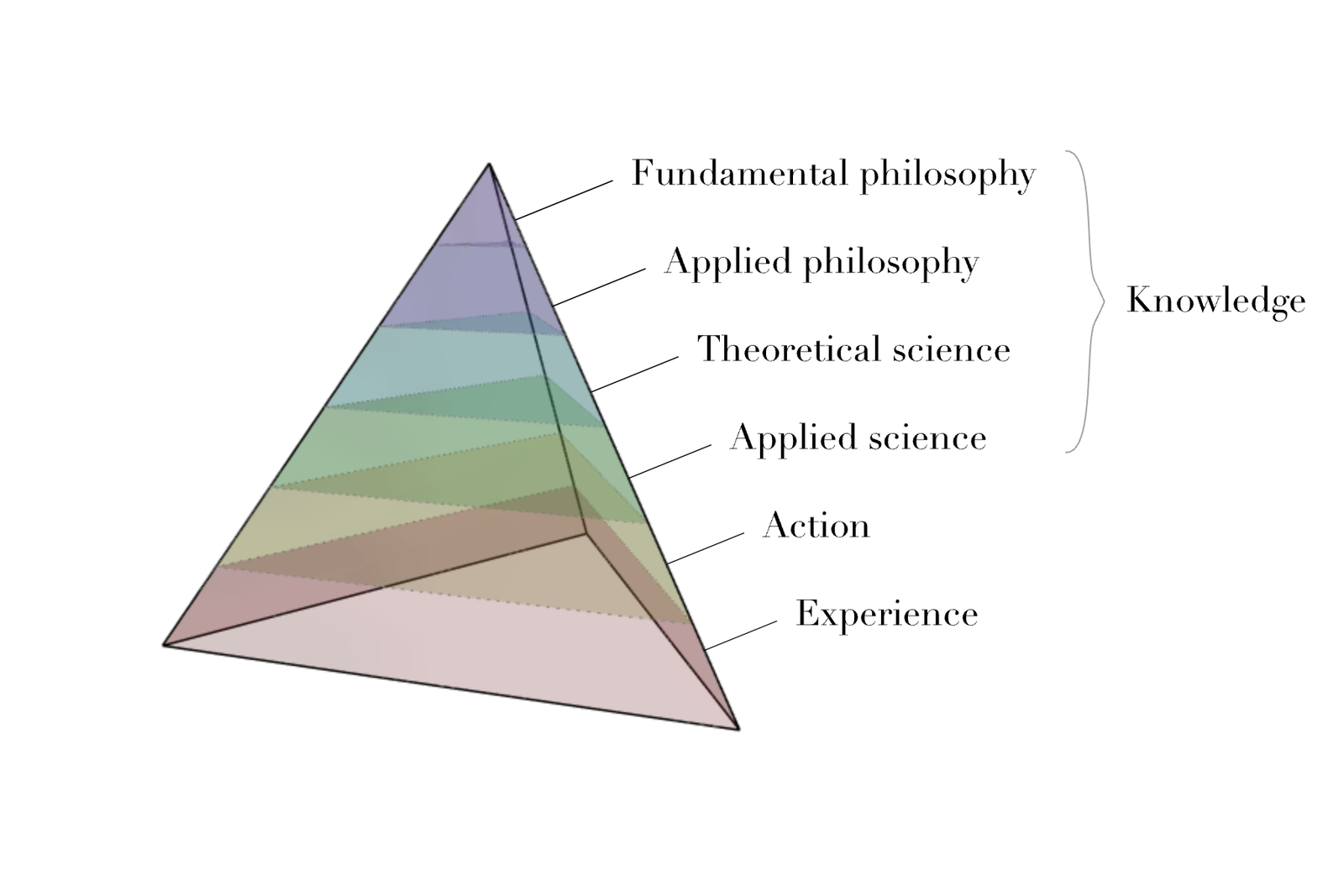
I will now present my six planes, named after these Aristotelian concepts, alongside simple definitions (expressed in common parlance, more details will follow about what that really means). The levels are:
Theoria: human knowledge
Sophia : fundamental philosophy
Phronesis: applied philosophy
Episteme: fundamental science
Techne: applied science
Poiesis: human activities
Praxis: human experience
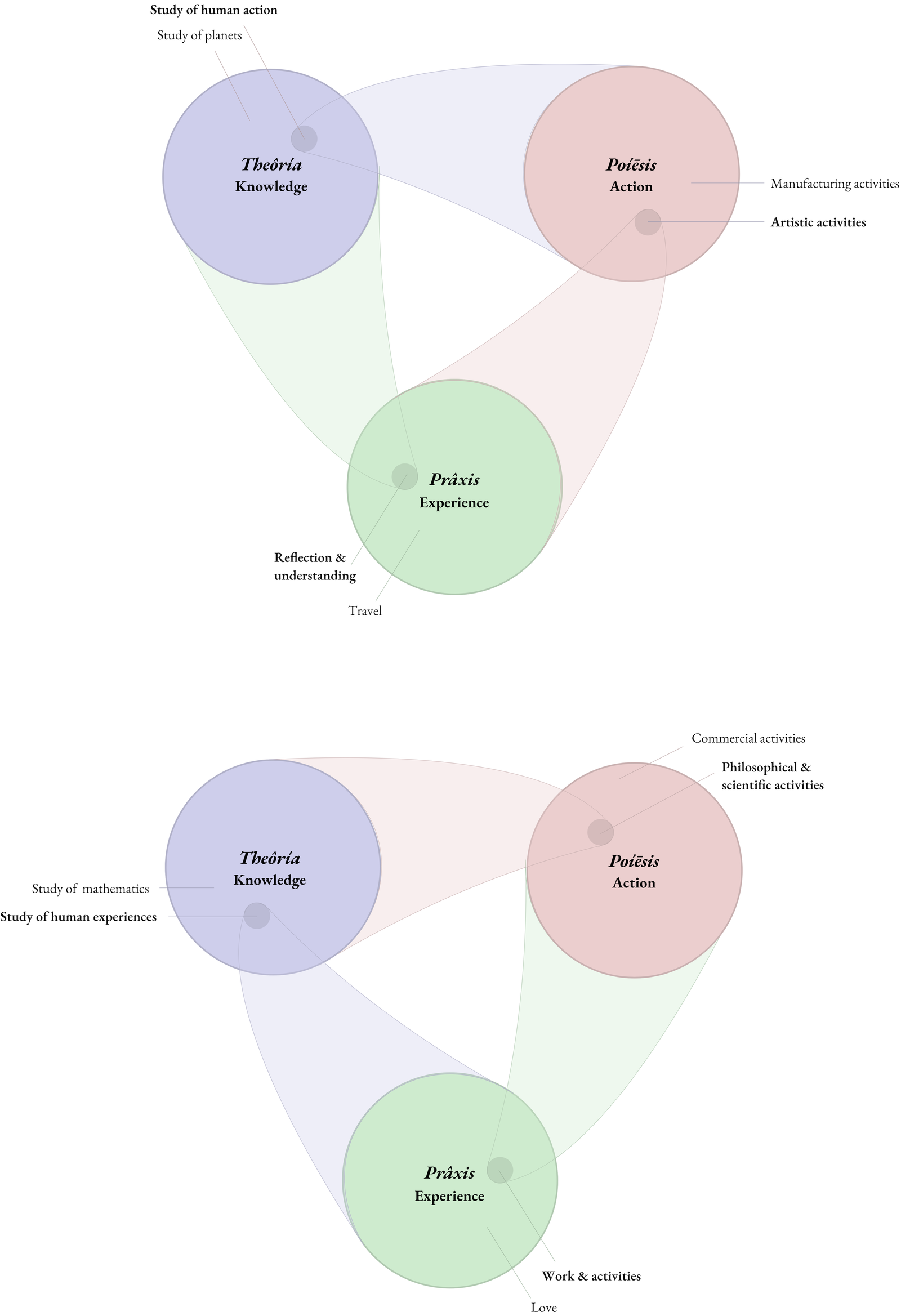
My approach to the basic triad differs a bit from the classic version described above. Where Aristotle sought to break down human activities in a threefold way, I’m considering the three concepts as being on different levels. As we shall see on the map itself, this version of the triad is actually nested on itself: each level can encompass the other two.
Theoria can have as a subject matter the gods, rocks, fish or planets; but it can also reflect on human activities like industry or medicine (poiesis), or human experience like love or justice (praxis). The mere fact that Aristotle had to engage in theoria to flesh out these concepts proves the point.
Poiesis includes all human activities. That can mean manufacture or education, but also the activity of a philosopher or scientist engaging in theoria, which then becomes the product (ergon) itself. Similarly, cultural and artistic activities writ large can be said to "produce praxis" in that they elicit in others various forms of human experience.
Praxis covers the lived experience of human beings. It incorporates experiences that Aristotle defines as actions that "are ends unto themselves", such as affection for others, or participation to the city’s affairs. It comprises poiesis under the guise of work and other productive activities performed with ergon in mind, and theoria as an inclination to reflect and understand. To put it simply: most humans do work and learn, but that is only part of their day!
I will now devote some time to a closer examination of all four theoria levels. Crucial choices regarding the definition of these terms need to be made and explained, lest terminological debates swirl up to a point where they engulf all subsequent sections of this work.