Claude Gellée, called le Lorrain
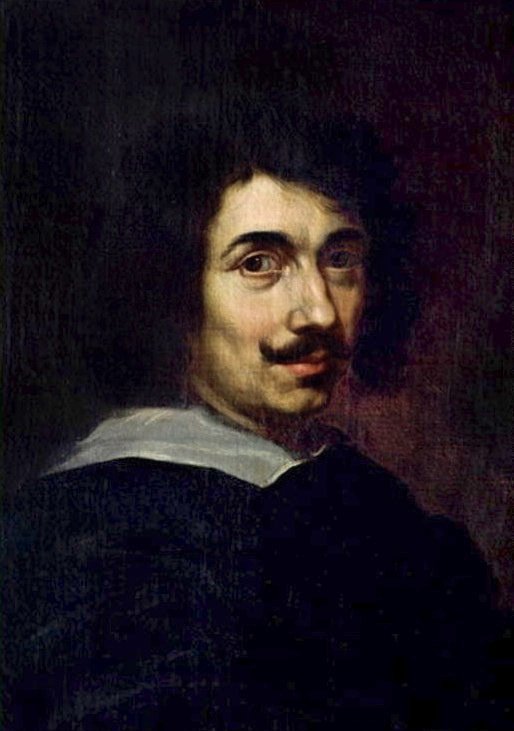
Born around 1600 at Chamagne, a village in Lorraine, and dead in Rome in 1682, Claude Gellée painted neither battles nor martyrdoms: harbours at sunrise or sunset, countrysides crossed by rivers, groves where small mythological figures lend the picture its title. On this apparently minor subject he built one of the most influential œuvres in history: the inventor of the ideal landscape, and the first painter to look the sun in the face.
Key facts
- Born
- c. 1600 at Chamagne (Duchy of Lorraine)
- Died
- 23 November 1682 in Rome, where he spent nearly all his life
- Training
- In Rome by c. 1617, under the landscapist Agostino Tassi; back in Lorraine 1625–1626, then Rome for good
- Breakthrough
- 1630s: commissions from Pope Urban VIII and Philip IV of Spain
- Liber Veritatis
- ~195 drawings recording his paintings against forgers (British Museum)
- Œuvre
- ~250 surviving paintings; major groups at the Louvre and the National Gallery, London
A Lorrainer in Rome
Orphaned early, Claude reached Rome as a teenager — a pastry-cook's boy, according to the legend passed on by his friend Sandrart — and entered the workshop of Agostino Tassi, painter of frescoes and marines. After a brief return to Lorraine (1625–1626, with Claude Deruet in Nancy), he settled in Rome for good, on the Via Margutta, at the heart of the colony of northern artists. Recognition came quickly: in the 1630s Urban VIII and Philip IV of Spain commissioned series from him, and for half a century he remained the most sought-after — and most expensive — landscape painter in Europe. Forgeries multiplied to the point that from 1635 he kept a drawn register of all his paintings, the Liber Veritatis or "book of truth", now in the British Museum: an exceptional source, almost unique for the seventeenth century, on a painter's production and patrons.
The ideal landscape
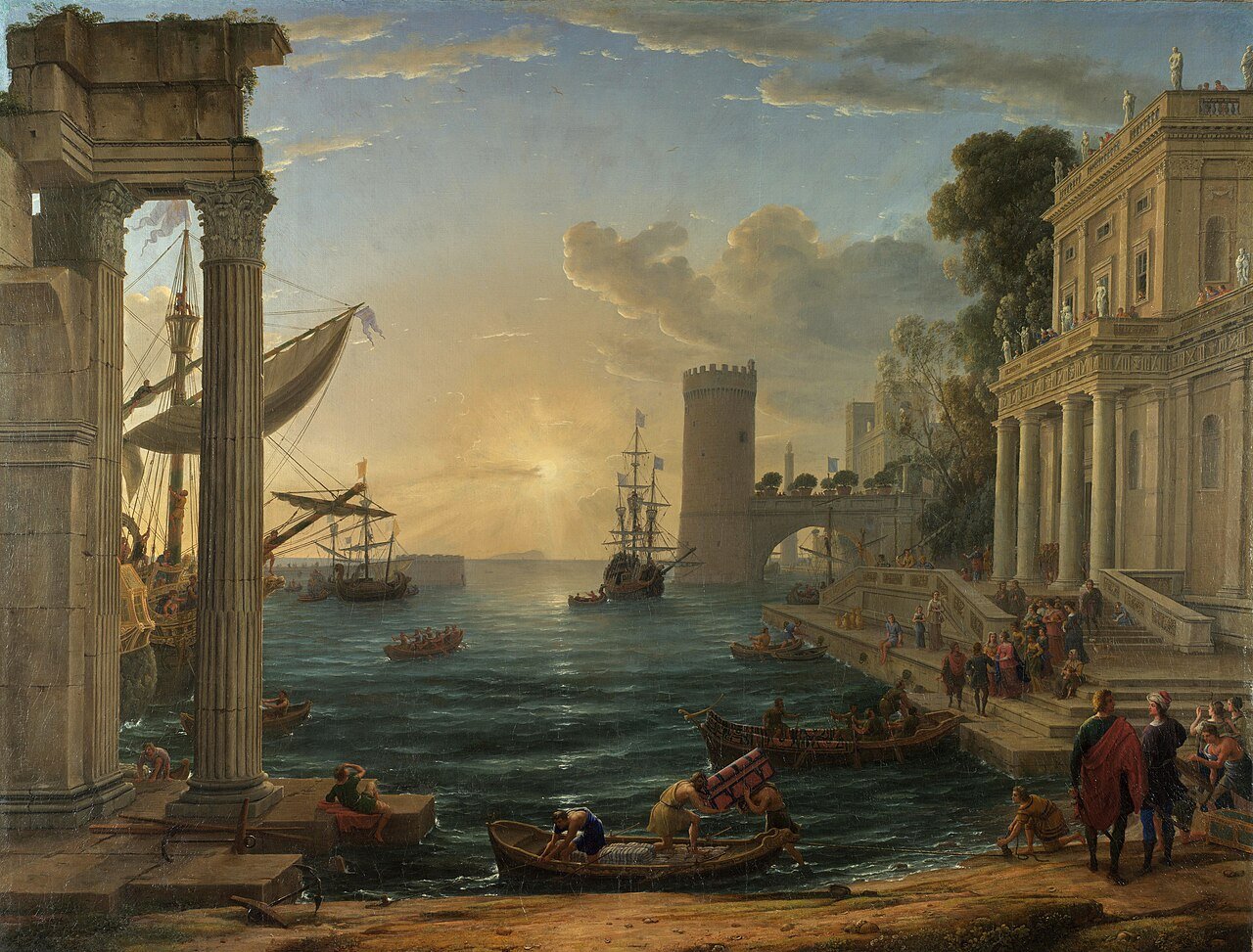
Claude does not copy nature: he recomposes it. From drawings made outdoors in the Roman countryside — the famous campagna, its aqueducts, umbrella pines, the Tiber and the Alban hills — he built up in the studio "composed" landscapes of inexhaustible efficacy: tall framing trees at the side, staged planes leading the eye from the shadowed foreground to a distance bathed in light, an antique building or a harbour to frame the scene, and small figures — Aeneas, Ulysses, the Queen of Sheba, Psyche — raising the whole to the dignity of the "historical landscape". His own revolution is light: he dared to place the sun inside the picture, facing the viewer, and to paint its effects — golden morning hazes, evening blazes over the sea. Poussin, his neighbour and friend, constructs; Claude radiates.
Major works
| Work | Date | Location |
|---|---|---|
| Seaport at Sunset | 1639 | Louvre, Paris |
| The Disembarkation of Cleopatra at Tarsus | 1642–1643 | Louvre, Paris |
| View of the Campo Vaccino | 1636 | Louvre, Paris |
| The Embarkation of Saint Ursula | 1641 | National Gallery, London |
| Seaport with the Embarkation of the Queen of Sheba | 1648 | National Gallery, London |
| Landscape with the Marriage of Isaac and Rebecca ("The Mill") | 1648 | National Gallery, London |
| The Enchanted Castle (Psyche outside the Palace of Amor) | 1664 | National Gallery, London |
| Landscape with Aeneas at Delos | 1672 | National Gallery, London |
| Ascanius Shooting the Stag of Sylvia (last painting) | 1682 | Ashmolean Museum, Oxford |
An English afterlife
No painter shaped the taste of a nation not his own as Claude did. In the eighteenth century, Englishmen on the Grand Tour brought his canvases home by the dozen — two thirds of the œuvre are today in Britain or America —, laid out their landscape gardens as walkable Claudes, and carried into the countryside the "Claude glass", a tinted mirror lending real scenery the master's golden tones. Keats wrote under the spell of The Enchanted Castle. Above all, Turner nursed a lifelong emulation of Claude, to the point of tying his bequest to the National Gallery to one condition: that two of his paintings hang forever between the collection's two Claudes — they are still there, in Room 15. In English, the very name of Claude became a synonym for the sublime landscape.
In perspective

The base spreads over half a century without a jolt: Claude is one long golden river, from the first seaport (1639) to the last Ascanius (1682, the year of his death). No abrupt “late manner” — only ever finer light, and ever smaller figures in an ever vaster world.
Further reading
- Marcel Röthlisberger, Claude Lorrain: The Paintings, catalogue raisonné, 2 vols., New Haven, Yale University Press, 1961.
- Claude Lorrain, 1600–1682, exhibition catalogue (National Gallery of Art, Washington, 1982), Washington, 1982.
- Humphrey Wine, Claude: The Poetic Landscape, exhibition catalogue, National Gallery, London, 1994.