Maurice Quentin de La Tour
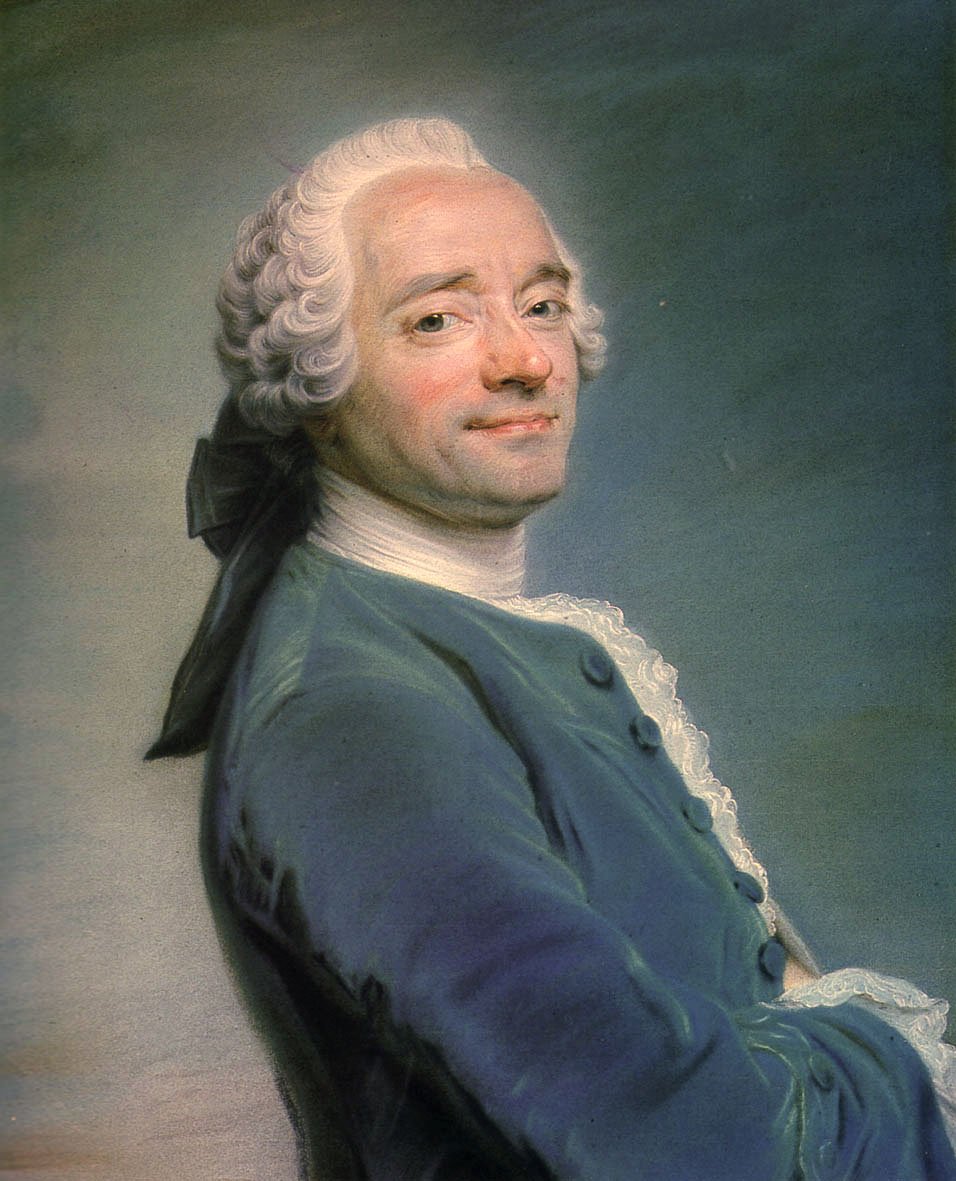
The French eighteenth century has a face, and he made it: Maurice Quentin de La Tour (Saint-Quentin, 1704 – Saint-Quentin, 1788), portraitist exclusively in pastel, fixed in coloured dust the kings, tax-farmers, actresses and philosophers of the Enlightenment — Louis XV, the marquise de Pompadour, Voltaire, Rousseau, d'Alembert. Famous for his sitters' wit as much as for his own, he left Paris at the height of his fame and went home to die in his native town, leaving it his charitable foundations and the essence of his studio — the fonds of the Musée Antoine-Lécuyer.
Key facts
- Born
- 5 September 1704 in Saint-Quentin (Picardy), a musician's son
- Died
- 17 February 1788 in Saint-Quentin, at his brother Jean-François's house
- Training
- Went up to Paris as a teenager; apprenticed to the portraitist Claude Dupouch
- Royal Academy
- Approved (agréé) in 1737, received in 1746; exhibited at the Salon from 1737 to 1773
- Consecration
- Pastels of the royal family (Salon of 1748); the full-length Pompadour (Salon of 1755); pensioned by the king
- Œuvre
- Finished portraits and préparations — the studies of the face alone; ~90 pieces at the Musée Antoine-Lécuyer, Saint-Quentin
The pastellist of the Enlightenment
A Saint-Quentin musician's son, La Tour went up to Paris as a teenager, against his father's wishes, and trained with the portraitist Claude Dupouch — whose portrait he kept all his life, as a kind of debt. Pastel, which the Venetian Rosalba Carriera had made fashionable during her Paris stay of 1720–1721, became his only instrument: he never painted in oils. Approved by the Royal Academy in 1737 — the year of his Voltaire — he showed at the Salon without interruption until 1773 and reigned there over portraiture: the critics watched for his entries, Diderot argued with them, the sitters queued. The years 1748–1755 were his summit: Louis XV, Queen Marie Leszczynska, the dauphin, the maréchal de Saxe, then the great full-length of the marquise de Pompadour, a machine of representation in which the favourite surrounds herself with books, scores and prints — a manifesto of the Enlightenment as much as a portrait.
Powder and breath: the technique
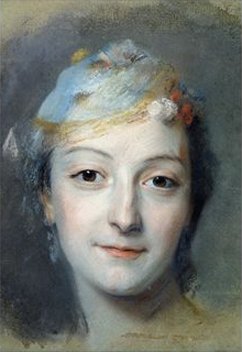
Pastel is the most fragile of mediums: pure colour, barely bound, laid on paper, which a breath can erase. La Tour made it the liveliest instrument of the century — the grain of skin, the grey of a nascent beard, the moisture of the eye, and above all the smile, that half-movement of the mind which is his signature. His method: seize the face first, alone, in rapid préparations — heads outlined on blued paper, of startling frankness — then build around it, sitting after sitting, the wig, the dress and the setting of the state portrait. Posterity has reversed the hierarchy: these working studies, kept by the artist and bequeathed to his town, are today what we love best — the laboratory of the face, before the performance.
Major works
| Work | Date (c.) | Location |
|---|---|---|
| Voltaire | 1735 and after | Musée Antoine-Lécuyer, Saint-Quentin |
| Self-portrait "à l'œil de bœuf" | c. 1737 | Musée d'art et d'histoire, Geneva |
| Gabriel Bernard de Rieux | 1739–1741 | J. Paul Getty Museum, Los Angeles |
| Louis Duval de l'Épinoy | 1745 | Calouste Gulbenkian Museum, Lisbon |
| Marie Leszczynska, Queen of France | 1747–1748 | Louvre, Paris |
| Louis XV | c. 1748 | Louvre, Paris |
| Maurice de Saxe, Marshal of France | 1748 | Staatliche Kunstsammlungen, Dresden |
| Self-portrait with lace jabot | c. 1750 | Musée Cognacq-Jay, Paris |
| The Marquise de Pompadour (full-length) | 1749–1755 | Louvre, Paris |
| Jean Le Rond d'Alembert | 1753 | Louvre, Paris |
| Mademoiselle Ferrand Meditating on Newton | 1753 | Alte Pinakothek, Munich |
| Jean-Jacques Rousseau | 1753 | Musée Carnavalet, Paris |
| Marie Fel (préparation) | 1757 | Musée Antoine-Lécuyer, Saint-Quentin |
| Pierre-Louis Laideguive | c. 1761 | Museu Nacional d'Art de Catalunya, Barcelona |
| Self-portrait | c. 1776 | Louvre, Paris |
The return to Saint-Quentin
Rich, famous and without a direct heir, La Tour turned his fortune to his town: a free drawing school, endowments for aged artisans, women in childbirth, poor children. His mind clouded in the last years; his brother Jean-François brought him home to Saint-Quentin in 1784, where he died on 17 February 1788. It was this brother who preserved the treasure of the studio — the préparations the artist had never sold — today the fonds of the Musée Antoine-Lécuyer. Eclipsed in the nineteenth century along with pastel itself, La Tour was brought back to the first rank by the Goncourt brothers and the cult of the "century of women"; the fragility of the medium, which all but forbids travel, makes Saint-Quentin the place to truly meet him.
In perspective
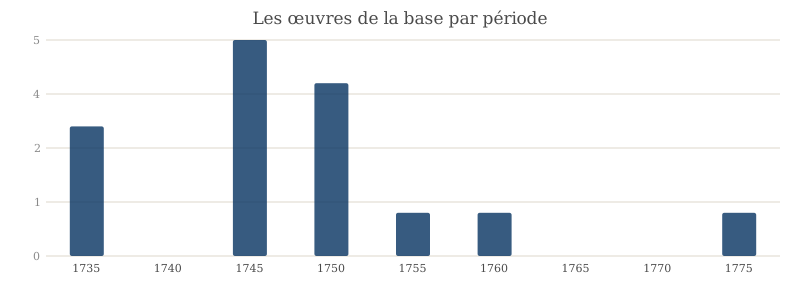
The selection draws the curve of a Salon career: a rise through 1735–1745, the dazzling summit of the decade 1745–1755 — the royal pastels of 1748, then the philosophers and the Pompadour — and a gradual thinning to the final self-portrait of the 1770s, when hand and mind withdrew together.
Further reading
- Albert Besnard and Georges Wildenstein, La Tour. La vie et l'œuvre de l'artiste, Paris, Les Beaux-Arts, 1928.
- Christine Debrie and Xavier Salmon, Maurice-Quentin de La Tour, prince des pastellistes, Paris, Somogy, 2000.
- Xavier Salmon, Le Voleur d'âmes. Maurice-Quentin de La Tour, exhibition catalogue (château de Versailles, 2004).
- Neil Jeffares, Dictionary of Pastellists before 1800, London, 2006 — continuously updated online edition.