Johannes Vermeer
Johannes Vermeer (Delft, 1632 – Delft, 1675) is one of the best-loved painters in the history of art, and one of the most mysterious. Only some thirty-five paintings by his hand survive; almost nothing is documented of his training, no drawing is attributed to him with certainty, and no identified self-portrait has come down to us. That near-nothing has been enough to make him, since his nineteenth-century rediscovery, the "Sphinx of Delft" — and the absolute painter of domestic light.
Key facts
- Born
- Baptised 31 October 1632 in Delft (Dutch Republic)
- Died
- Buried 15 December 1675 in Delft, aged 43
- Surviving œuvre
- 34 to 37 paintings depending on attributions; no securely attributed drawing
- Guild
- Master of the Delft Guild of Saint Luke, 1653; headman (hoofdman) 1662–1663 and 1670–1671
- Family
- Married Catharina Bolnes in 1653; fifteen children, eleven surviving
- Rediscovery
- Théophile Thoré-Bürger, Gazette des Beaux-Arts articles, 1866
- Signature works
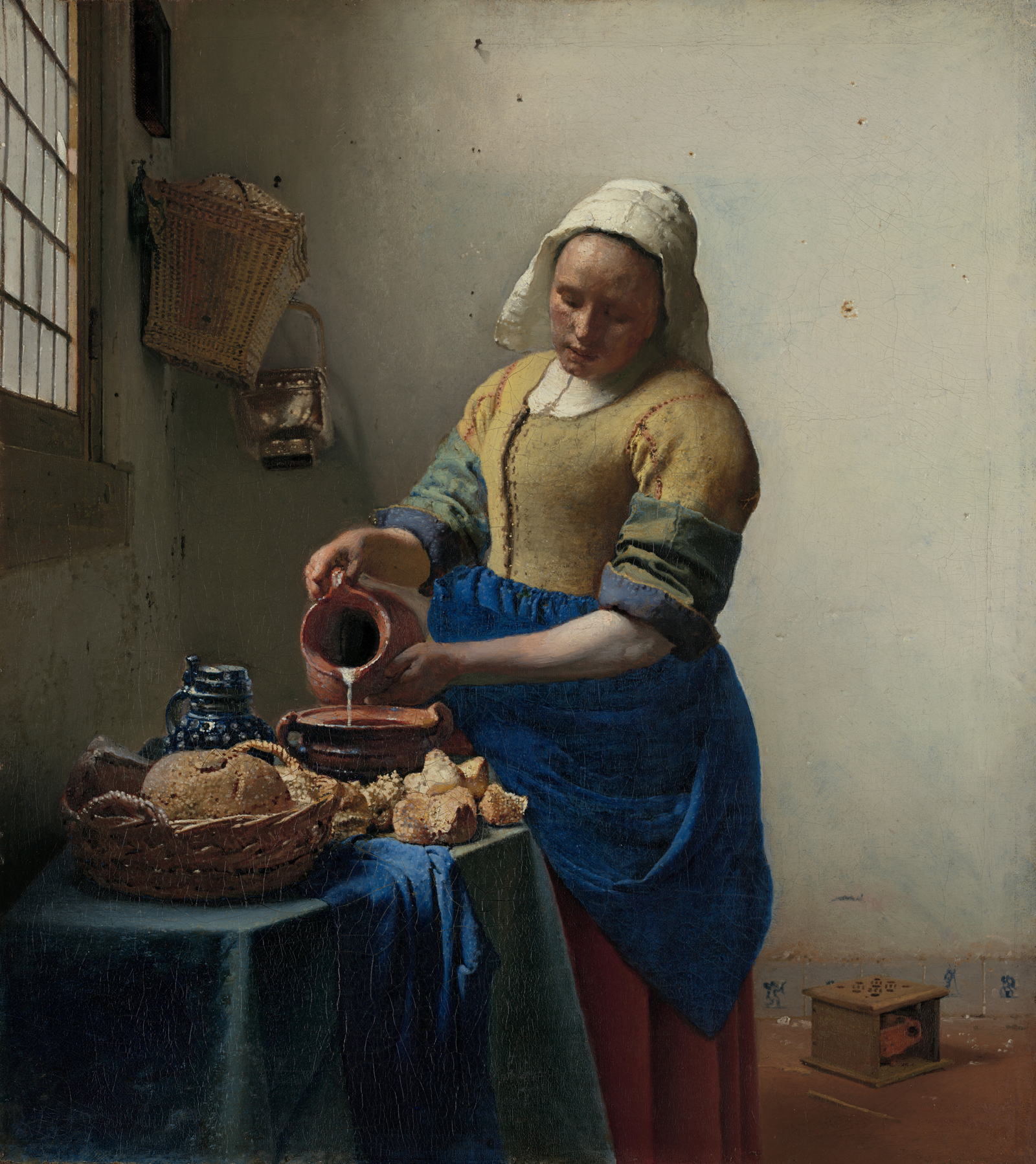
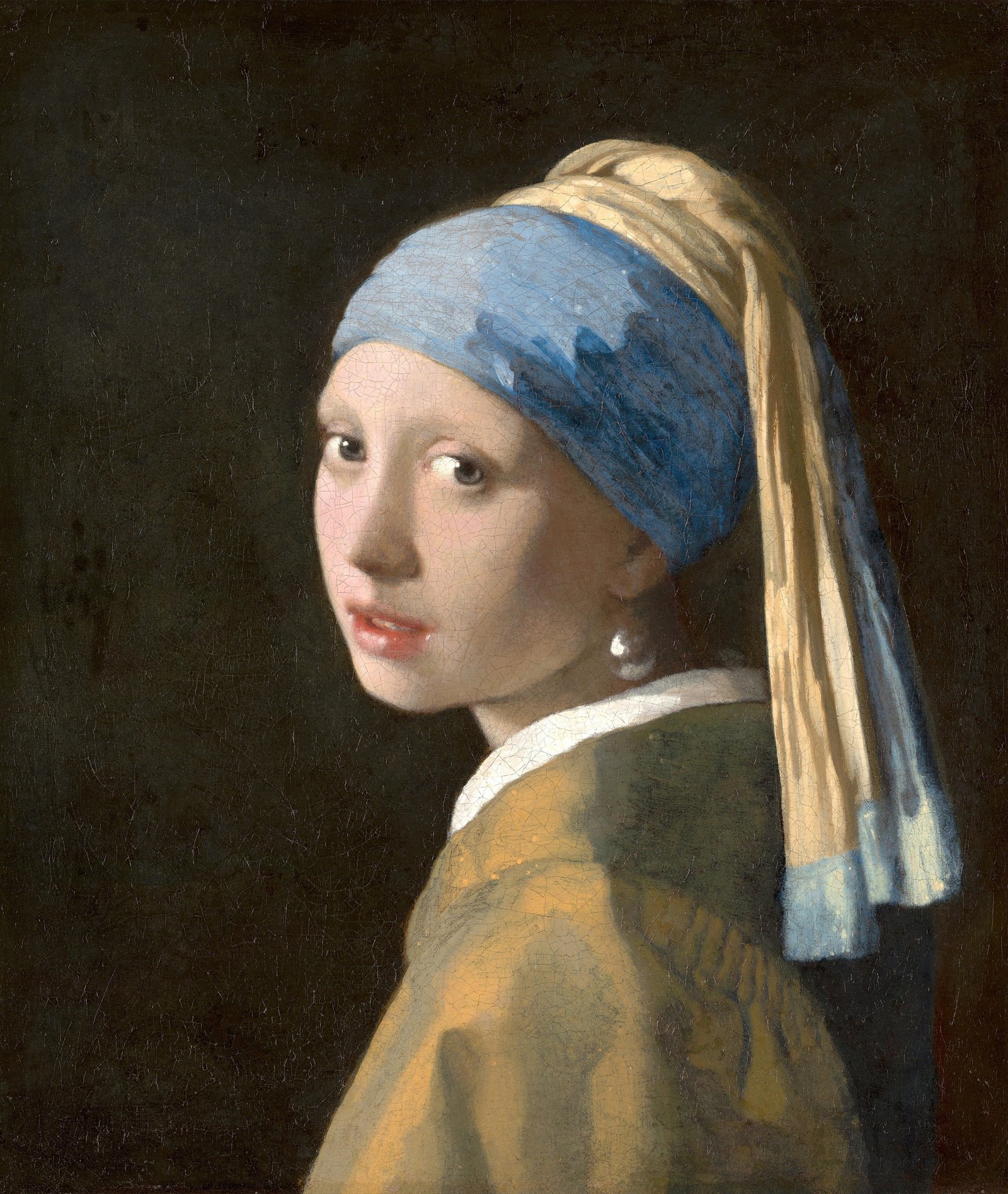
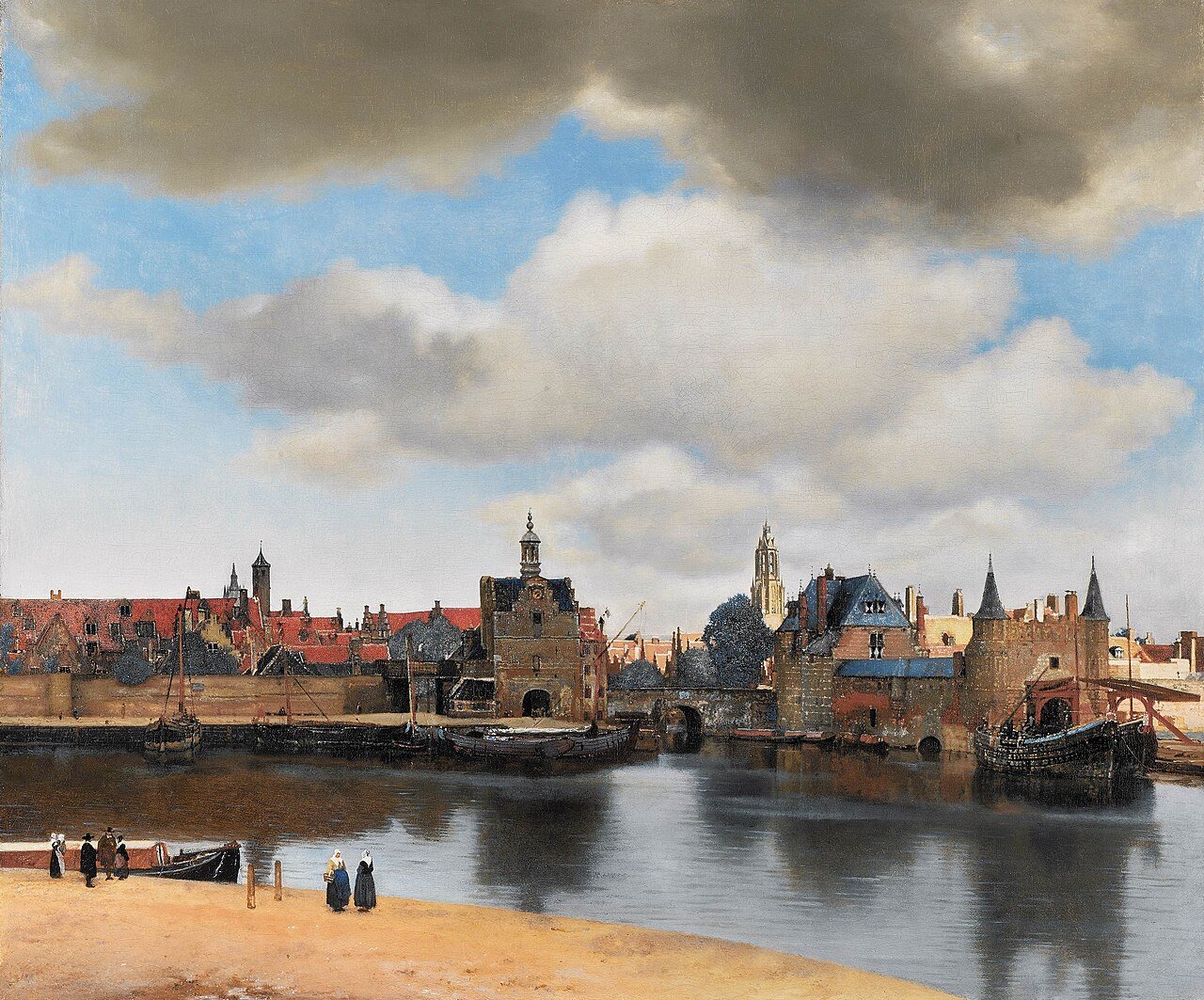
- Girl with a Pearl Earring, View of Delft, The Milkmaid, The Art of Painting
A short life in Delft
Vermeer was born in 1632 to a family of modest means: his father, a weaver of caffa (a figured silk) turned innkeeper, was also an art dealer registered with the Guild of Saint Luke. Johannes would take over both trades. We do not know with whom he learned to paint — the names of Carel Fabritius, killed in the Delft gunpowder explosion of 1654, and of Leonaert Bramer, a family friend, have been proposed without decisive evidence. In April 1653 he married Catharina Bolnes, from a well-off Catholic family; he probably converted to Catholicism at that time and moved in with his mother-in-law, Maria Thins, in Delft's "Papists' Corner". In December of the same year he was admitted as a master to the Guild of Saint Luke, of which he twice served as one of the headmen — a mark of his colleagues' esteem.
Vermeer painted little: two or three pictures a year, sold at high prices to a small circle of Delft connoisseurs, foremost among them Pieter van Ruijven, his probable patron. That fragile economy collapsed with the Franco-Dutch War of 1672, the "Year of Disasters" (Rampjaar) that ruined the art market. Deep in debt, Vermeer died in December 1675, leaving his widow bankrupt. Much of what we know of him comes from the inventories of that bankruptcy — and from the testimony of the Frenchman Balthasar de Monconys, who visited him in 1663 and could not see a single painting in the studio.
A tiny corpus
The surviving œuvre would fit in a single room: 34 to 37 canvases, depending on how one judges the debated attributions (Saint Praxedis; the Washington Girl with a Flute; the Leiden Collection's Young Woman Seated at a Virginal). After two youthful history paintings and The Procuress (1656), Vermeer devoted himself almost exclusively to the genre scene: silent interiors in which a figure — most often a woman — reads, writes, weighs, pours, or makes music. To these are added two townscapes (The Little Street and the View of Delft, which Marcel Proust called "the most beautiful painting in the world"), two allegories, and three study heads, among them Girl with a Pearl Earring.
The full list, with dates and museums, is given in the catalogue of works.
The art of light
What sets Vermeer apart from his contemporaries — Gerard ter Borch, Pieter de Hooch, Gabriel Metsu, who painted neighbouring subjects — is not the motif but the treatment: lateral light entering through a window at the left, rigorous geometry, harmonies of lemon yellow, ultramarine blue (the costly lapis lazuli, which he used with unusual prodigality) and pearl grey. His touch melts contours and scatters points of light across surfaces — the famous pointillés of The Milkmaid or the View of Delft — which recall the circles of confusion of an optical image. Hence the hypothesis, debated since the nineteenth century and revived by David Hockney and Philip Steadman, that he used a camera obscura: seductive, never proven, and in any case no explanation of the moral, silent construction of his images.
With Vermeer the genre scene ceases to be anecdote. The Woman Holding a Balance weighs her pearls before a Last Judgement; the Dresden letter-reader is wrapped in a space that curtain and window turn into a threshold; The Art of Painting, the allegory he kept at home until his death, makes the studio the theatre of painting's own glory. Time is suspended rather than stopped: it is that restraint — that inhabited silence — which fascinates.
Oblivion and rediscovery
Celebrated locally in his lifetime, Vermeer slipped after his death into semi-obscurity: his paintings circulated under other names (de Hooch, Metsu), and the great eighteenth-century dictionaries all but ignored him. It was a French critic and journalist, Théophile Thoré-Bürger, who resurrected him: dazzled by the View of Delft in The Hague, he devoted three articles to Vermeer in the Gazette des Beaux-Arts in 1866 and drew up a first catalogue — over-generous, but foundational. The twentieth century completed the consecration: the paintings entered the great museums at vertiginous prices; Han van Meegeren's forgeries (including the Supper at Emmaus, sold as a Vermeer in 1937) made a resounding scandal; Proust wrote his famous pages — Bergotte dying before the "little patch of yellow wall" of the View of Delft — and the landmark exhibitions of The Hague and Washington (1995–1996) and of the Rijksmuseum (2023), the most complete ever assembled, sealed his fame.
In perspective
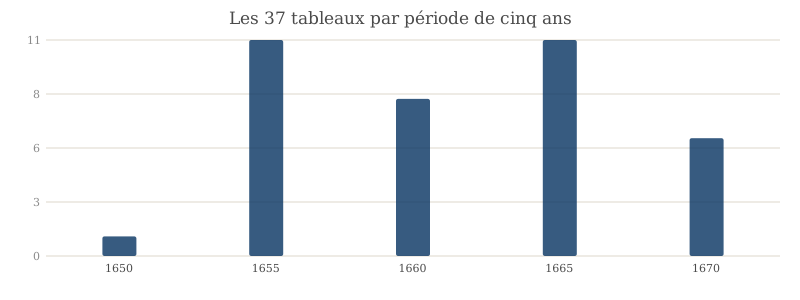
The chronology of the 37 paintings sketches a plateau career: after the history pieces of the 1650s, Vermeer settles around two paintings a year — and the visible trough after 1672 is not the painter slowing but the market collapsing in the Year of Disasters. Rarity was not a pose: it was a perfectionist's economics.
Further reading
- John Michael Montias, Vermeer and His Milieu: A Web of Social History, Princeton University Press, 1989.
- Walter Liedtke, Vermeer: The Complete Paintings, Ludion, 2008.
- Daniel Arasse, Vermeer: Faith in Painting, Princeton University Press, 1994 (French original: L'Ambition de Vermeer, 1993).
- Timothy Brook, Vermeer's Hat: The Seventeenth Century and the Dawn of the Global World, Bloomsbury, 2008.