Gustav Klimt
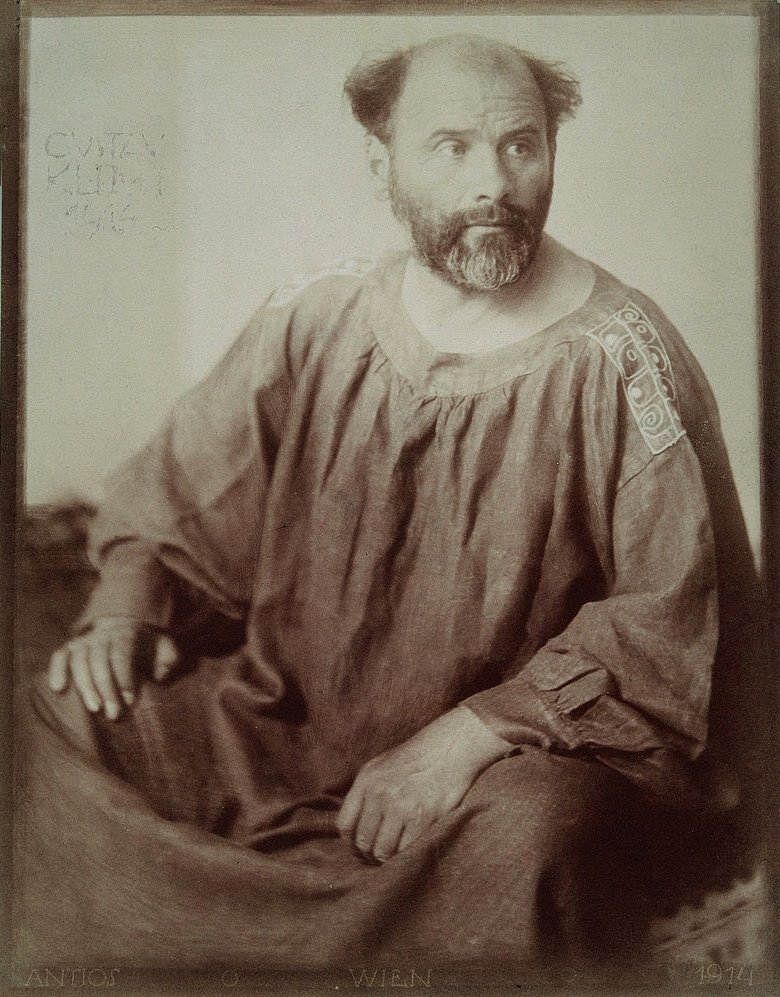
An official decorator destined for museum ceilings, Gustav Klimt (Baumgarten, near Vienna, 1862 – Vienna, 1918) seceded — literally: founder and first president of the Vienna Secession in 1897, he became the painter of the Vienna of Freud, Mahler and Schnitzler, scandalous and adored, whose golden icons — The Kiss, Adele Bloch-Bauer — are today among the most recognisable images of modern art.
Key facts
- Born
- 14 July 1862 at Baumgarten, near Vienna, son of a gold engraver
- Died
- 6 February 1918 in Vienna, aged 55
- Beginnings
- Künstler-Compagnie with his brother Ernst and Franz Matsch: decorations for the Burgtheater and the Kunsthistorisches Museum staircase
- Secession
- Founder and first president, 1897; the journal Ver Sacrum
- Scandal
- Faculty Paintings for the University (1900–1907), withdrawn; burned in 1945
- Golden period
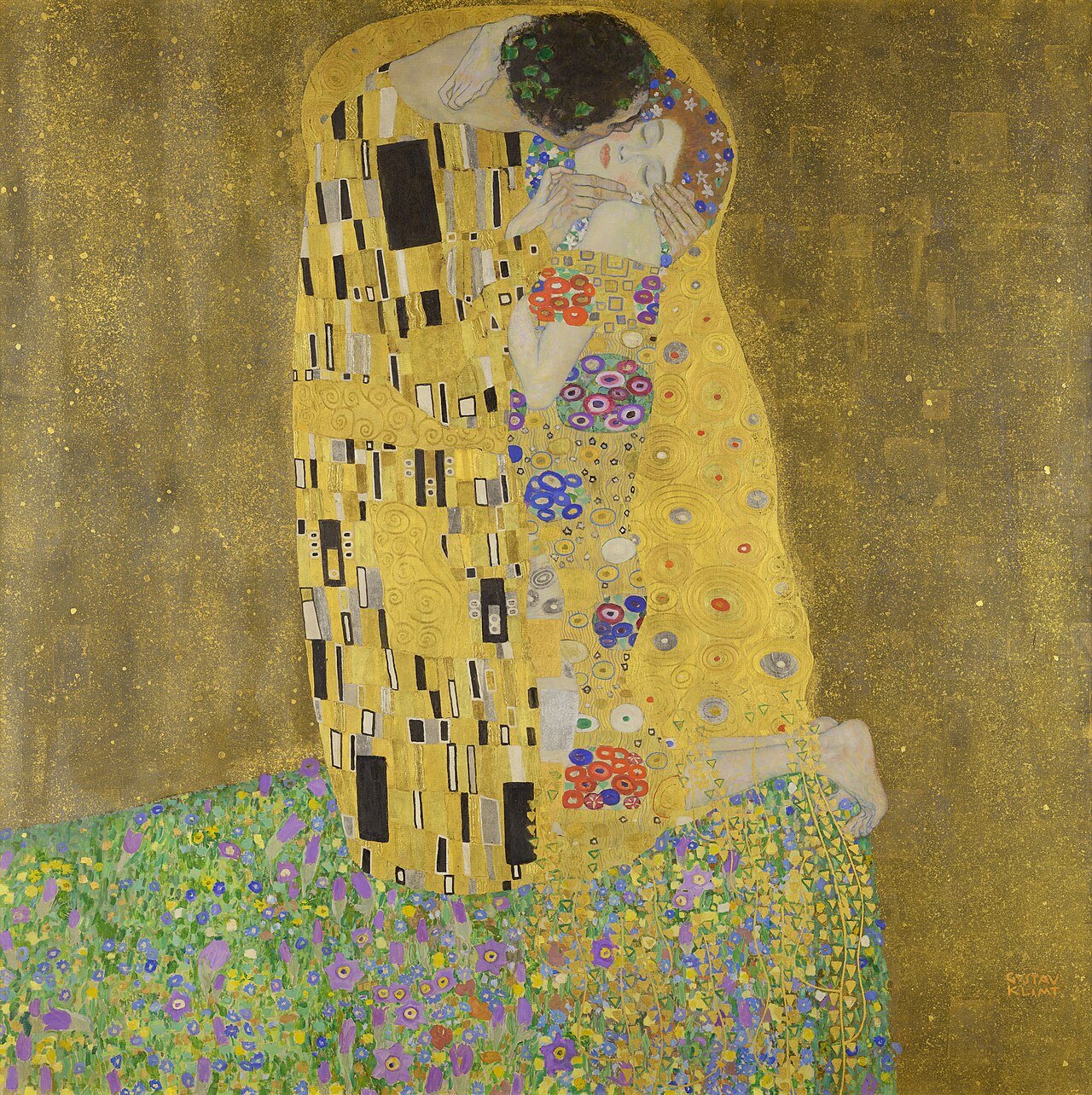
- c. 1901–1909: Judith, Adele Bloch-Bauer I, The Kiss
- Largest collection
- Österreichische Galerie Belvedere, Vienna

From decorator to secessionist
A goldsmith's son trained at the School of Applied Arts, Klimt began as the perfect heir of Ringstrasse historicism: with the Künstler-Compagnie he painted the decorations of the Burgtheater and of the grand staircase of the Kunsthistorisches Museum — academic virtuosity rewarded by the emperor. The break came at the end of the 1890s. In 1897 he founded, with Otto Wagner, Hoffmann, Olbrich and Moser, the Vienna Secession ("To every age its art, to art its freedom") and presided over its beginnings. In 1900–1907 the three Faculty Paintings commissioned for the University ceiling — Philosophy, Medicine, Jurisprudence — unleashed the greatest artistic scandal in Austrian history: instead of the triumph of Reason, streams of floating bodies, life as a blind torrent. Klimt repaid the State, took back his canvases (they would perish in the fire of Immendorf Castle in 1945, along with other masterpieces) and thereafter worked only for private patrons.
Gold, and after
The golden period — the gold ground learned in his father's workshop and before the mosaics of Ravenna, visited in 1903 — produced the icons: Judith I (1901), the Beethoven Frieze (1902), painted for the Secession exhibition around Klinger's statue, the portrait of Adele Bloch-Bauer (1907), and The Kiss (1907–1908), bought by the Austrian State straight from the easel. Ornament here does not decorate: it signifies — the virile rectangles and feminine circles of The Kiss, the Horus eyes and Mycenaean spirals of Adele. After 1909 Klimt abandoned gold for liberated colour, nourished by Matisse and the Fauves: late portraits (Elisabeth Bachofen-Echt, Mäda Primavesi), allegories (The Virgin, the unfinished Bride) and, each summer on the Attersee, those square landscapes — a quarter of the œuvre — in which the motif dissolves into vibrant mosaic. He died in February 1918, a few months before Schiele, Wagner and Moser: Vienna 1900 went out in the same year as the Empire.
Major works
| Work | Date | Location |
|---|---|---|
| Pallas Athene | 1898 | Wien Museum, Vienna |
| Judith I | 1901 | Belvedere, Vienna |
| Beethoven Frieze | 1902 | Secession Building, Vienna |
| Portrait of Emilie Flöge | 1902 | Wien Museum, Vienna |
| The Three Ages of Woman | 1905 | Galleria Nazionale d'Arte Moderna, Rome |
| Stoclet Frieze (cartoons) | 1905–1911 | MAK, Vienna; frieze in situ at the Stoclet Palace, Brussels |
| Adele Bloch-Bauer I | 1907 | Neue Galerie, New York (restituted to the heirs in 2006) |
| The Kiss | 1907–1908 | Belvedere, Vienna |
| Danaë | 1907–1908 | Private collection, Vienna |
| Hope II | 1907–1908 | Museum of Modern Art, New York |
| Church in Cassone | 1913 | Private collection |
| The Virgin | 1913 | Národní galerie, Prague |
| Mäda Primavesi | 1912–1913 | Metropolitan Museum of Art, New York |
| The Bride (unfinished) | 1917–1918 | Belvedere, Vienna |
The painter of women — and the Bloch-Bauer affair
Klimt, who never married (Emilie Flöge, the fashion designer of the blue smock, was his life's companion), painted almost exclusively women — the grandes bourgeoises, often Jewish, of liberal Vienna: the Bloch-Bauers, the Lederers, the Primavesis. That patronage sealed the œuvre's posthumous fate: looted by the Nazis in 1938, many of these canvases ended up in Austrian museums. In 2006, at the close of a famous case, Austria restituted five Klimts to the heirs of Adele Bloch-Bauer, including the golden portrait, acquired by Ronald Lauder for the Neue Galerie in New York — then the most expensive painting ever sold, and the subject of the film Woman in Gold (2015).
In perspective

The 1905–1910 bump is the golden period: barely a lustrum, out of which came the Kiss, Adele and the Stoclet Frieze. Before it, the decorator; after it, the colourist of the Attersee — the base shows a painter who shed his skin every ten years.
Further reading
- Tobias G. Natter (ed.), Gustav Klimt: The Complete Paintings, Cologne, Taschen, 2012.
- Alfred Weidinger (ed.), Klimt, catalogue raisonné of the paintings, Munich, Prestel, 2007.
- Carl E. Schorske, "Gustav Klimt: Painting and the Crisis of the Liberal Ego", in Fin-de-Siècle Vienna: Politics and Culture, New York, Knopf, 1980.