Raphael
Raffaello Sanzio (Urbino, 1483 – Rome, 1520) died at thirty-seven, on Good Friday, laden with honours and mourned by the entire papal court. In a career of barely twenty years he defined, for three centuries, the very idea of perfection in painting: grace — that supreme ease which conceals effort — in the service of a synthesis of everything the Italian Renaissance had conquered before him.
Key facts
- Born
- 1483 in Urbino, son of the painter Giovanni Santi
- Died
- 6 April 1520 in Rome, aged 37; buried in the Pantheon
- Training
- His father's workshop, then with Perugino; Florence c. 1504–1508
- Rome
- Summoned by Julius II in 1508; Vatican Stanze, 1508–1520
- Offices
- Architect of St Peter's (1514); prefect of Roman antiquities (1515)
- Signature works
- The School of Athens, The Sistine Madonna, Portrait of Baldassare Castiglione, The Transfiguration
From Urbino to Florence
Son of the court painter and poet Giovanni Santi, Raphael grew up in Urbino, one of the most refined courts of Italy — the very setting of the Book of the Courtier by his friend Castiglione. Orphaned at eleven and trained in the orbit of Perugino, whose sweetness and lucid compositions he absorbed, he was already styled magister at seventeen. The Umbrian altarpieces of his beginnings (the Marriage of the Virgin of 1504 openly surpasses its Peruginesque model) preceded the decisive move: in Florence, from 1504 to 1508, he studied Leonardo — sfumato, pyramidal composition, the Mona Lisa that his Maddalena Doni remembers — and Michelangelo. From these years date the great series of Madonnas (Granduca, Goldfinch, La Belle Jardinière), inexhaustible variations on the mother-and-child triangle in which geometry becomes tenderness.
Rome: the Stanze and glory
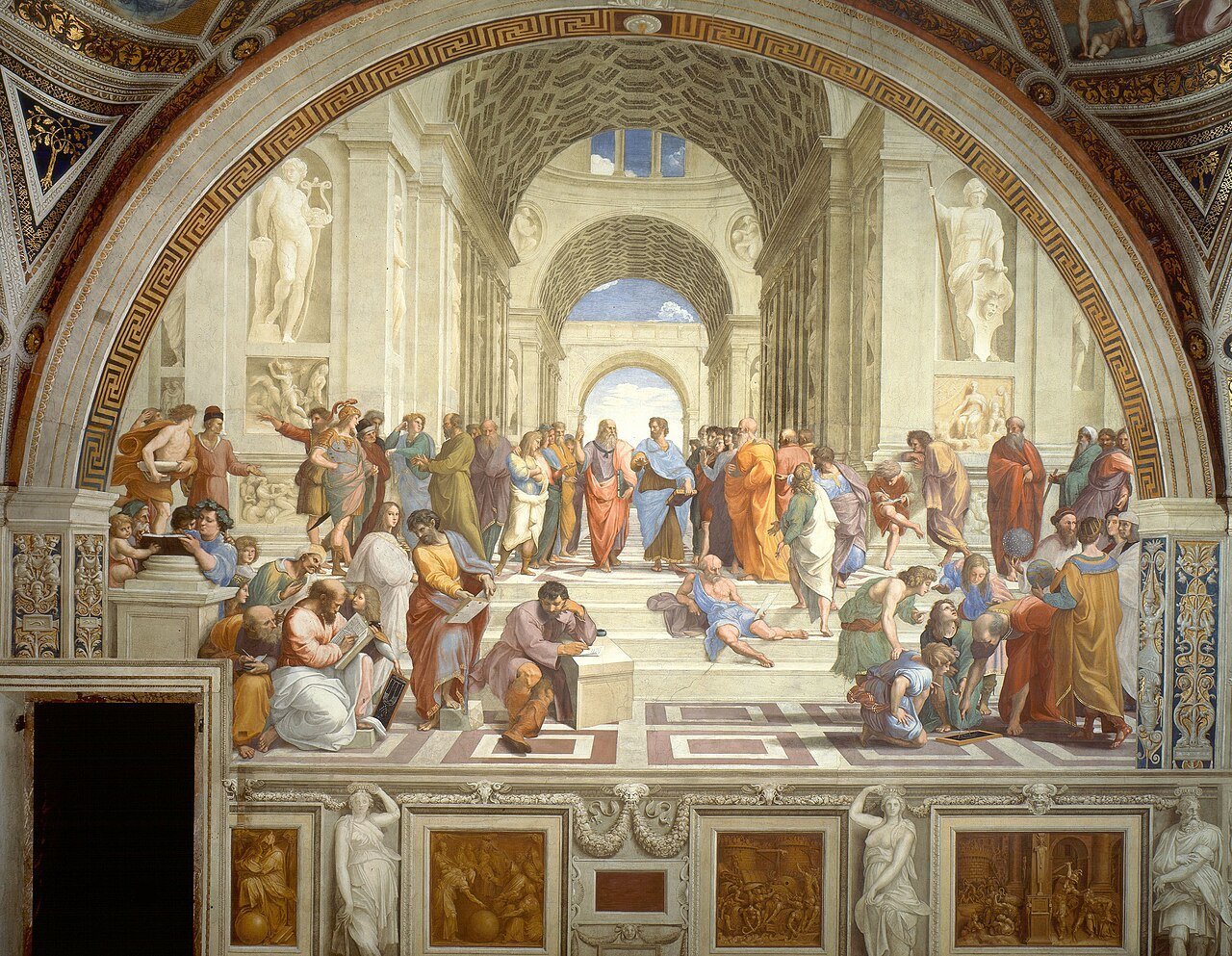
Late in 1508 Julius II summoned him to Rome to decorate his private apartments. In the Stanza della Segnatura (1508–1511) Raphael painted the visual manifesto of the Renaissance: the Disputation of the Holy Sacrament facing The School of Athens — theology and philosophy, Plato and Aristotle at the centre of an ideal architecture, surrounded by all the branches of knowledge, with a pensive Heraclitus bearing the features of Michelangelo, then at work on the neighbouring Sistine ceiling. There followed the Stanza di Eliodoro (1511–1514), bolder in drama and nocturnal light (The Liberation of Saint Peter), then the Stanza dell'Incendio, largely executed by the workshop.
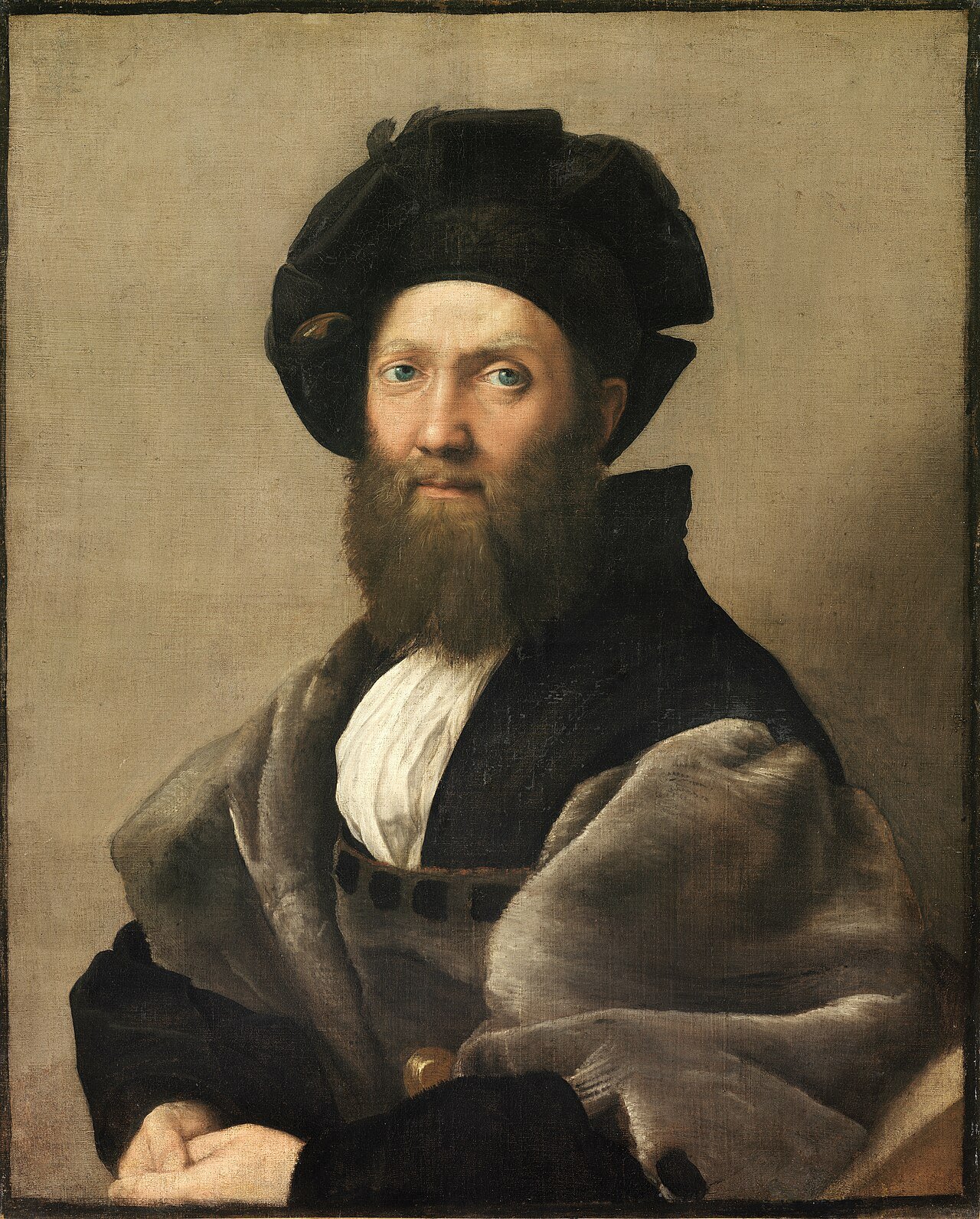
For in Rome Raphael became an artistic entrepreneur without precedent: cartoons for the Sistine tapestries, the decoration of the Vatican Loggie, frescoes at the Villa Farnesina (The Triumph of Galatea), the fabric of St Peter's, of which Leo X made him architect in 1514, and the survey of Roman antiquities, of which he was made prefect — all carried by a brilliant team (Giulio Romano, Penni, Giovanni da Udine) that he led with affable authority. His portraits of these years — Julius II, the sober and utterly present Baldassare Castiglione, La Fornarina, Leo X with Two Cardinals — are among the most penetrating of the century. He died on 6 April 1520, leaving the Transfiguration unfinished; it was placed above his funeral bed.
Major works
| Work | Date | Location |
|---|---|---|
| The Marriage of the Virgin | 1504 | Pinacoteca di Brera, Milan |
| The Granduca Madonna | c. 1505 | Palazzo Pitti, Florence |
| Madonna of the Goldfinch | c. 1506 | Uffizi, Florence |
| La Belle Jardinière | 1507–1508 | Louvre, Paris |
| Disputation of the Holy Sacrament | 1509–1510 | Stanza della Segnatura, Vatican |
| The School of Athens | 1509–1511 | Stanza della Segnatura, Vatican |
| The Triumph of Galatea | c. 1512 | Villa Farnesina, Rome |
| Portrait of Julius II | 1511–1512 | National Gallery, London |
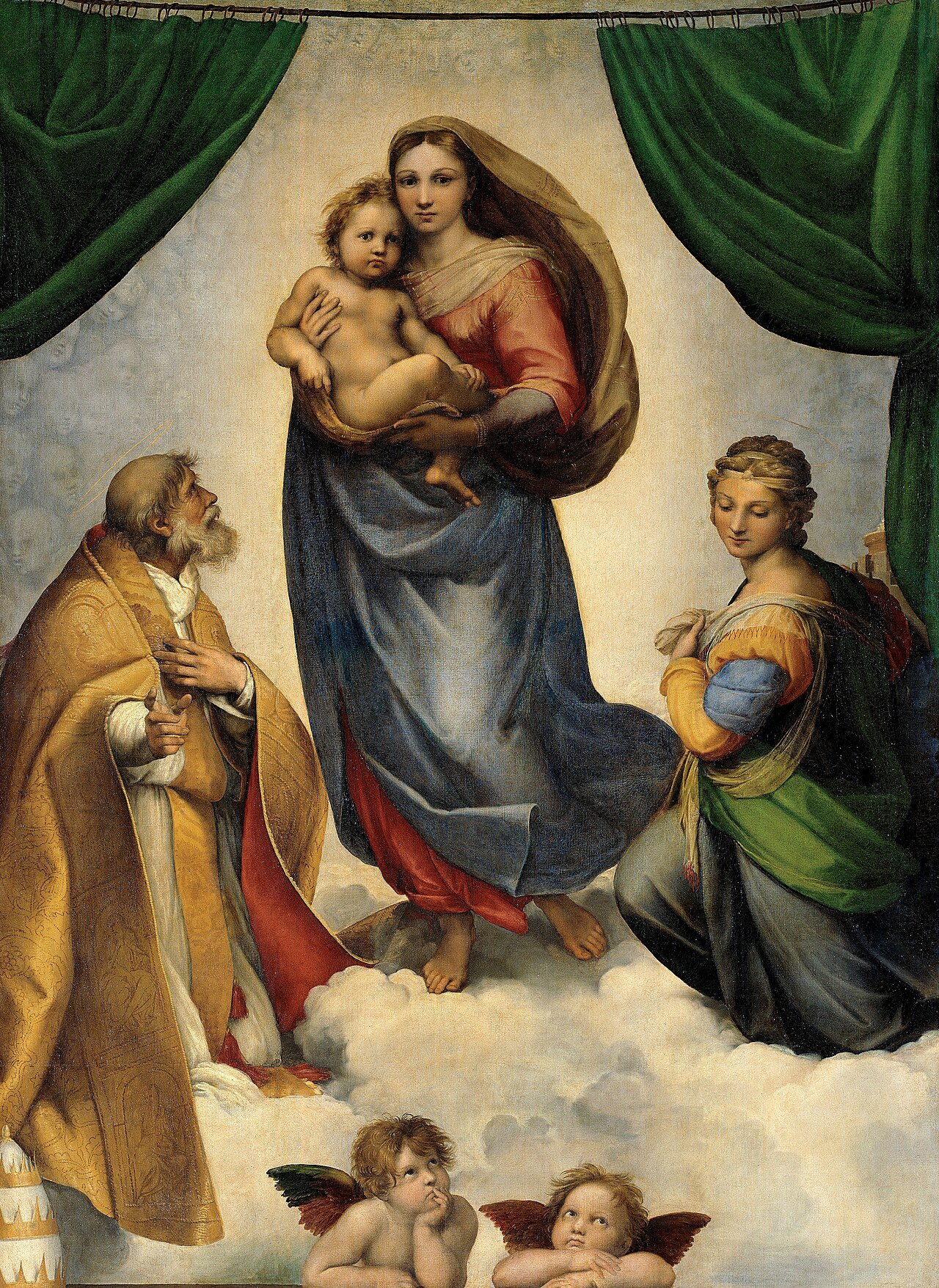
| The Sistine Madonna | c. 1513–1514 | Gemäldegalerie Alte Meister, Dresden |
| Madonna della Sedia | c. 1513–1514 | Palazzo Pitti, Florence |
| Portrait of Baldassare Castiglione | c. 1514–1515 | Louvre, Paris |
| The Liberation of Saint Peter | 1514 | Stanza di Eliodoro, Vatican |
| The Acts of the Apostles cartoons | 1515–1516 | Victoria & Albert Museum, London |
| La Fornarina | c. 1518–1519 | Palazzo Barberini, Rome |
| Leo X with Two Cardinals | 1518–1519 | Uffizi, Florence |
| The Transfiguration | 1518–1520 | Vatican Pinacoteca, Rome |
The afterlife of grace
No painter has exercised so uncontested an authority for so long. For the academies, from Bologna to Paris, Raphael was the canon: Poussin meditated on him, Ingres made him a cult — the Madonna della Sedia appears as a fetish in several of his canvases. It took the English Pre-Raphaelites, who chose their name against him, for the star to pale in favour of his "primitive" predecessors. The twentieth century, more responsive to torment than to harmony, long preferred Michelangelo or Leonardo; the exhibitions of the fifth centenary (Rome, 2020) restated the obvious: a total pictorial intelligence — composition, colour, portraiture, architecture, archaeology — served by the most fluent of hands.
In perspective
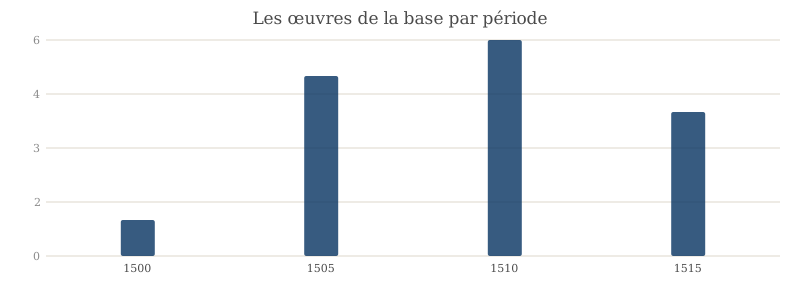
The 1510s column says it all: the Roman decade concentrates most of the masterpieces — in ten years Raphael produced more durable icons than most entire schools. The curve stops dead in 1520: he is the only painter whose “late period” is a counterfactual.
Further reading
- Giorgio Vasari, "Life of Raphael of Urbino", in Lives of the Most Excellent Painters, Sculptors, and Architects (1550/1568).
- Roger Jones and Nicholas Penny, Raphael, Yale University Press, 1983.
- Late Raphael, exhibition catalogue (Museo del Prado / Louvre, 2012–2013), Madrid, 2012.