Les Mémoires de Saint-Simon
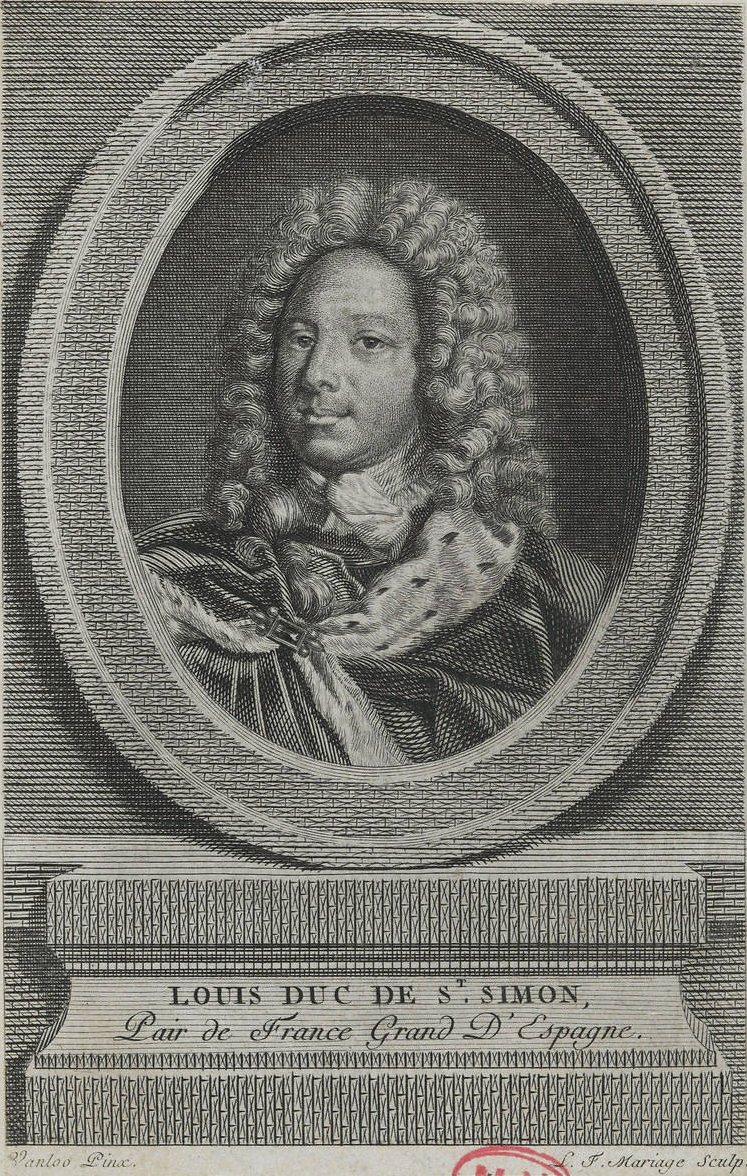
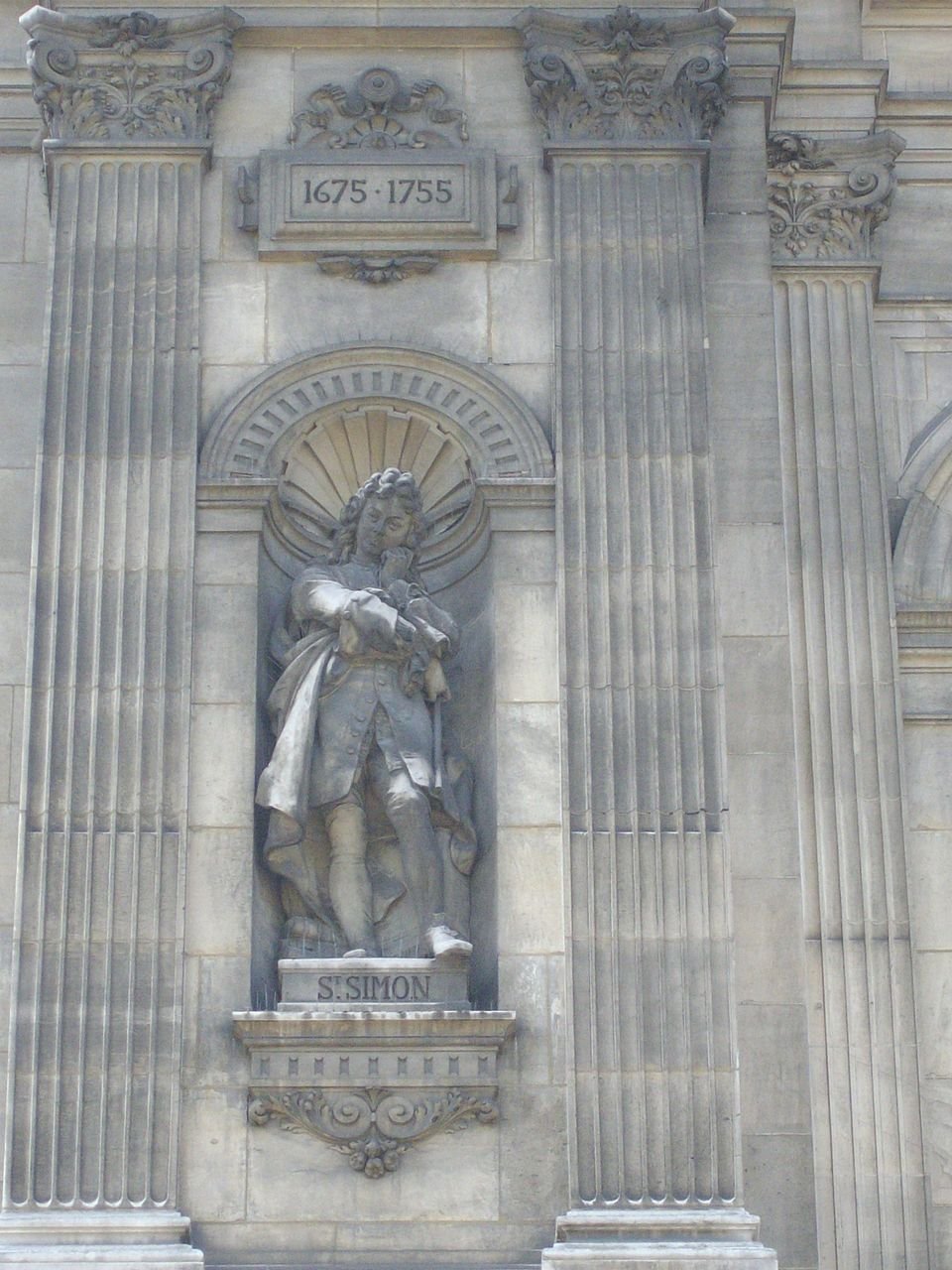
A duke and peer obsessed with precedence, without office or victory, kept away from affairs by a Louis XIV who thought him "glorieux" — proud of his rank: nothing destined Louis de Rouvroy, duc de Saint-Simon (1675–1755), for greatness. It came through writing — Mémoires of several thousand pages, unpublishable in his lifetime, in which the court of Versailles is dissected with a vehemence, a comic verve and a power of portraiture that French prose has never recovered. "The greatest involuntary writer in the language," it has been said; Proust, Chateaubriand and Stendhal held him an absolute master.
Two working instruments now accompany this site: the detailed synopses of the 404 chapters, each with its complete running summary (9,542 entries of the Chéruel edition) and a written summary — and the analytical index (2,352 people, 12,737 references, filterable by dignity, volume and year), with its statistics.
Key facts
- The man
- Louis de Rouvroy, duc de Saint-Simon (1675–1755), duke and peer at 18, at court from 1691
- The matter
- The court from 1691 to 1723: the end of Louis XIV's reign, the Regency, the beginnings of Louis XV
- The writing
- Notes from 1694; main composition 1739–1749, in the margins of Dangeau's Journal
- The text's fate
- Manuscripts seized by the State at his death (1755); first complete editions in the nineteenth century
- The scale
- Eight Pléiade volumes (ed. Yves Coirault, 1983–1988); ~3,000 portrayed figures
- Context
- His entry in the Grand Siècle encyclopedia (in French)
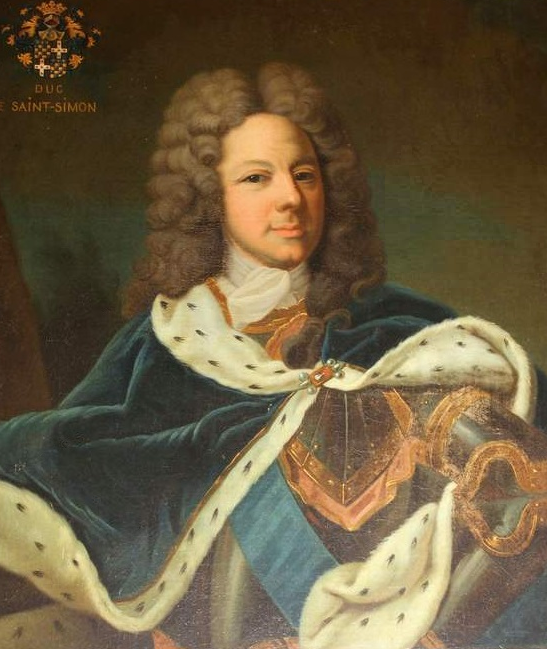
The thwarted duke
The late-born son of a favourite of Louis XIII made duke in 1635, Saint-Simon inherited at twelve a dignity — duke and peer of France — whose defence became his life's passion. At court from 1691, he left the army in 1702 for want of promotion: Louis XIV never quite forgave the sulk, and kept him from affairs. Reduced to the role of observer, he made it a watchtower: friend of the Duke of Burgundy, whose death in 1712 ruined his hopes of aristocratic reform, then of the Regent Philippe d'Orléans, he enjoyed his hour of power under the Regency — a member of the council, ambassador extraordinary to Spain (1721–1722) — before definitive retirement at his friend's death in 1723. For thirty years, in his château of La Ferté-Vidame, he wrote.
How the Mémoires were made
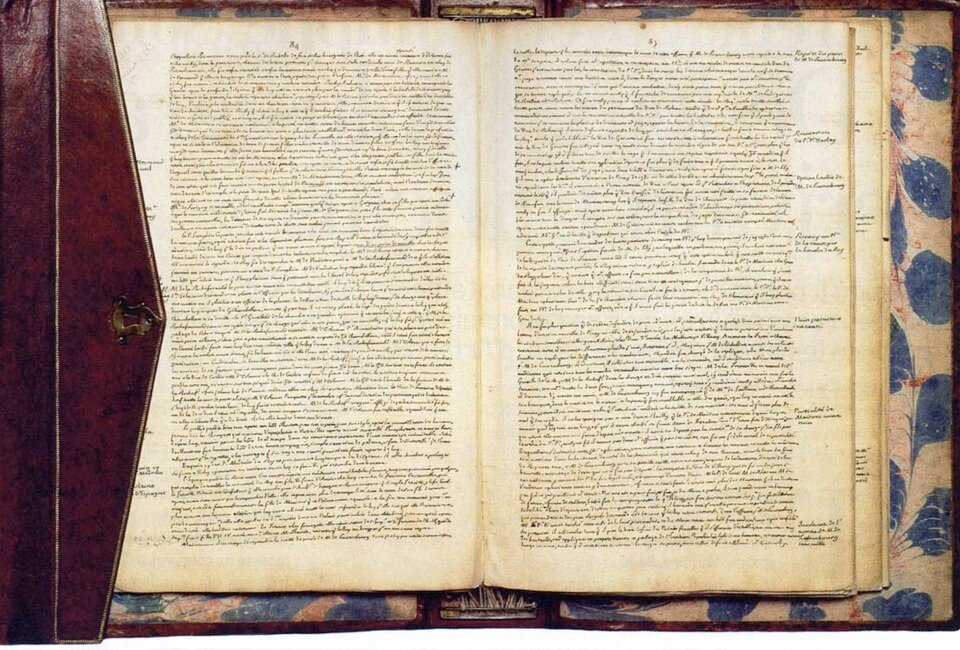
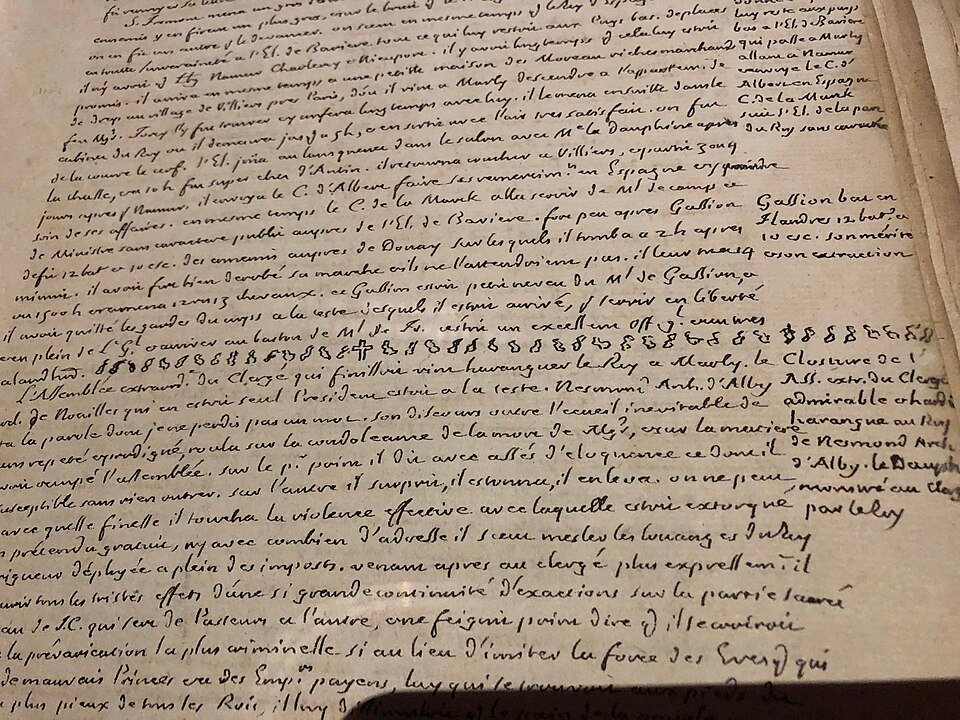
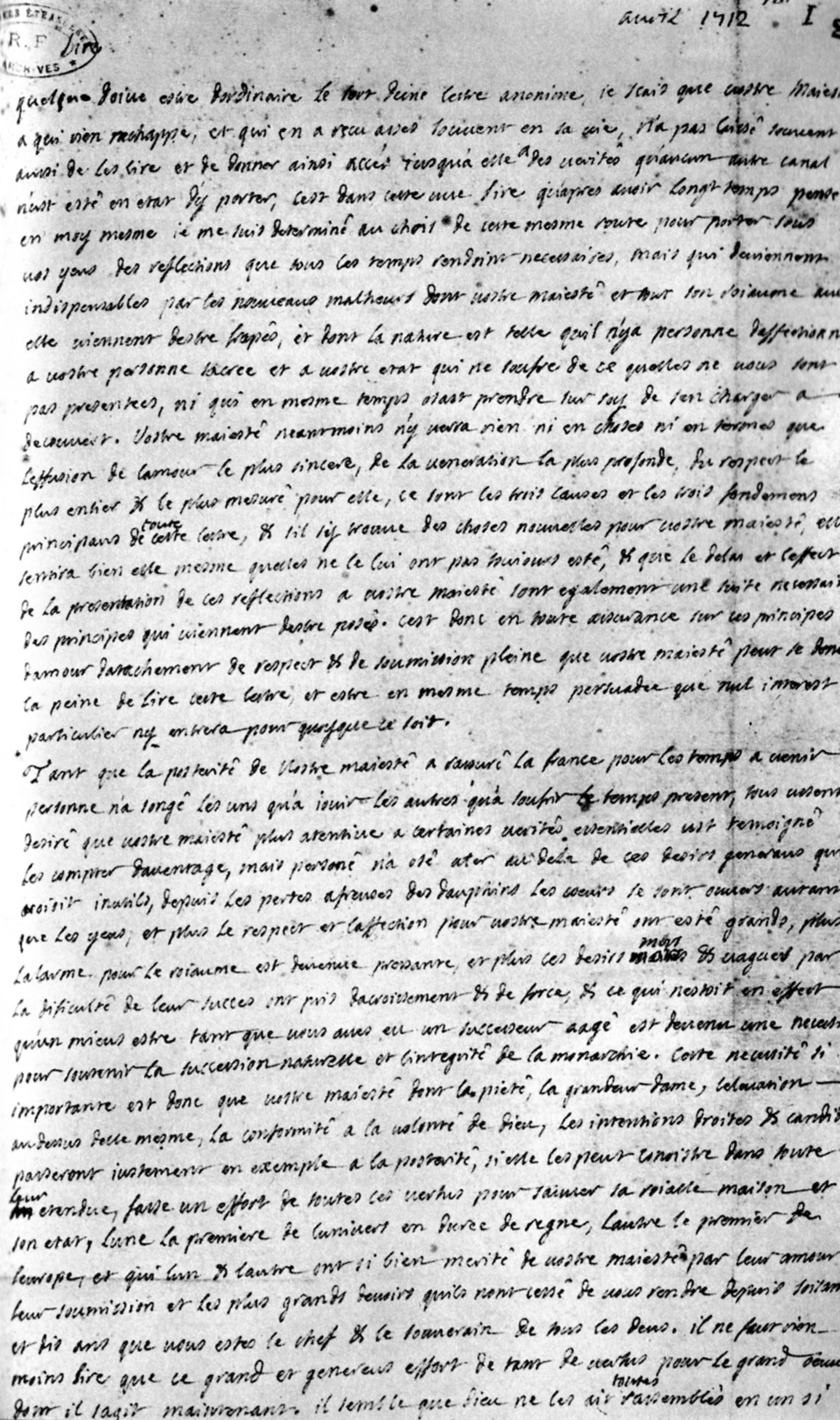
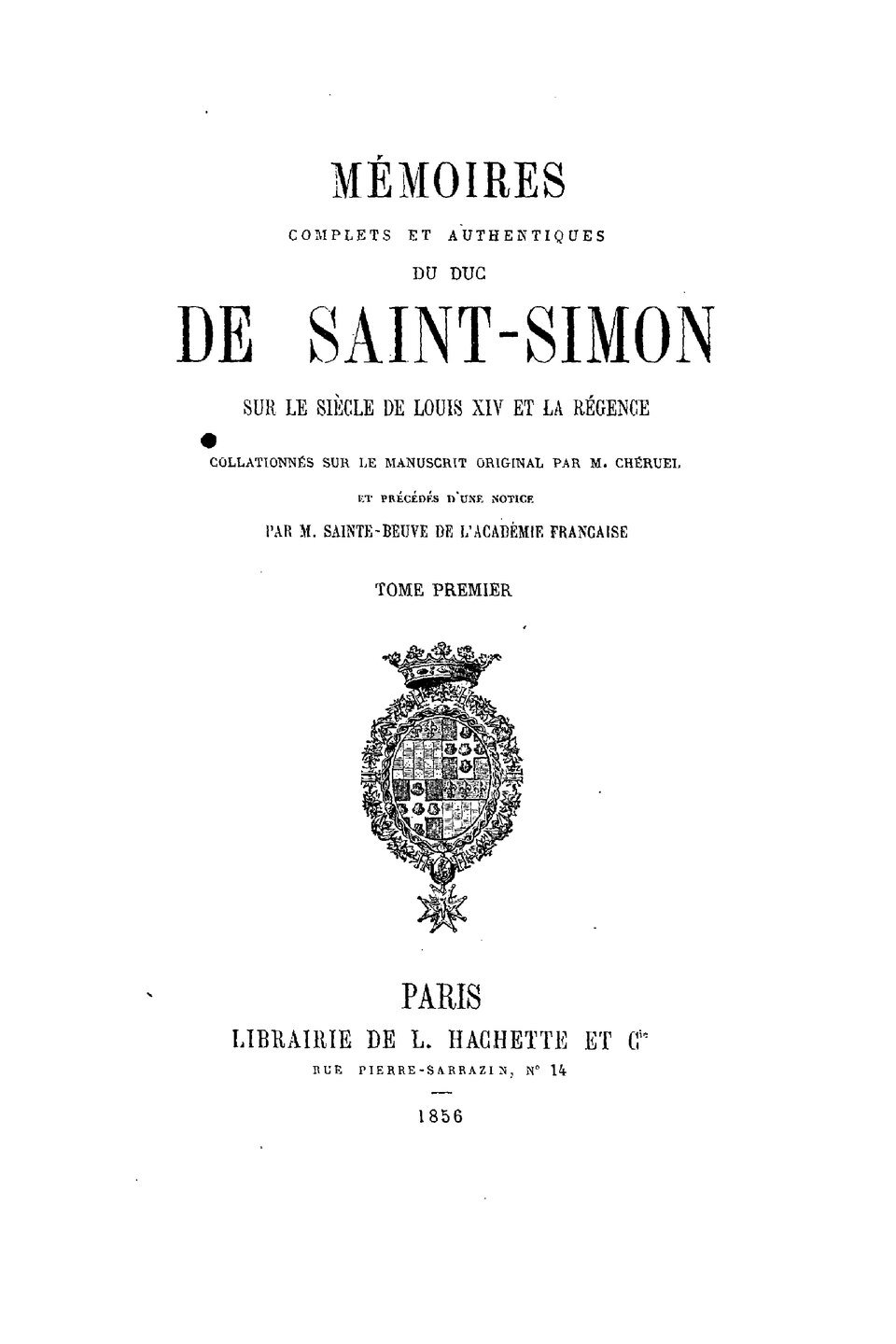
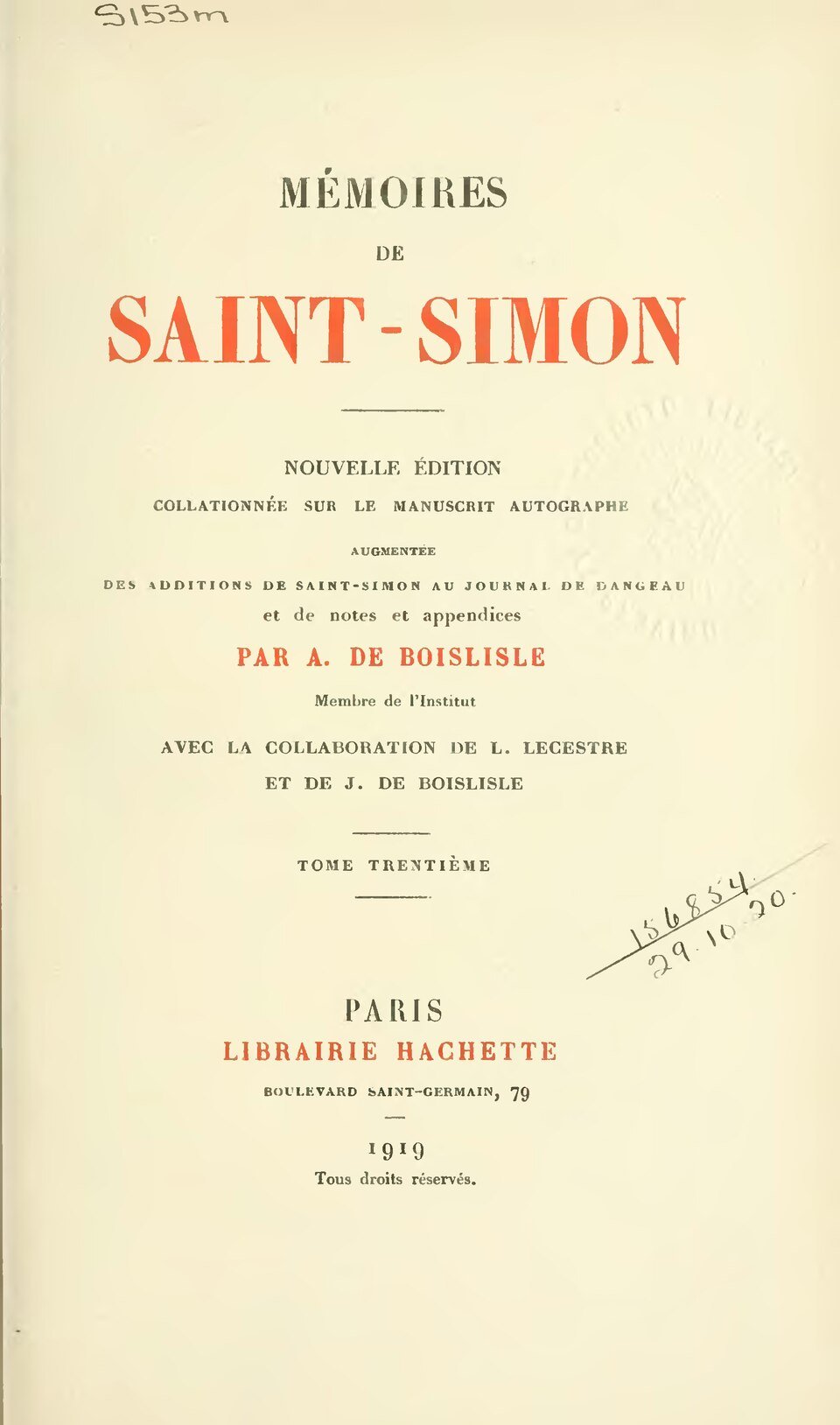
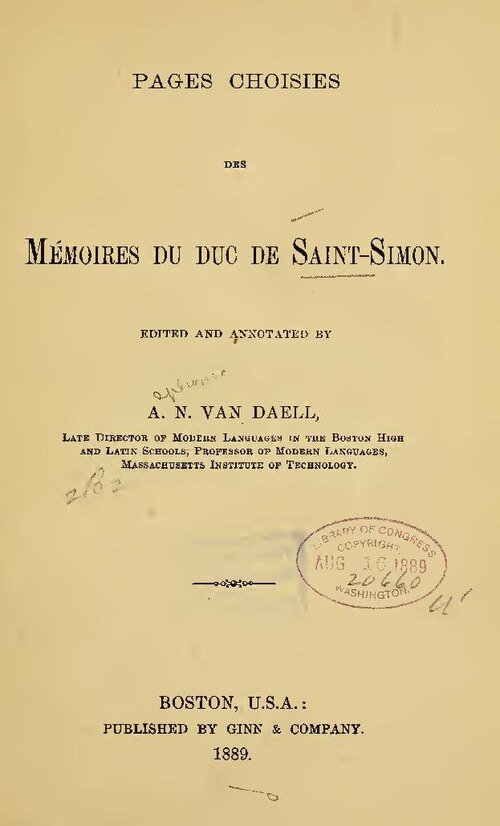
Saint-Simon began taking notes in 1694 — at nineteen, while reading Bassompierre's memoirs. But the trigger was a book: the Journal of the marquis de Dangeau, a flat, deferential chronicle of the court, of which he obtained a copy in 1729 and which he covered with furious "Additions". From that marginalia grew, mostly between 1739 and 1749, the work itself: Memoirs covering 1691–1723, written at full tilt, without a preset plan, with the freedom of a man writing for no one — publication was unthinkable in his lifetime, so raw were its truths. At his death in 1755 the State seized the manuscripts; they slept in the archives of the Foreign Ministry, read by a privileged few (extracts circulated; Voltaire used them), until the nineteenth-century editions — Chéruel (1856), then the monumental Boislisle edition in forty-one volumes (1879–1928), and finally Yves Coirault's Pléiade.
The style and the scenes
What sets Saint-Simon apart is a language: jostled syntax, coinages, sentences that coil and strike — a prose of passion, written "à bride abattue", at full gallop, always seemingly ahead of its own grammar. The portraits, first: some three thousand, from assassin thumbnail sketches (Harlay, Noailles, the princesse d'Harcourt) to great admiring machines (Rancé, the Duke of Burgundy). Then the scenes, staged like theatre: the death of the Grand Dauphin (1711), the stupor of a court caught between grief and calculation; the lit de justice of 1718, the triumph of his life, savouring the degradation of the legitimised royal bastards — "I triumphed, I was avenged"; the "affair of the bonnet", a derisory epic of precedence; and the great summing-up portrait of Louis XIV, a unique blend of acknowledged grandeur and implacable indictment. All of it serves a thesis — monarchy corrupted by the abasement of the great nobility in favour of the "vile bourgeois" — which the work overflows on every side: the reactionary wrote, despite himself, the human comedy of absolutism.
Afterlife
Banned, then bowdlerised, the Mémoires became a nineteenth-century revelation: Chateaubriand measured himself against them ("he wrote like the devil, for immortality"), Sainte-Beuve made the duke his favourite quarry, Stendhal confessed that "spinach and Saint-Simon have been my only lasting tastes". Proust, above all, made them a matrix: the Search is strewn with references to the duke, its narrator dreams of writing the "Memoirs of Saint-Simon of his own time", and the pastiche in Pastiches et mélanges is homage to the inimitable style. Historians, long wary — so many hatreds! — rehabilitated the observer: Emmanuel Le Roy Ladurie's Saint-Simon ou le système de la Cour (1997) showed the ethnographic precision of that gaze on the mechanics of rank. The duke meant to defend a dead hierarchy; he left the most alive of written worlds.
In perspective
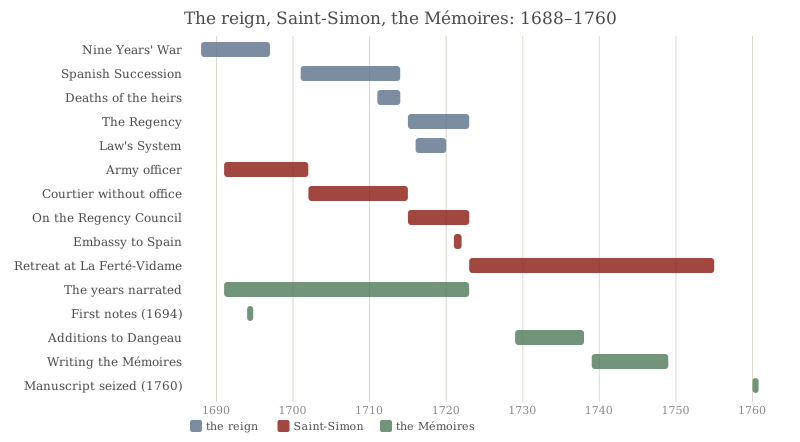
Three bands on a single axis: the reign, Saint-Simon's life, the history of the book. The years narrated (1691–1723) cover the end of Louis XIV's reign and the Regency; Saint-Simon lives through them as an officer, then as a courtier without office, finally on the Regency Council. Yet the Mémoires were written only between 1739 and 1749, in retirement at La Ferté-Vidame, from his notes and from the additions he had made to Dangeau's Journal: fifteen to fifty years separate the event from the page. From that distance comes the book's singular blend — the precision of the thing seen, a passion left intact, and the gaze of a man who already knows how it all ended.
Gallery
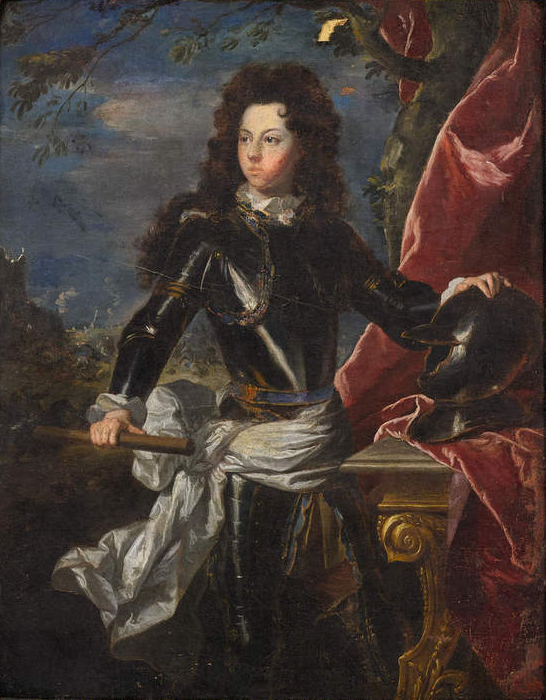
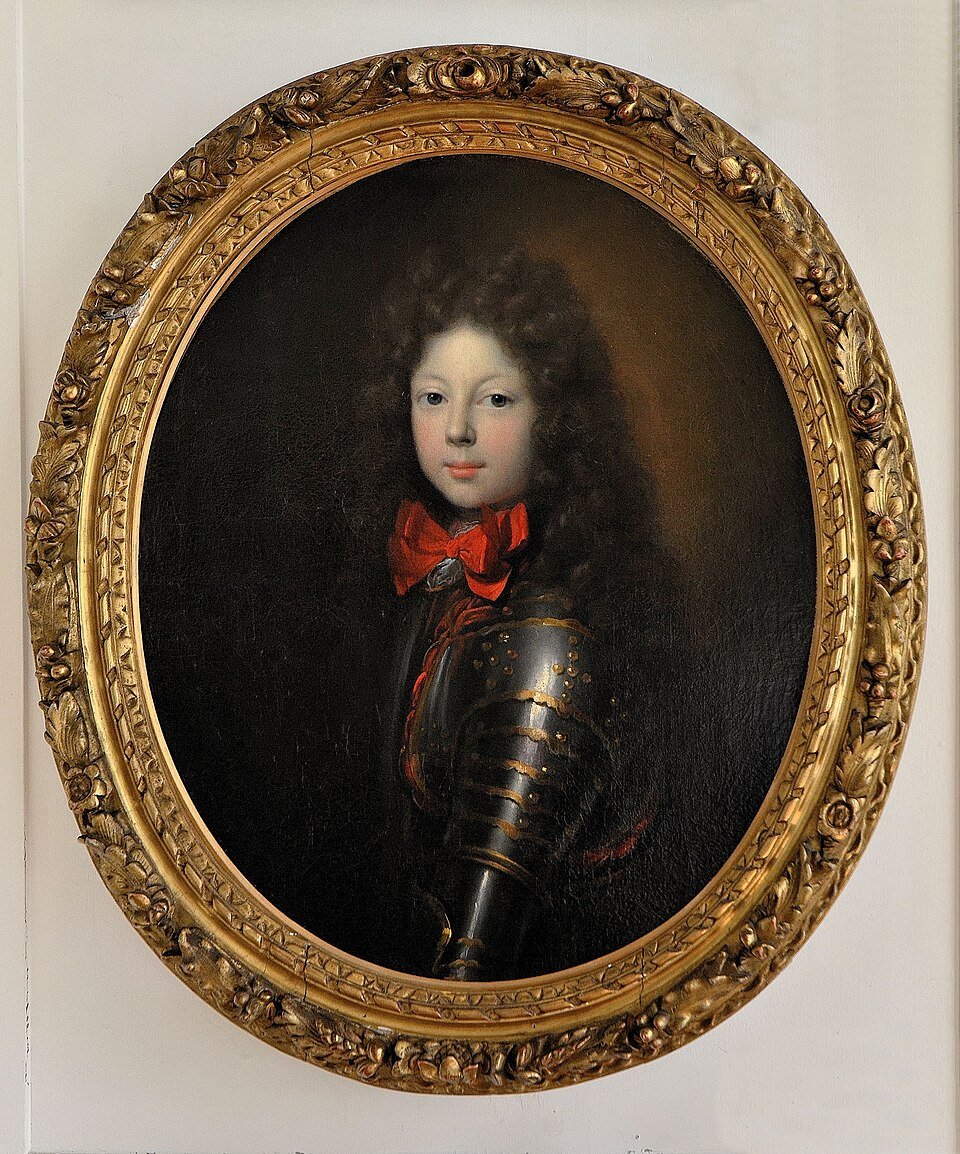
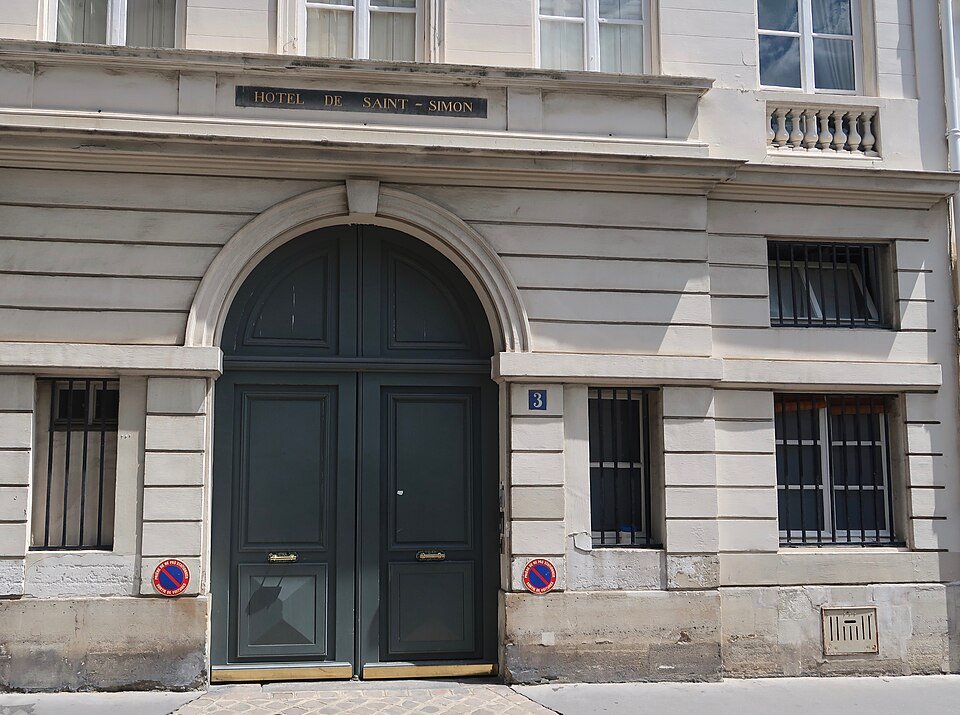
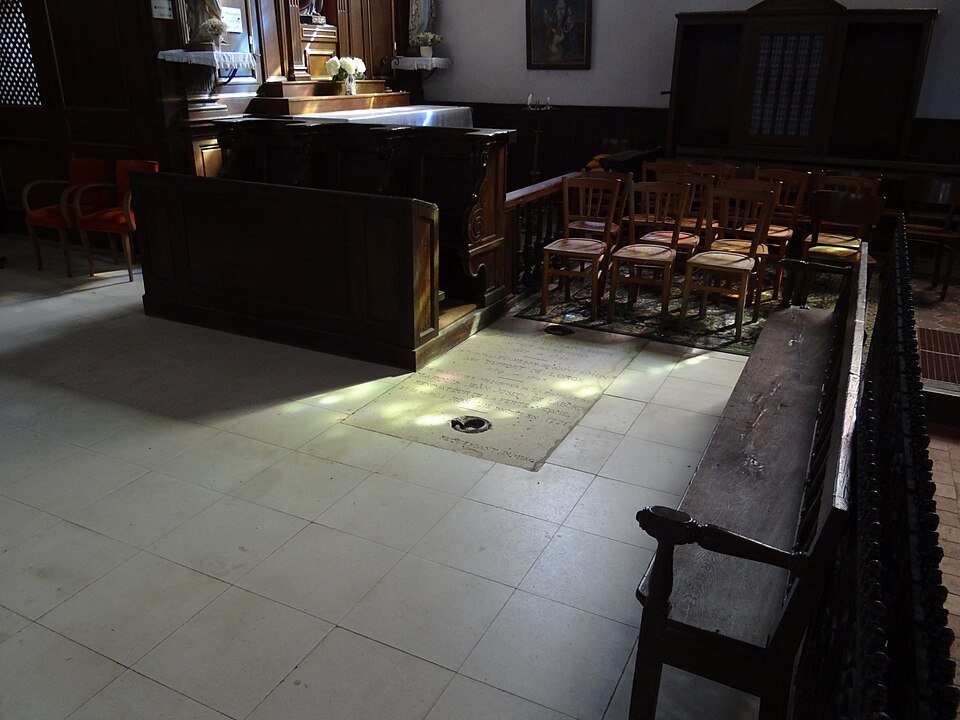
Provisional selection, to be sorted: portraits, manuscript, editions, court figures and places. All images come from Wikimedia Commons (public domain or free licence); click to enlarge.
Portraits of Saint-Simon





The manuscript and the hand





Editions of the Mémoires

Places and memory



Further reading
- Saint-Simon, Mémoires, abridged English translation by Lucy Norton, Historical Memoirs of the Duc de Saint-Simon, 3 vols., London, Hamish Hamilton, 1967–1972.
- Emmanuel Le Roy Ladurie (with Jean-François Fitou), Saint-Simon and the Court of Louis XIV, University of Chicago Press, 2001 (French original 1997).
- Saint-Simon, Mémoires, ed. Yves Coirault, Paris, Gallimard, "Bibliothèque de la Pléiade", 8 vols., 1983–1988 (the reference edition, in French).