Pieter Bruegel the Elder
Of Pieter Bruegel (c. 1525/1530 – Brussels, 1569) we know neither the exact date nor the place of birth, and barely a handful of sure facts. But the forty-odd surviving paintings suffice for a singular glory: no one has painted the whole world as he did — proverbs and games, seasons and labours, human folly seen from above and peasant dignity seen up close. "The most perfect painter of his century," his friend the geographer Ortelius already called him.
Key facts
- Born
- c. 1525–1530, perhaps near Breda (Brabant)
- Died
- 9 September 1569 in Brussels
- Guild
- Free master of the Antwerp Guild of Saint Luke, 1551
- Travels
- Italy 1552–1554, as far as Rome and Sicily; the Alps marked him more than Antiquity
- Surviving œuvre
- Some forty paintings; 61 drawings; ~80 prints after his designs
- Largest collection
- Kunsthistorisches Museum, Vienna: 12 paintings
- Dynasty
- Father of Pieter Brueghel the Younger and of Jan "Velvet" Brueghel
A sparsely documented life
Admitted as master in Antwerp in 1551, Bruegel left at once for Italy — reaching Rome, Naples and Messina. From the journey he brought back neither ruins nor Raphael, but the Alps: "it was said that he had swallowed the mountains and rocks and spat them out again, on his return, as paintings," Carel van Mander would write in 1604. Back in Antwerp he worked for the publisher Hieronymus Cock, at the sign of the Four Winds, designing satirical and moral prints in the vein of Hieronymus Bosch — he was then perceived as a "second Bosch". His career as a painter proper spans barely a dozen years: in 1563 he married Mayken Coecke, daughter of his former master Pieter Coecke van Aelst, and settled in Brussels, where his two painter sons were born — Pieter the Younger, his father's industrious copyist, and Jan, the delicate "Velvet" Brueghel, future collaborator of Rubens. He died in 1569, barely past forty.
The world at eye level — and seen from the sky
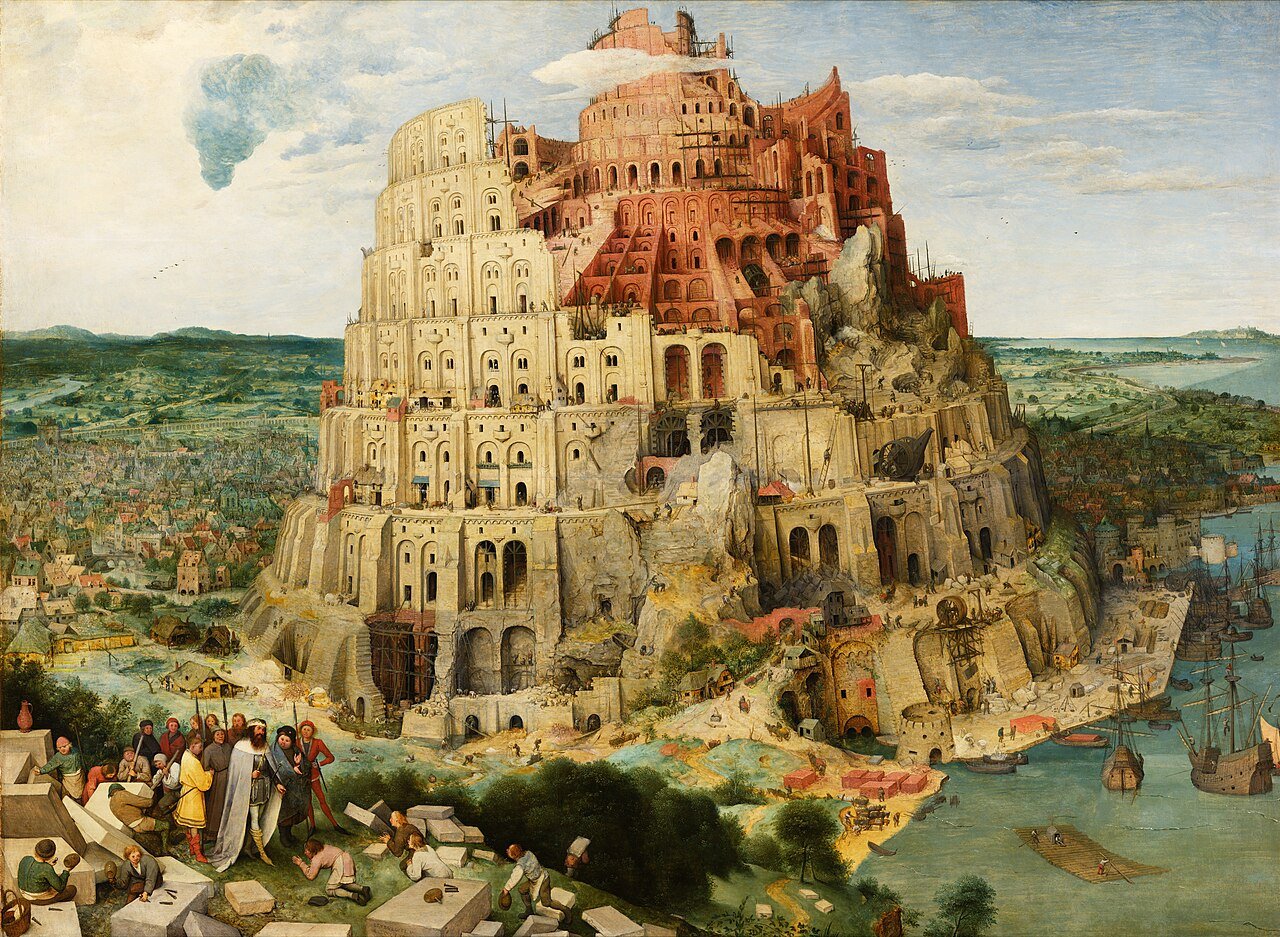
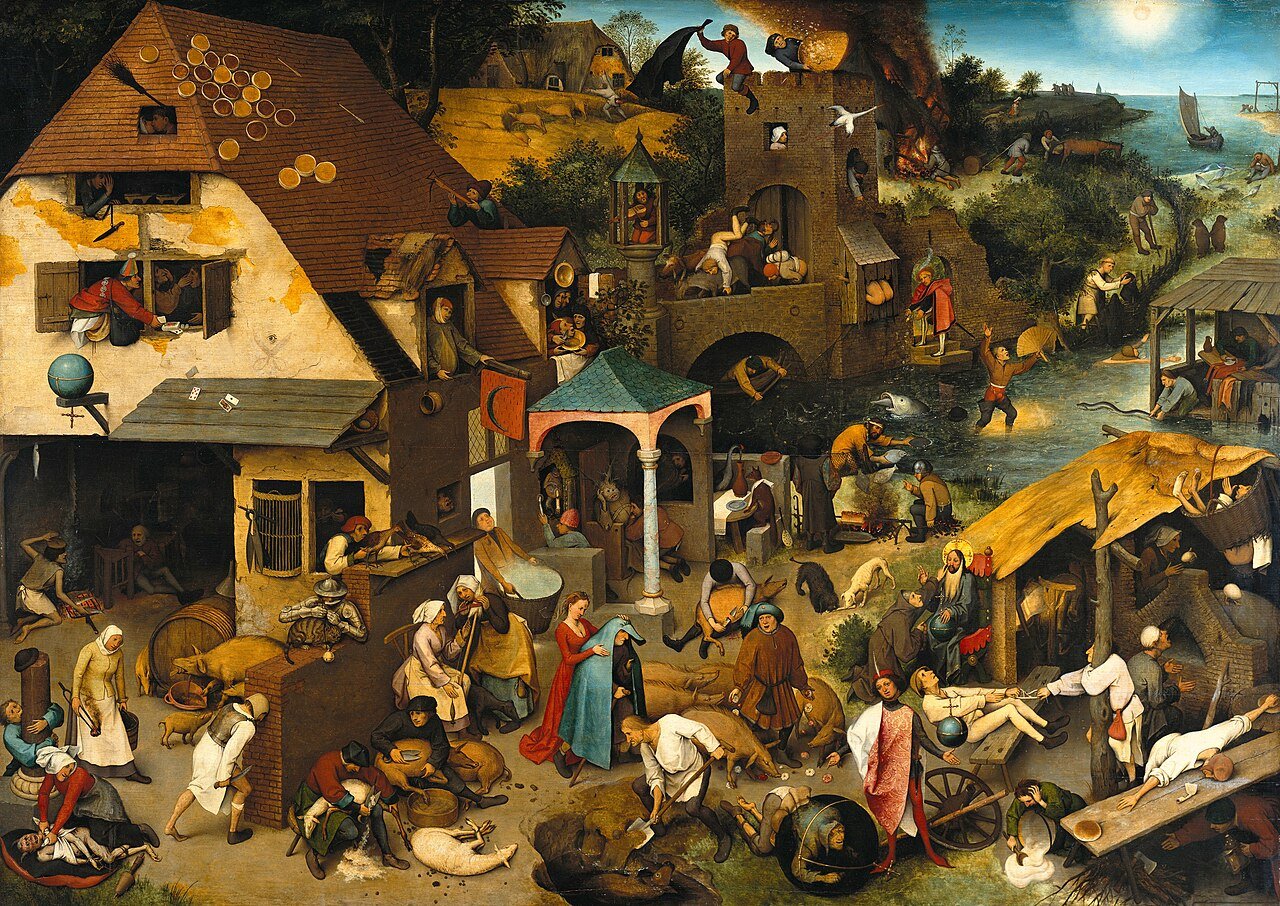
The œuvre alternates two viewpoints. From above, the encyclopaedic gaze: the Netherlandish Proverbs (1559) pack more than a hundred sayings into a theatre-village; Children's Games (1560) catalogues ninety of them; The Fight between Carnival and Lent sets the two halves of the popular year against each other; the two Towers of Babel turn human pride into a prodigious building site. From below, the peasant monumentality of the last years: The Peasant Wedding and The Peasant Dance (c. 1567–1568) give villagers the stature painting had reserved for heroes, without folklore or condescension — Bruegel, van Mander tells us, would slip into village weddings in disguise to observe.
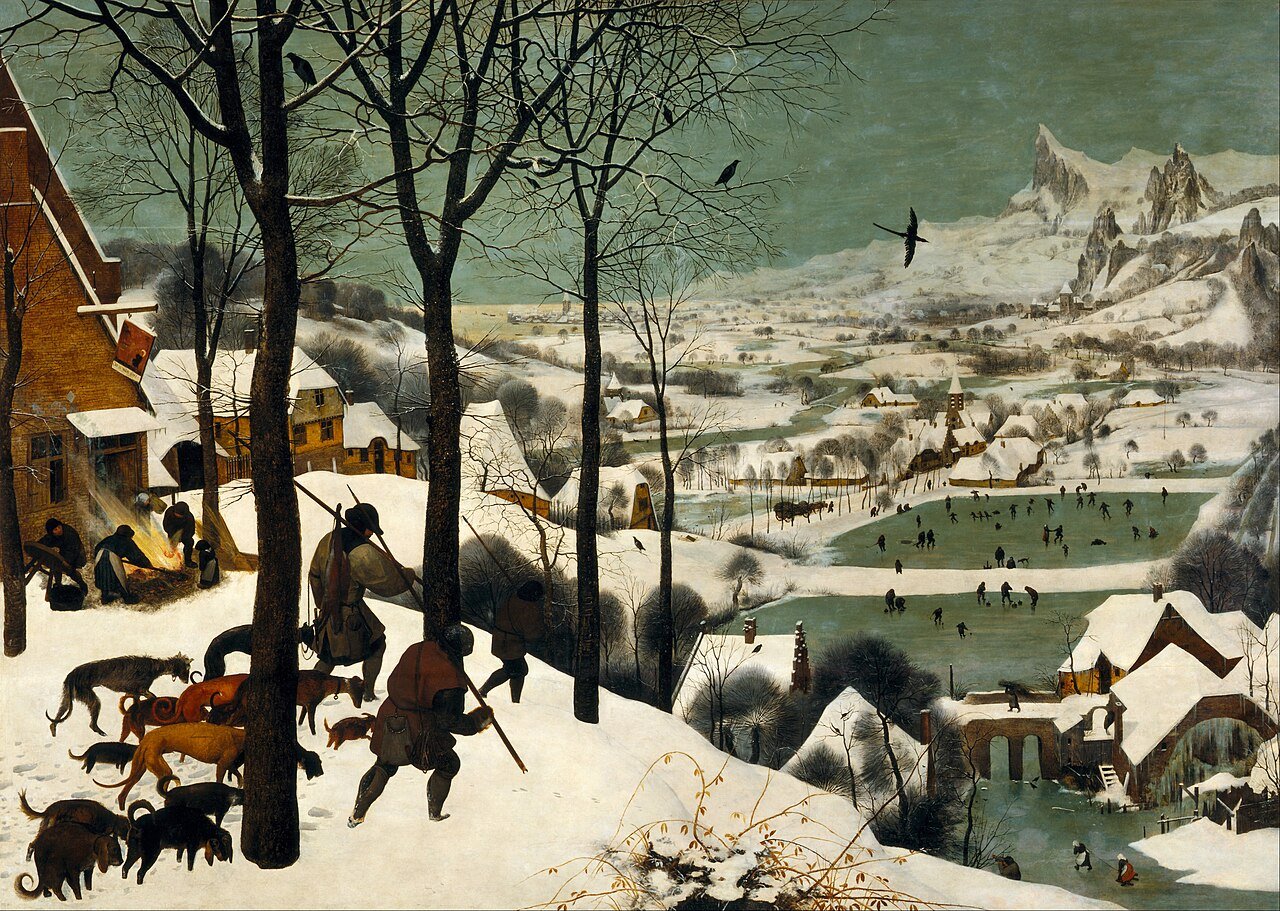
Between the two, the summit: the cycle of the Seasons (1565), six panels — five surviving — painted for the Antwerp merchant Nicolaes Jonghelinck. The Hunters in the Snow, The Gloomy Day, The Haymaking, The Harvesters, The Return of the Herd: for the first time, landscape is no longer the backdrop of a sacred story but a total subject, the breathing of the year in which man takes his place in the rhythm of the world. The last canvases (The Parable of the Blind, The Magpie on the Gallows, 1568) harden the moral line in a Flanders under repression — the Duke of Alba arrived in 1567; Bruegel, it is said, had some of his most biting drawings burned to protect his family.
Major works
| Work | Date | Location |
|---|---|---|
| Netherlandish Proverbs | 1559 | Gemäldegalerie, Berlin |
| The Fight between Carnival and Lent | 1559 | Kunsthistorisches Museum, Vienna |
| Children's Games | 1560 | Kunsthistorisches Museum, Vienna |
| Dulle Griet (Mad Meg) | c. 1562 | Museum Mayer van den Bergh, Antwerp |
| The Fall of the Rebel Angels | 1562 | Royal Museums of Fine Arts, Brussels |
| The Tower of Babel (large) | 1563 | Kunsthistorisches Museum, Vienna |
| The Tower of Babel (small) | c. 1563–1565 | Museum Boijmans Van Beuningen, Rotterdam |
| The Adoration of the Kings | 1564 | National Gallery, London |
| The Hunters in the Snow | 1565 | Kunsthistorisches Museum, Vienna |
| The Gloomy Day | 1565 | Kunsthistorisches Museum, Vienna |
| The Return of the Herd | 1565 | Kunsthistorisches Museum, Vienna |
| The Haymaking | 1565 | Lobkowicz Palace, Prague |
| The Harvesters | 1565 | Metropolitan Museum of Art, New York |
| The Massacre of the Innocents | c. 1565–1567 | Royal Collection, Hampton Court |
| The Land of Cockaigne | 1567 | Alte Pinakothek, Munich |
| The Peasant Wedding | c. 1567–1568 | Kunsthistorisches Museum, Vienna |
| The Peasant Dance | c. 1568 | Kunsthistorisches Museum, Vienna |
| The Parable of the Blind | 1568 | Museo di Capodimonte, Naples |
| The Magpie on the Gallows | 1568 | Hessisches Landesmuseum, Darmstadt |
| Landscape with the Fall of Icarus (disputed — probably a copy after Bruegel) | — | Royal Museums of Fine Arts, Brussels |
Afterlife
Sought after in his lifetime by the greatest collectors — Cardinal Granvelle, then Emperor Rudolf II, whence the Viennese treasure — and copied wholesale by his elder son, Bruegel was then filed for two centuries among the "droll" painters of comic peasants. The twentieth century made him something else entirely: a cosmic moralist, scrutinised by historians (the 450th-anniversary exhibition, Vienna 2018–2019, gathered three quarters of the paintings), meditated by poets — Auden before the Icarus ("About suffering they were never wrong, / The Old Masters") — and by filmmakers, from Tarkovsky (Solaris, Mirror) to Lech Majewski (The Mill and the Cross, after The Procession to Calvary).
In perspective
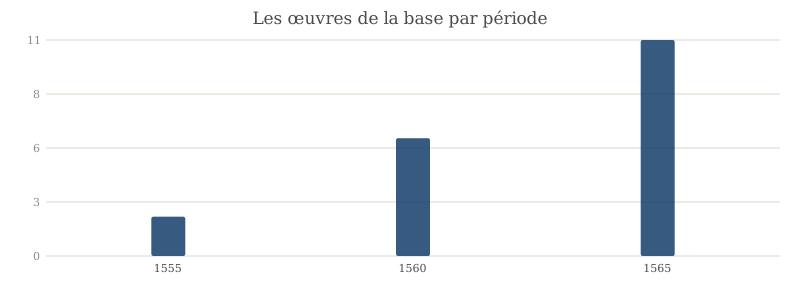
All of Bruegel's painting fits in a decade and a half — and half the base in the 1560s alone. The year 1565, that of the Seasons cycle, is by itself a summit of art history: few artists changed painting so much in so few accounting years.
Further reading
- Manfred Sellink, Bruegel: The Complete Paintings, Drawings and Prints, Ghent, Ludion, 2007.
- Carel van Mander, "Life of Pieter Bruegel", in The Book of Painters (Het Schilder-boeck, 1604).
- Bruegel: The Master, exhibition catalogue (Kunsthistorisches Museum, Vienna, 2018–2019), Thames & Hudson, 2018.